






 Portuguese
  Spanish
  6 min of reading
  0 comments


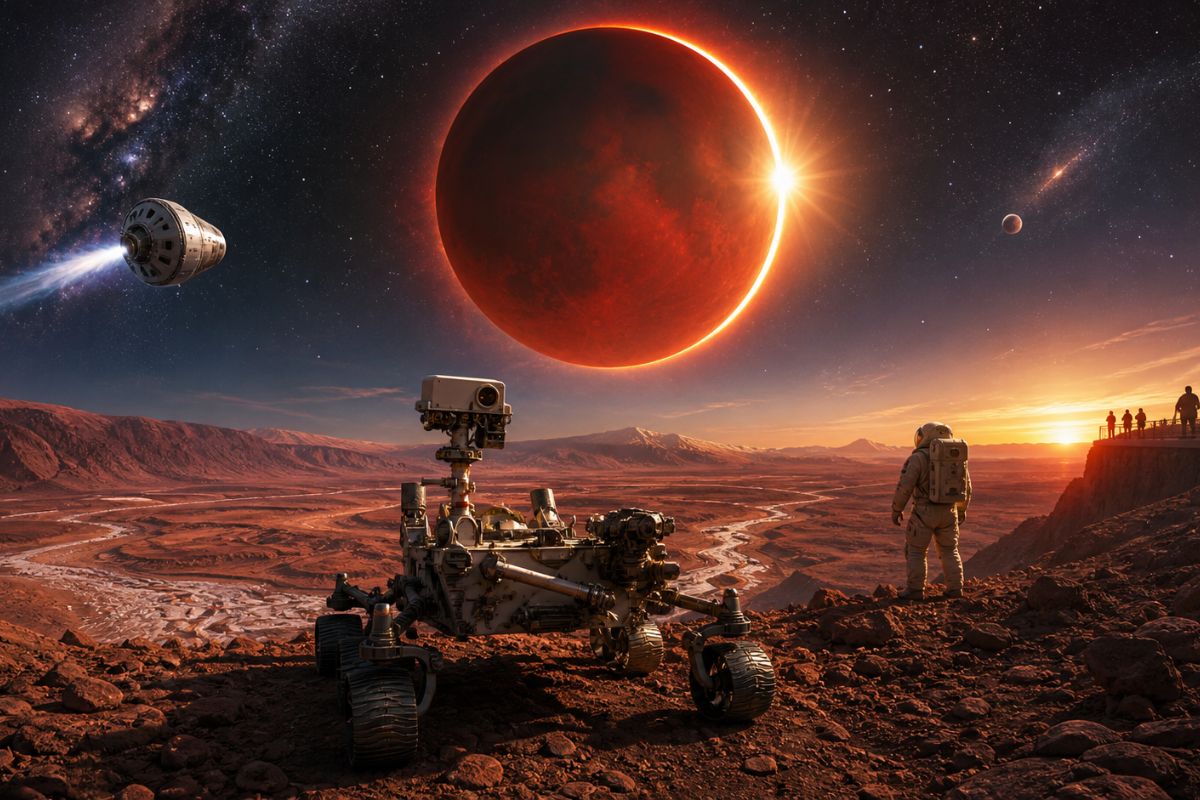
NASA helps answer questions driving global searches, from the so-called Blood Moon to signs of ancient water on Mars, passing through the extreme effects of a crewed mission to the red planet and a detail that frustrates many Brazilians: the total solar eclipse of August 12, 2026, will not have a path of totality over Brazil.
NASA returned to the center of some of the most researched space curiosities by bringing together explanations that connect eclipses, atmosphere, Mars, rovers, and the human body in a single conversation. On one hand, the agency shows why the Moon can turn red during a total lunar eclipse. On the other, it reinforces that Mars once had rivers, lakes, and deltas, while new high-resolution images captured by Curiosity and Perseverance once again fuel the question that never leaves the scene: was the red planet ever habitable?
What makes this story bigger is that none of these questions end in themselves. The red Moon helps to understand Earth’s atmosphere. Traces of water on Mars change how the planet is viewed. The risks of a crewed mission show that getting there doesn’t just depend on rockets. And the 2026 eclipse reveals that the expectations of those researching the phenomenon in Brazil do not match the official area of total visibility listed by NASA.
Why does the Moon turn red during a total lunar eclipse?


The Moon turns red during a total lunar eclipse because Earth passes between the Sun and the Moon and blocks direct light, but not all illumination. Part of the sunlight passes through Earth’s atmosphere before reaching the lunar surface, and along this path, bluish tones scatter more, while reddish and orange tones manage to pass through. It is this atmospheric filter that gives the Moon the hue that popularized the expression “Blood Moon.”
-
Survivor of 1966 SS Daniel J. Morrell Shipwreck in Lake Huron Recounts 38-Hour Ordeal in Extreme Cold

-
The Greatest Hoax in World Cup History? The Film That Denied Brazil’s 1958 Victory and Exposed How Fake Evidence Can Seem Convincing on TV
-
Fake South Korean Online Stores Offer Shopping Thrill Without Spending Money or Receiving Products
-
Helicopter Drops 180 Tons of Sand and Gravel on Swedish River to Revive Ecosystem Damaged by Decades of Exploitation



NASA itself summarizes this effect with a powerful image: it’s as if all of Earth’s sunrises and sunsets were projected onto the Moon at the same time. The agency also highlights that the more dust or clouds there are in Earth’s atmosphere, the redder the Moon may appear during the eclipse.
Is it true that Mars once had rivers, lakes, and an environment similar to Earth?


Yes, there is strong evidence of this, although NASA does not say that Mars was identical to present-day Earth. Soon after landing, the Curiosity rover found smooth, rounded pebbles that, according to the agency, likely rolled for several kilometers in an ancient river with a depth between ankle and hip. This provided concrete imagery for an idea that previously seemed abstract: liquid water truly flowed across the Martian surface.
The discovery became even more significant when Curiosity advanced towards Mount Sharp. NASA states that more than 1,000 vertical feet of rock there originally formed as mud at the bottom of a series of shallow lakes, and that rivers and lakes may have persisted in Gale Crater for perhaps a million years or more. In other words, Mars did not just have isolated episodes of water, but environments that lasted long enough to gain weight in the discussion about habitability.
Perseverance reinforces this interpretation in Jezero. According to NASA, more than 3.5 billion years ago, river channels overflowed into the crater and created a lake, bringing sediments and clay minerals to the site. This is one of the strongest points of the current exploration of Mars: the planet once had scenarios that, in theory, could favor microbial life.
What would happen to the human body on a long journey to Mars?

A human mission to Mars would also be an extreme test for the body. NASA organizes this problem into five major hazards: space radiation, isolation and confinement, distance from Earth, different gravitational fields, and enclosed or hostile environments. The agency itself emphasizes that these risks do not act separately and can combine, aggravating the physical and psychological impact of the journey.
Among the most concerning effects are bone and muscle loss. NASA reports that, without Earth’s gravity, weight-bearing bones lose an average of 1% to 1.5% of mineral density per month during spaceflight, while muscle mass also decreases more rapidly without adequate exercise and diet. The agency also points out that bodily fluids shift towards the head in microgravity, which can put pressure on the eyes and cause vision changes.
In other words, a journey to Mars would not just be a technological crossing, but a continuous wear and tear on the human organism. Radiation, confinement, distance, and reduced gravity form a risk package that helps explain why the mission is still much more linked to research than to a near execution date.
Will the total solar eclipse of 2026 be visible from Brazil or only in other countries?
In the case of the total solar eclipse on August 12, 2026, NASA is direct: the path of totality will pass through Greenland, Iceland, Spain, Russia, and a small area of Portugal. The partial phase will be visible in parts of Europe, Africa, North America, and oceanic areas. Brazil does not appear on the official list of visibility regions for this total eclipse.
This helps correct a common expectation for those researching the phenomenon here. For the Brazilian public, the event most directly linked to the country in NASA’s highlighted program is the annular solar eclipse of February 6, 2027, listed as visible in parts of South America and Africa, including Brazil.
Why do the new images of Mars taken by NASA’s robots impress scientists so much?

The new images are impressive because they are not just beautiful panoramas. They function as a very high-resolution visual record of different chapters in Mars’ history. In one of the most recent materials, NASA reports that Curiosity captured a 360-degree panorama with 1.5 billion pixels between November 9 and December 7, 2025, assembled from 1,031 images, one of the largest ever produced by the mission.
This panorama shows formations called boxwork, networks of low ridges that, according to NASA, emerged when groundwater flowed through large rock fractures and left behind more erosion-resistant minerals. Perseverance, meanwhile, gathered 980 images between December 18, 2025, and January 25, 2026, to assemble another 360-degree panorama in an area near the rim of Jezero Crater. The effect of these images lies in the combination of visual impact and scientific value: they show where water passed, where sediments accumulated, and where Mars’ past may still be preserved.
What does NASA still need to confirm about Mars, ancient life, and the future of human missions?
This is the question that closes all others. NASA already has robust evidence that Mars had rivers, lakes, deltas, clay minerals, and environments considered promising for ancient habitability. It also knows that the human body suffers significantly during long space missions. But the decisive answer does not yet exist: the agency has not confirmed past life on Mars and is still working to understand to what extent a long human journey can be made with real safety.
It is precisely this gap that keeps the topic so strong. The red Moon continues to fascinate because it makes the physics of the atmosphere visible. Mars continues to attract because it preserves clues of a wetter and possibly habitable past. And human exploration remains distant because the biggest obstacle may not just be reaching the red planet, but enduring the journey there and back. Therefore, each new panorama, each new study, and each new eclipse expand a story that is still far from over.
And you, which of these NASA curiosities impresses you the most: the red Moon during eclipses, the ancient rivers of Mars, the risks of a human journey to the planet, or the 2026 eclipse outside Brazil? Tell us in the comments what caught your attention the most.


Be the first to react!