






 Portuguese
  Spanish


Change under debate in Congress could create a special permit for teenagers to drive before the age of 18, but with time limits, urban circulation, and mandatory accompaniment, without immediately altering the current rules of the National Driver’s License in Brazil.
Teenagers aged 16 and 17 may obtain a Driving Permit before reaching adulthood if a proposal to change the Brazilian Traffic Code advances in the National Congress.
The measure is included in a draft substitute from the Special Committee of the Chamber of Deputies on changes to the CTB, linked to PL 8085/2014, and does not yet have the force of law.
According to the rules under discussion, the authorization would be temporary and valid only until the young person turns 18, with driving limited to roads within the urban perimeter.
-
Scientists warn that melting ice is triggering an alarming chemical transformation in preserved areas, and the first signs are already concerning researchers worldwide.

-
China placed 198 robotic legs under a 7,600-ton school and made the building walk 62 meters in 18 days, rotating the historic structure as if a concrete structure had gained feet to escape demolition.

-
Distributor confirms the premiere of ‘Dark Horse’, Bolsonaro’s film, in 650 cinemas with 99% of copies dubbed.
-
9-year-old boy who could only hold a plank for 6 minutes in physical education class trained alone for 6 months, without needing encouragement from his parents, until he broke the world children’s record with 61 minutes and 5 seconds.


The permitted hours would be from 5 a.m. to 11:59 p.m., always with the presence of an adult with a valid license in the vehicle, according to the proposal under review.
The proposal began to be discussed as it provides for a supervised licensing model for those under 18, but does not modify the current rules in force. According to the Congresso em Foco portal, the report was filed this Thursday (11).
Currently, the Brazilian Traffic Code requires that the candidate be criminally liable, a requirement that keeps the licensing process restricted to individuals aged 18 and over.
Permission to drive before the age of 18
According to the draft, the teenager approved in the licensing process would receive a restricted Driving Permit, without immediate equivalence to the definitive National Driver’s License.
This document would function as an intermediate stage, with specific rules of circulation, supervision, and accountability during the period before reaching adulthood.
In addition to the time restriction and the limit to the urban perimeter, the authorization would not allow the young person to drive the vehicle alone.
During supervision, the licensed companion would become administratively responsible as the driver, including in situations involving breathalyzer tests or checks for intoxicating substances.
The substitute also addresses category A, intended for the operation of motorcycles and vehicles classified under this type of license.
In this case, the teenager under 18 years old would only be authorized to drive motorcycles with an engine capacity of up to 150 cm³, provided they meet the other requirements outlined for the special permit.
Infractions may block the driver’s license at 18
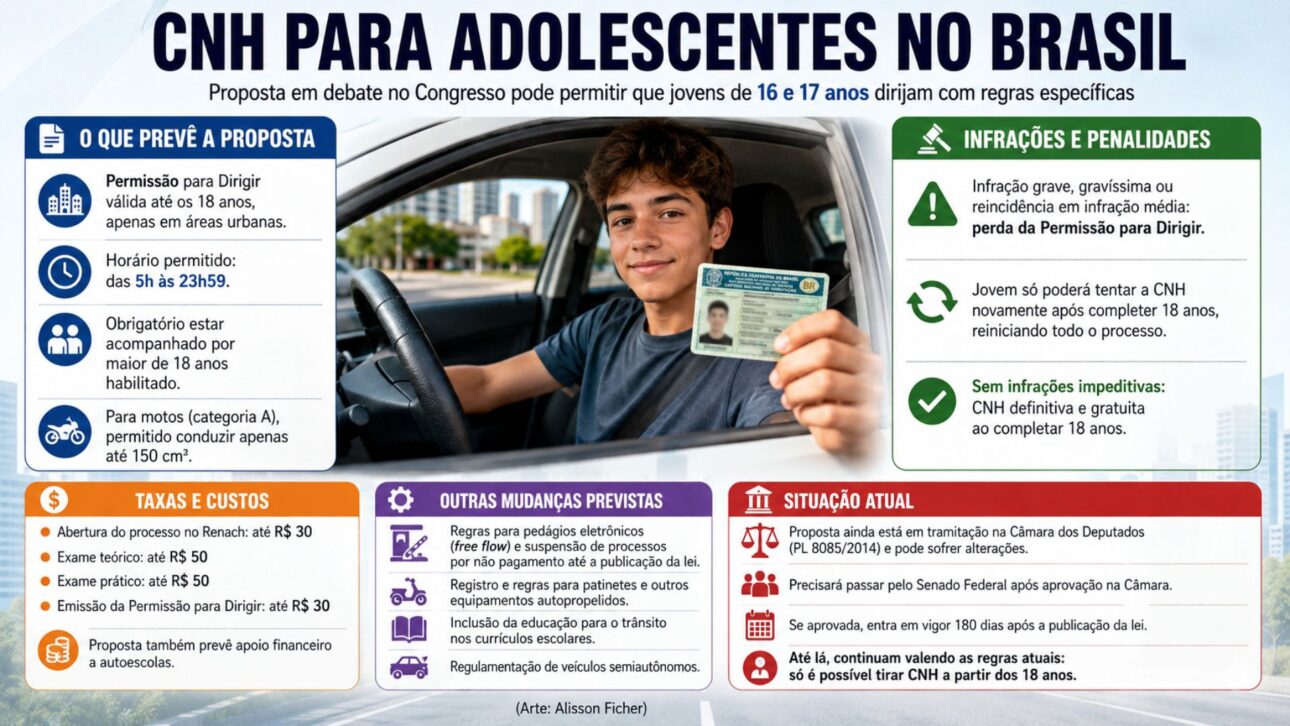
The proposed model establishes administrative consequences for the teenager who violates the rules during the validity period of the Driving Permit.
If there is a serious, very serious infraction or recurrence of a medium infraction, the young person will not automatically receive the driver’s license upon turning 18.
In this situation, the Driving Permit would be revoked, and the teenager would have to restart the entire licensing process only after reaching adulthood.
The rule was included in the draft as part of a probationary period, where maintaining the benefit would depend on compliance with traffic regulations.
On the other hand, those who turn 18 without prohibitive infractions would receive the National Driver’s License automatically and free of charge, according to the draft under review in the committee.
This provision appears in the explanatory chart attached to the draft, which presents the change as a gradual and supervised driver training.
Driver’s license fees and support for driving schools
The permit for teenagers is one of the changes proposed in the substitute bill, which also addresses the costs of the licensing process in the country.
The document establishes national limits for administrative fees charged to candidates, with maximum values for opening the process in Renach, theoretical and practical exams, and issuance of the Driving Permit.
Among the points under review is the setting of a ceiling of R$ 30 for opening the process in Renach and for issuing the Driving Permit.
The draft also provides a limit of R$ 50 for each written and driving test, applicable to licensing categories and authorizations related to mopeds and self-propelled mobility equipment.
In another section, the substitute bill proposes a financial support program for driving schools, with resources from the National Traffic Safety and Education Fund, Union budget allocations, and other sources provided for in regulations.
The execution of this program would depend on subsequent regulation by the Executive Branch, should the proposal advance and be approved by the National Congress.
The draft also includes rules on electronic toll collection in free passage systems, known as free flow.
According to the substitute, administrative processes for infractions resulting from non-payment of fees would be suspended until the law is published, with deadlines and payment conditions defined in federal regulations.
Electric bicycles, scooters, and semi-autonomous vehicles


The package of changes also reaches self-propelled mobility equipment, such as scooters and similar vehicles used in urban commuting.
The proposal provides for the registration and licensing of these devices for road circulation, according to Contran regulations, but excludes electric bicycles and equivalents from this requirement.
The substitute creates a specific infraction for operating these devices without a safety helmet and also provides penalties for irregular passenger transport, dangerous maneuvers, and transporting children unable to ensure their own safety.
The application of these rules would depend on complementary regulations from the National Traffic Council, the body responsible for establishing national guidelines for the sector.
The draft also includes provisions for semi-autonomous vehicles, a category involving automobiles with technological driving assistance features.
According to the text under analysis, this type of vehicle could not be used for collective school transportation, and situations of driver inattention could receive specific treatment depending on the level of automation of the vehicle.
Current CNH rules remain in effect
Despite the ongoing discussion, nothing changes immediately for those wishing to obtain a National Driver’s License in Brazil.
The proposal is still in the legislative phase and may be altered before any eventual vote, especially as it involves points related to driver training, enforcement, and traffic responsibility.
If the substitute advances, the matter will still need to go through the formal stages of processing in the Chamber of Deputies and, subsequently, the Federal Senate.
Even in case of approval, the text itself provides for entry into force only 180 days after the official publication of the law.
Until a new rule is approved by the National Congress and sanctioned by the Presidency of the Republic, adolescents aged 16 and 17 remain prohibited from obtaining a CNH in Brazil.
For now, the proposal remains as an initiative under discussion to change the licensing process, with no immediate effect on the currently existing regulations.


