






 Portuguese
  Spanish


In the Sertão do Pajeú, public school students created the Filtropinha to treat cassava manipueira, using simple materials, 3D printing, and environmental tests linked to flour houses.
In the hinterland of Pernambuco, four students from a public technical school created a low-cost filter to treat manipueira, a toxic liquid generated in the production of cassava flour.
The project, called Filtropinha, uses layers of cotton, filter paper, activated charcoal made from pine shells, and a piece produced on a 3D printer to reduce the toxicity of the residue and allow its reuse.
The idea was born in Carnaíba, in the Sertão do Pajeú, from a problem observed in flour houses linked to the Quilombo do Caroá.
-
Astronaut from Artemis II steps down after mission to the Moon and decision surprises after a record of 406,771 km, a historic 10-day journey, and an unprecedented achievement for Canada.

-
A fossil kept for years in a small museum in Montreal concealed 450-million-year-old soft tissue, a discovery that has only happened once before in history.

-
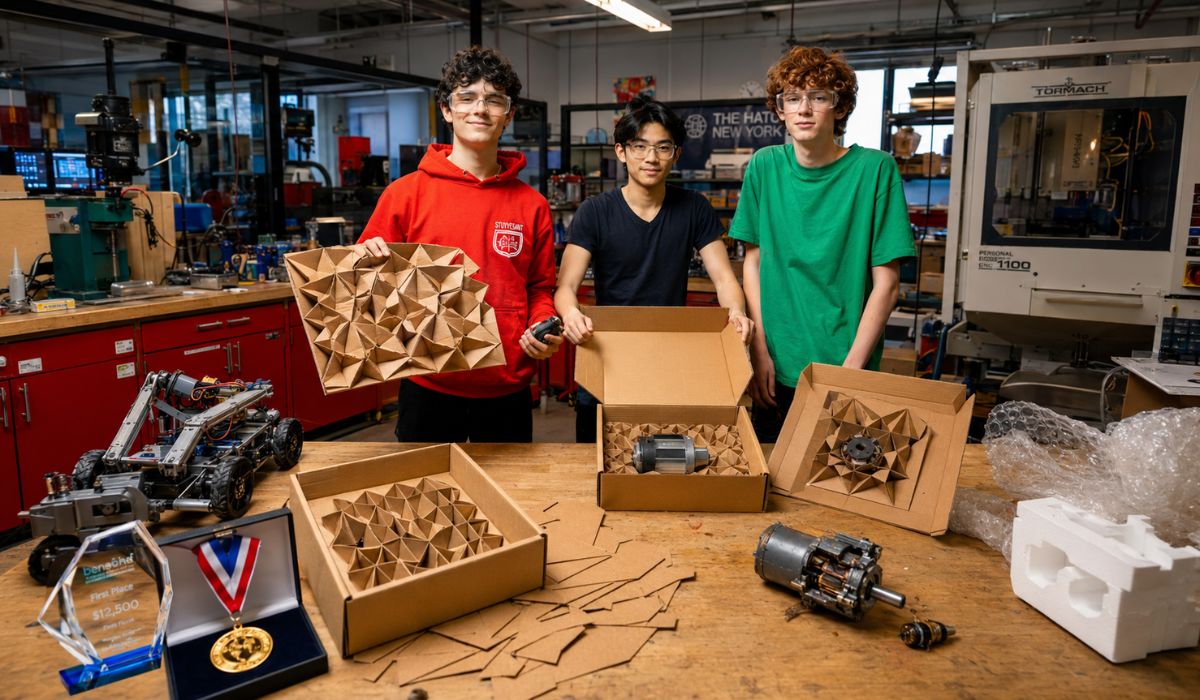
Three teenagers transform cut cardboard into Japanese origami-style packaging that promises to retire styrofoam and bubble wrap, win a $12,500 prize, and target giants like Amazon, FedEx, and Home Depot after a robot motor arrived broken.

-
The large jar blender has a rival: Oster Ultra Power bets on 1,000 W, six stainless steel blades, and two portable cups with leak-proof lids.


In these units, cassava is processed to become food and a source of income, but it also generates a yellowish liquid that can contaminate the soil, affect water, and cause symptoms in exposed workers, according to reports from the Pernambuco Department of Education and Consed.
The project was developed by Angela Rafaela, Beatriz Vitória de Assis, Eduardo da Silva Oliveira, and Luana Noêmia da Silva, students from the State Technical School Professor Paulo Freire.
The guidance was provided by teachers Gustavo Santos Bezerra and Carla Robecia.
In December 2024, the Filtropinha won the 11th edition of Solve for Tomorrow Brazil, a Samsung program focused on science, technology, engineering, and mathematics solutions created by public school students.
In 2025, the project received further recognition by winning the Prêmio Criativos Escola + Natureza in the Caatinga category, according to the Pernambuco Department of Education.
The case stands out for the relationship between a local problem and a solution created within the school.
A common residue in cassava production, often discarded without treatment, served as the basis for tests with simple materials, seed germination, and 3D piece design.
Cassava Manipueira and Environmental Risk
Manipueira is the liquid released during the processing of cassava.
In flour houses, it appears after the root is washed, pressed, or prepared for flour production.
Although linked to a traditional food and income chain, manipueira can pose risks when improperly discarded.
The liquid contains toxic compounds, such as hydrocyanic acid, and can cause damage to the environment and the health of those working near the residue.
According to Consed, community workers reported symptoms such as headaches, dizziness, and shortness of breath.
Professor Gustavo Bezerra stated that, in many cases, people working in flour houses do not use protective equipment and are unaware of the risks of improper disposal.
The environmental effects were also observed by the team during the research.
In a report published by Solve for Tomorrow Latam, the professor said that students identified degradation around the visited flour house, in an area where nothing grew near the waste disposal site.
From this observation, the students began to study a way to reduce the pollutant load of the manipueira and allow the reuse of the water used in the process.
How the Filtropinha Filter Works
The Filtropinha is made up of layers of simple materials and a structure adapted for use in storage containers.
According to Consed, the prototype includes cotton, filter paper, pine cone shell flour, activated charcoal produced from the burning of these shells, and a model built with a 3D printer.
The 3D printed piece includes a screw designed to facilitate installation in water tanks where manipueira is stored in flour houses.
The proposal is for the liquid to pass through the filter before being discarded or reused.
The activated charcoal plays a significant role in the filtration due to its porous structure.
According to the Solve for Tomorrow Latam material, the students tested the filter with only pine cone shell, then only with charcoal, and the best result was recorded with the combination of both materials.
The publication states that the prototype managed to reduce the toxicity level of the manipueira by up to 80%.
The concentrate retained in the process can also be used in the production of organic fertilizer, according to the project description.
This stage explains the reuse logic presented by the students.
The declared intention is not only to treat a contaminating liquid but to transform part of what was previously waste into an input for agricultural use.
Test with Seeds and Biofertilizer
One of the tests mentioned by Consed involved seed germination.
With the manipueira treated by Filtropinha, the germination rate reached 80%; with the liquid in its natural state, it dropped to 20%, according to the research conducted by the team.
Student Beatriz Vitória, a resident of Quilombo do Caroá, explained that the soil contaminated by improper disposal of manipueira hinders germination.
According to her, the treated manipueira can be reused in washing cassava roots, helping to prevent new soil contamination.
The project also addresses water consumption in flour mills.
According to Consed, student research indicated that these units can use 15,000 to 20,000 liters of water per production.
In this context, the reuse of treated water can reduce some of the pressure on water resources, especially in a semi-arid climate region.
As the project is still presented as a prototype, large-scale application depends on new tests, adjustments, and implementation in flour houses.
Project was born in Quilombo do Caroá
Filtropinha was designed for Quilombo do Caroá, a community near the school where the involved young people study.
Some members of the group have a direct connection with the territory, which brought the project closer to a problem observed in the local routine.
Before the national award, the students visited flour houses, talked to producers, and presented the filter to the residents.
According to Luana Noêmia, the community’s interest emerged during these visits.
“We visited the quilombola community, talked about the issue of poor manipueira disposal, and presented our filter as a possibility. The residents of Quilombo do Caroá showed a lot of curiosity and interest in applying the project in their daily lives,” said Luana to Consed.
On December 3, 2024, Samsung announced Filtropinha as the first-place winner in the National Winners category of Solve for Tomorrow Brazil.
The edition awarded projects from students in Pernambuco, Bahia, Ceará, and São Paulo.
According to Samsung, the winners were chosen by a panel with representatives from the company, Cenpec, OEI, Unesco in Brazil, the São Paulo Department of Education, the NGO Todos Pela Educação, Colégio Bandeirantes, as well as specialists from universities and professionals in the fields of education, science, and technology.
Student Innovation Awards
In June 2025, the project received another recognition.
The Pernambuco Department of Education reported that Filtropinha won the Creative School + Nature Award in the Caatinga category.
The award, linked to the Creative School program by the Alana Institute, selected six initiatives, one for each Brazilian biome.
According to Undime, the edition received 1,593 entries, mobilized more than 60,000 students and more than 5,000 educators from 738 municipalities.
According to the Pernambuco Department of Education, the award included R$ 12,000 to develop the project and the opportunity to participate in activities related to COP30, in Belém.
The new recognition shows that Filtropinha continued in public circulation after the victory in Solve for Tomorrow.
Even so, there is no reliable public confirmation that the filter has already been produced on a large scale or permanently installed in the flour houses of Quilombo do Caroá.
Technical School and Applied Science
ETE Professor Paulo Freire appears in reports as a school with a history of scientific projects.
Consed cites previous initiatives related to biodegradable diapers and a glove to stabilize tremors in people with Parkinson’s.
In the case of Filtropinha, the project was born within the Sustainable Productions discipline, which addresses problems in the students’ surroundings and seeks alternative solutions.
The proposal led students to combine chemistry, environmental education, technology, and field observation.
Professor Gustavo Bezerra stated, in a text published by the Pernambuco Department of Education, that the award helped students to see a neglected problem in their own community and propose an economically viable alternative.
Student Angela Rafaela, a resident of Quilombo do Caroá, also linked the achievement to the territory.
According to her, the future expectation was to implement the filter in the community’s flour houses.


