






 Portuguese
  Spanish


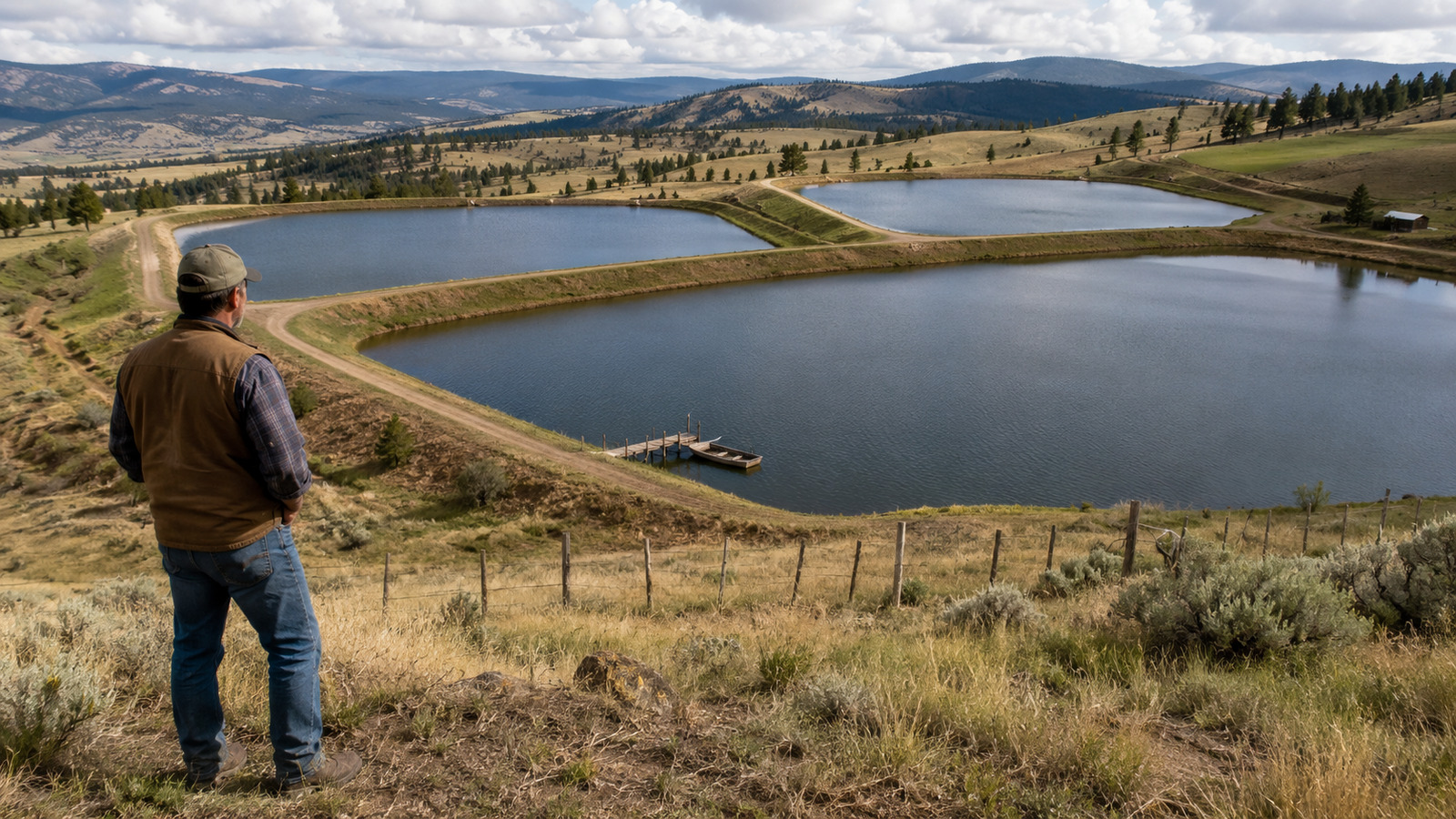

Gary Harrington’s case went viral as imprisonment for collecting rainwater, but it involved three dams, shared watercourses, lack of state authorization, and non-compliance with previous court orders
Almost 50 million liters of rainwater accumulated in three dams led Gary Harrington, a resident of Eagle Point, Oregon, to be sentenced to 30 days in jail and a $1,500 fine. The case went viral as punishment for “collecting rain,” but it involved dams in shared watercourses. The case gained attention in 2012 when Gary Harrington was convicted in Oregon for maintaining three illegal reservoirs on his property.


Case did not involve simple rainwater collection
The story gained attention because it seemed, at first glance, an extreme case of bureaucracy: a man punished for storing water on his own property. However, the situation described in the case was broader.
Gary Harrington maintained three large dams in an area of about 69 hectares. Two were approximately 3 meters high, while the third reached about 6 meters.
-
Recycled PET Bottles to Become Eco-Friendly Insulation Solution by 2026: Reduces Heat and Noise, Resists Moisture and Mold

-
2,500-Year-Old Biblical Figurine Discovered by Israel Antiquities Authority Sheds Light on Ancient Child Protection and Fertility Rituals in the Negev Desert

-
Young Innovator from the Brazilian Amazon Develops Acai Seed Brick, Turning Fruit Waste into Building Material, Wins Over 25 Awards, Showcases Globally
-
From Street Vendor to Startup Success: At 25, Brazilian Entrepreneur Projects $90 Million Revenue by 2026 Solving Retail Giants’ Challenges


These structures formed reservoirs that accumulated almost 50 million liters of water. The volume was compared to about 20 Olympic-sized swimming pools, a much larger scale than barrels or domestic cisterns.
The lakes were also not discrete reservoirs. Harrington stocked the locations with fish and installed piers and boats. He claimed to use the water for personal consumption and to help combat forest fires.
Dams blocked streams connected to a river used by a neighboring city
The central point of the case was the origin of the stored water. According to the base material, the dams did not just collect rain falling on roofs or simple structures on the property.
The dams interrupted the flow of streams that feed a river used to supply a neighboring city. Therefore, the case came to involve state water use regulations.
In Oregon, a 1925 law treats the state’s water as a public resource. By the logic of priority of use, those who dam or divert watercourses need authorization to avoid harming users located downstream.
Harrington did not have this license. This difference is essential to understand the conviction: the problem pointed out by the authorities was not collecting rain on a small scale, but damming a shared watercourse.
Collecting rain was not the prohibited point in Oregon
The repercussion of the case simplified the situation by suggesting that any rainwater collection would be illegal. The base material itself differentiates the two situations.
Collecting water from the roof in barrels or cisterns is allowed without a license. However, damming and diverting a watercourse that supplies rivers and cities is prohibited without specific authorization.
This distinction changes the reading of the case. The conflict did not involve a bucket, a domestic reservoir, or a common practice of rainwater harvesting.
The dispute was linked to the storage of almost 50 million liters in dams capable of altering the natural path of the water before it continued to other users.
Judicial history dragged on for more than a decade
The punishment also did not occur immediately. The history cited in the base material shows that the case extended for more than ten years.
In 2002, the state identified the dams and called in the state police. In 2007, Harrington pleaded guilty, received probation, and was required to empty the reservoirs.
Shortly after, he closed the gates again and refilled the lakes. In 2012, he was convicted of nine misdemeanors, with 30 days in jail and a $1,500 fine.
The decision also required him to break the dams and drain the lakes. Thus, the conviction was linked not only to the use of water but to the non-compliance with previous orders.
State defended authorization, Harrington spoke of persecution
For the authorities, the license requirement existed to protect a collectively used resource. Tom Paul, deputy director of the Oregon Water Resources Department, stated that building an earthen dam, interrupting the flow, and storing water requires a use authorization.
Harrington, on the other hand, classified the case as “government persecution.” He claimed that the state had approved his licenses and then reversed, in addition to defending the right over his own land.
The case became known precisely for this tension between private property and collective water use. In practice, the controversy revolved around scale, authorization, and impact on shared watercourses.
This article was prepared based on information from the provided source material, with data, numbers, and statements preserved as per the consulted content.


