Portuguese
  Spanish


O acúmulo de resíduos é resultado de décadas de descarte inadequado de plástico, que é levado pelas correntes oceânicas e se concentra em áreas específicas. A organização estima que a mancha contenha cerca de 1,8 trilhão de pedaços de plástico, pesando mais de 80 mil toneladas.
Esse material não apenas prejudica a vida marinha, mas também representa uma ameaça à saúde humana, pois o plástico pode entrar na cadeia alimentar através dos peixes e outros organismos marinhos.
A missão da The Ocean Cleanup é desenvolver tecnologias avançadas para remover plástico dos oceanos e prevenir que mais resíduos cheguem a esses ecossistemas. O System 03 é um passo significativo nessa direção, com o potencial de fazer uma diferença real na redução da poluição oceânica.
-
Brazil’s Public Health System Launches Study on Semaglutide’s Impact on Obesity

-
NASA’s Giant “Space Flower” to Unveil Earth-like Planets by Blocking Distant Stars’ Light

-
A 13-foot robot nicknamed Godzilla is assembling the world’s largest nuclear fusion reactor piece by piece.
-
Experts Warn: Aging NASA Launch Facilities Could Hinder Artemis Moon Mission Progress



In the same survey, the organization states that there were more than 1.8 trillion plastic fragments floating in the patch, with an estimated mass of about 100 thousand tons. This helps explain why conventional vessels alone cannot produce significant cleaning on an oceanic scale.
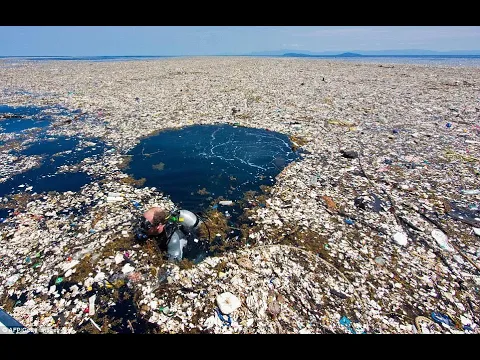

The modeling presented by the organization itself shows that the trash does not form a solid and compact island. It is an extensive area with variable concentrations, where the center gathers a higher density of waste and the edges present a wider dispersion.
System 03 expanded the scale after years of testing with previous prototypes
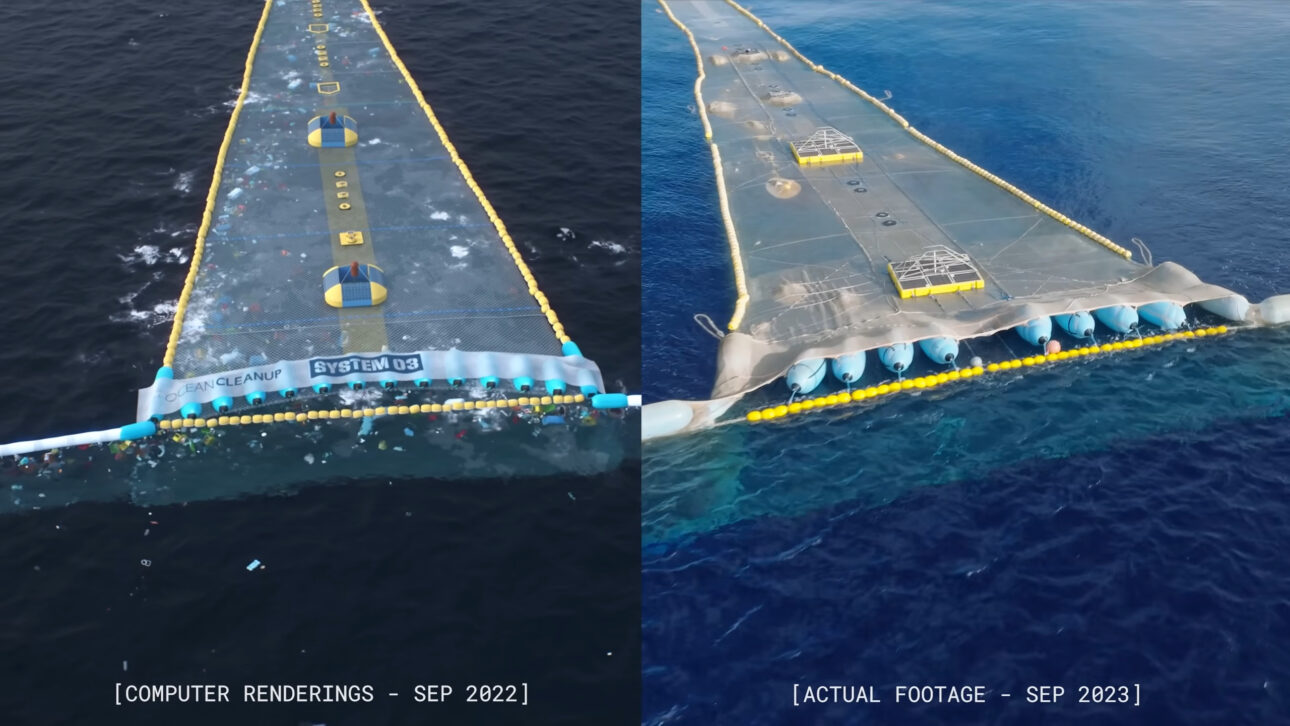
The System 03 is the third generation of the organization’s ocean technology. The Ocean Cleanup reports that the system was launched after testing previous versions and following the performance of System 002, which removed more than 250 thousand kilograms of plastic from the Great Pacific Garbage Patch between 2021 and 2023.
The new version was described by the organization itself as almost three times larger than the previous one. The goal was to transform an experimental concept into a platform with enough scale to serve as a basis for a future fleet of similar systems.
This increase in size is central to the project’s logic. The larger the area covered by each operation, the greater the volume of waste tends to be removed per mission, and the more feasible the idea of reducing, over the years, the mass of plastic concentrated in the patch becomes.
Plastic removed from the sea can be recycled and returned to the production chain
After extraction, the material is not simply discarded. The Ocean Cleanup states that the goal is to ensure that the removed plastic does not return to the marine environment, directing this waste for recycling and reuse in new products.
This step is important because it gives the project an industrial dimension, not just a symbolic one. The logic is to remove the trash from the sea, separate the materials, and transform part of this volume into reusable raw material, enhancing the environmental value of the operation.
In practice, this reinforces the idea of a circular economy applied to ocean cleaning. Instead of treating the recovered plastic as waste without a destination, the organization tries to reinsert part of it back into the production chain after proper processing.
Ocean cleaning also depends on blocking waste in rivers
The organization itself recognizes that removing the plastic already accumulated in the ocean does not solve the problem alone. Therefore, it also operates Interceptor systems, created to prevent large volumes of waste from flowing through rivers to the sea.

In the Interceptor Original model, waste is guided by a barrier to the equipment’s opening, passes through a conveyor belt, and is automatically distributed into containers for later removal. According to The Ocean Cleanup, the system was designed for mass production and faster deployment in highly polluted rivers.
This strategy shows that ocean cleaning and blocking waste before it reaches the sea need to go hand in hand. Without containing the continuous entry of new waste, any removal effort on the high seas tends to face a constant replenishment of plastic over time.
System 03 became one of the largest environmental engineering experiments in open sea
The advancement of System 03 does not eliminate the magnitude of the challenge, but it changes the level of the technological response. With 2.2 kilometers in length, the equipment has brought ocean cleaning closer to an industrial-scale operation rather than a one-off experiment.
The weight of this system becomes even clearer when compared to the size of the Great Pacific Garbage Patch. Faced with an area of 1.6 million square kilometers and an estimated liability of 1.8 trillion pieces of plastic, the solution requires much larger machines, operational repetition, and continuous action for years.
Therefore, System 03 represents more than just a giant floating barrier. It symbolizes the attempt to tackle a planetary problem with a scale compatible with the extent of the damage accumulated in the ocean over decades.