






 Portuguese
  Spanish


Ukraine has introduced the Datum — an autonomous underwater drone that dives to three hundred meters deep, navigates without remote guidance, and can attack surface ships or submerged vessels without any human operator needing to be in the loop in real time, in an advancement that is quietly changing the naval doctrine of countries that do not have submarines but need naval area denial power.
What the Datum is and what it can do
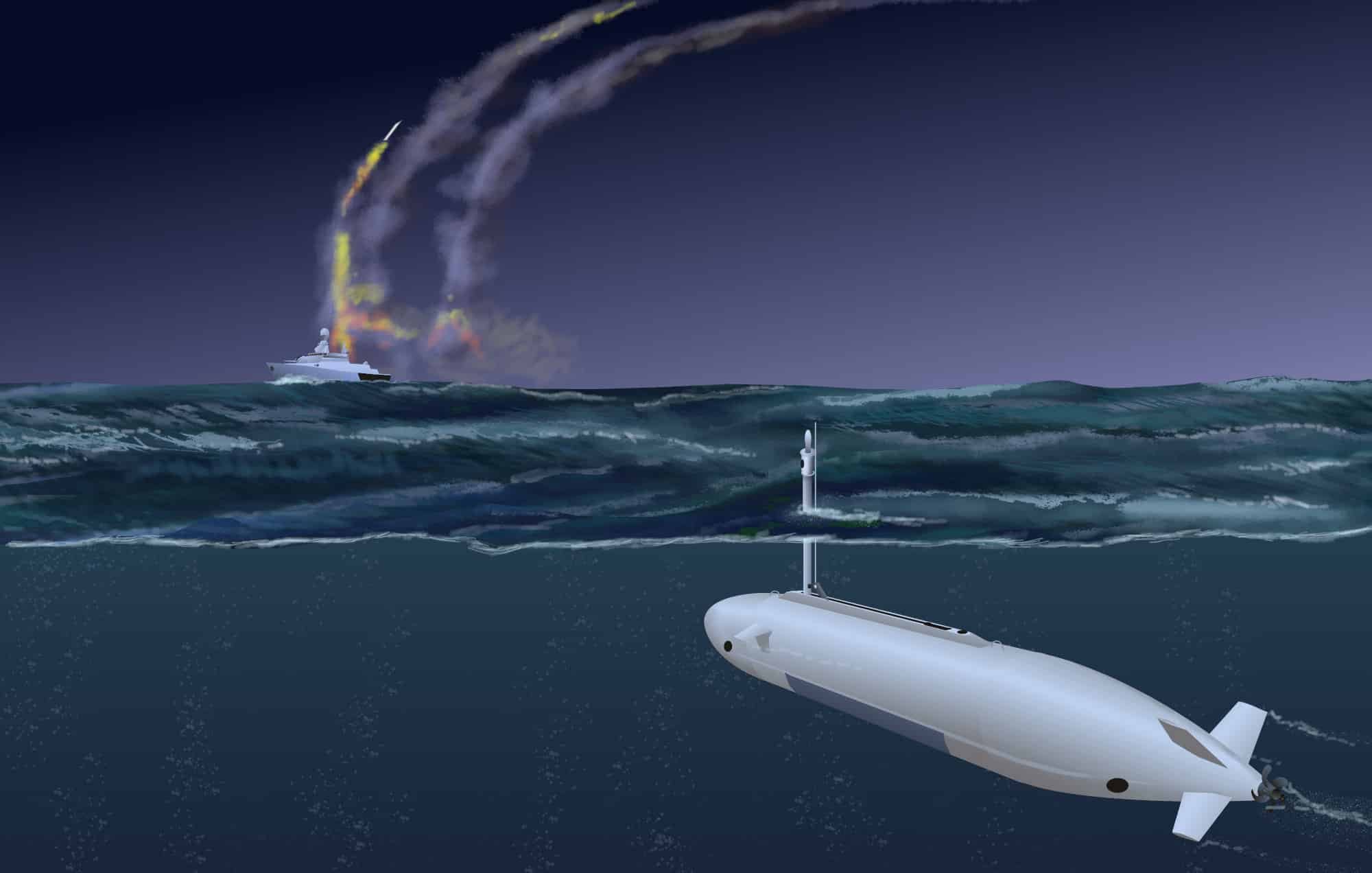
The Datum is an unmanned underwater vehicle — UUV, in English acronym — developed by Datum Systems, a Ukrainian defense technology company that emerged from the ashes of the 2022 war. Unlike the Sea Baby and Magura surface drones that Ukraine has already used to attack Russian ships in the Black Sea, the Datum operates completely submerged.
The vehicle has a torpedo-like shape with rear control surfaces and silent electric propulsion. Length of about four meters, load capacity of up to 200 kilograms — enough for a demolition warhead or long-duration surveillance sensors. The reported autonomy reaches 72 hours in patrol mode.
The navigation system combines INS — inertial navigation system — with underwater SLAM, a simultaneous mapping technique by sonar that allows the drone to navigate in unknown waters without GPS, which does not penetrate the water column. When it reaches the attack distance, it uses passive sonar to identify the target’s acoustic signature and autonomously decides the approach vector.
-
Saudi Arabia intercepts Iranian cruise missiles mid-air, proving Patriot defense system’s effectiveness

-
Europe Opens Military Satellite Hub in Cologne, Transforming Continental Defense
-
The United States launches autonomous drone ship capable of hunting submarines and firing missiles
-
Poland’s Massive Tank and Artillery Purchases Make It Europe’s Largest Land Army Overnight


Why this matters beyond Ukraine
Modern naval warfare has been reinvented by the Black Sea. Russia had the largest surface force in the region. Ukraine, without a conventional navy after 2022, improvised an area denial doctrine using surface drones, anti-ship missile attacks, and special operations. The result: the Russian Black Sea fleet lost the Moskva — the largest warship sunk in combat since World War II — and withdrew from Sevastopol.
The Datum takes this doctrine to a new dimension. A country without conventional submarines can now operate underwater denial capability at a fraction of the cost. A conventional Varshavyanka-type submarine — which Russia operates in the Black Sea — costs between 300 and 500 million dollars. A Datum costs orders of magnitude less and can be produced in dozens.
For countries like Finland, Poland, Romania, and others that have coastlines but do not have nuclear or conventional submarines in sufficient numbers, the concept is strategically interesting.
The technical challenges no one mentions
Underwater autonomy is a difficult problem. Passive sonar sensors are excellent for detecting surface ships — whose engines, propellers, and auxiliary systems emit reasonably predictable acoustic signatures — but have limitations against modern submarines with anechoic coating.
Communication is also a challenge. Radio does not penetrate water at any useful depth. The only ways to communicate with an operational UUV are ELF — extremely low frequencies, which require kilometer-long antennas — or underwater acoustic communication, which has very limited bandwidth. In practice, this means that the Datum needs to make its own tactical decisions for long periods — which raises serious questions of control, target identification, and international armed conflict law.
We still do not have an established legal framework for armed drones that make attack decisions autonomously. This gap will need to be resolved — and will likely be resolved first in practice, and then in law.
What Russia will do in response
The Russian Navy operates Ka-27 helicopters specialized in anti-submarine warfare, as well as sonobuoys and pursuit torpedoes. Against a UUV like the Datum, conventional countermeasures work — but require you to know where to look.
A drone launched at 11 PM fifty kilometers away and navigating silently for twelve hours before reaching the attack zone is much harder to detect than a conventional submarine periscope. The cost and detection asymmetry is the central argument of the Datum as a weapon system.
For the Brazilian naval industry, which is developing the Álvaro Alberto conventional submarine and planning the first national nuclear submarine, the Datum represents a warning: the underwater warfare of the future will have many more actors, and not all will have steel hulls.
Read also: the American robot ship that hunts submarines alone | the spy drone that Indonesia pulled from the sea.
Do you think armed autonomous underwater drones will change the naval power balance in the next ten years, or will anti-submarine defense systems keep pace? Share your thoughts below.


