Portuguese
  Spanish


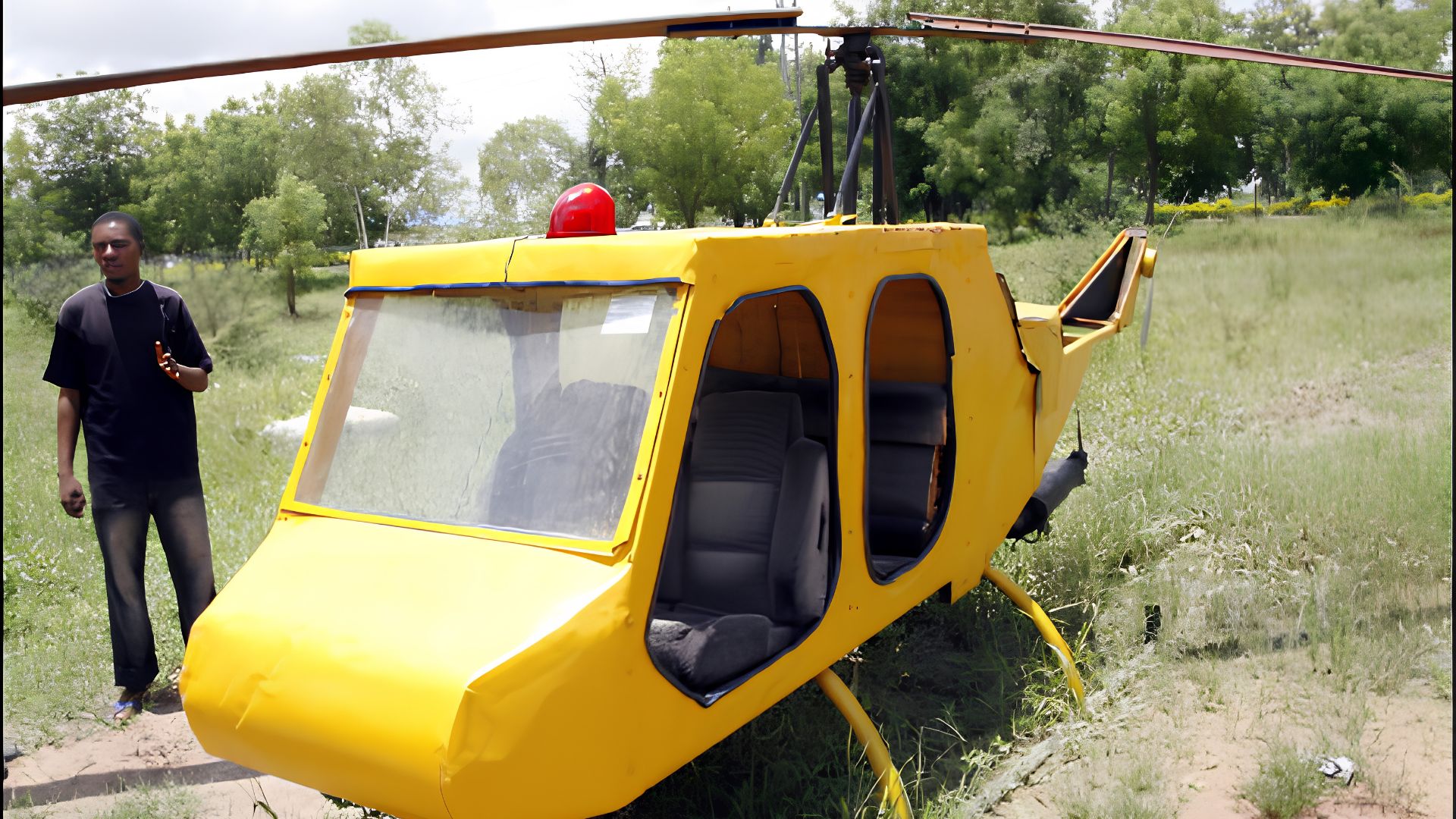

Nigerian student built a helicopter with car, motorcycle, and airplane scrap, and the machine managed to fly in short tests.
In 2007, the story of Mubarak Muhammad Abdullahi, a 24-year-old physics student from Bayero University in Kano, attracted attention far beyond Nigeria. Reports published by Mail & Guardian showed that the university student spent eight months building a homemade helicopter with parts taken from cars, motorcycles, and fragments of a crashed aircraft. The case was impressive not only for the improvisation but also because the machine actually managed to lift off the ground in short tests. Instead of just a visual concept or a scenic shell, what Abdullahi assembled was a functional prototype, still rudimentary, but capable of demonstrating low-altitude takeoff and transforming scrap into an operable aircraft.
Helicopter built with scrap in Nigeria was born from a mix of curiosity, internet, and improvisation
The project began in the backyard, where Abdullahi dismantled old vehicles and reused what he found useful. The student financed part of the construction with the money he earned repairing computers and cell phones, in addition to receiving help from his father to buy aluminum and other components.
The Mail & Guardian reports show that the motivation did not come from a laboratory, a company, or an official innovation program. Abdullahi himself stated that he learned basic notions about helicopters from the internet and that the idea of building the machine came from the fascination he developed watching action movies on television.
-
Digital Transformation Essential in Energy, Oil, and Gas Industries, But IT Infrastructure Often Overlooked

-
Brazilian Students Repurpose Clay Tea Cups to Create Cooler That Lowers Room Temperature by Up to 10°C Without Air Conditioning or Fans
-
353-Year-Old Mystery Deepens as Archaeologist Arrested with Teeth and Bone Fragment Possibly Linked to d’Artagnan, the Real Musketeer Behind Alexandre Dumas’ Inspiration

-
16-Year-Old Invents CoolTowel, a Fitness Towel That Stays Cold for Up to 2 Hours, Wins Global Alibaba Competition with Over 15,000 Participants, Earning $1 Million





It was not an aeronautical engineer with an equipped workshop, but a self-taught university student who decided to take on an extreme challenge with the resources he had at hand, combining basic physics knowledge, manual skill, and persistence.
Honda Civic engine, Toyota seats, and Boeing part formed the structure of the helicopter
The helicopter’s structure brought together unlikely elements. According to reports published in 2007 by Mail & Guardian, the machine used a 133-horsepower engine taken from a second-hand Honda Civic, as well as seats from a Toyota car and metal parts from dismantled vehicles.
Another point that helped turn the case into a symbol of ingenuity was the origin of part of the fuselage. The reports state that Abdullahi also reused components from the carcass of a Boeing 747 that had crashed near Kano years earlier, incorporating these fragments into the prototype.
The result was a helicopter of unusual dimensions for a homemade project. Texts from the time describe an aircraft with 12 meters in length, about 7 meters in height, and approximately 5 meters in width, proportions that reinforced the ambition of the project even with its artisanal execution.
How the cockpit of Mubarak Abdullahi’s homemade helicopter worked
Despite the improvisation, the prototype had a clear operational logic. The cockpit featured an ignition button, a throttle lever installed between the seats, and a joystick used for balance and direction, forming a simple set but designed for basic aircraft control.
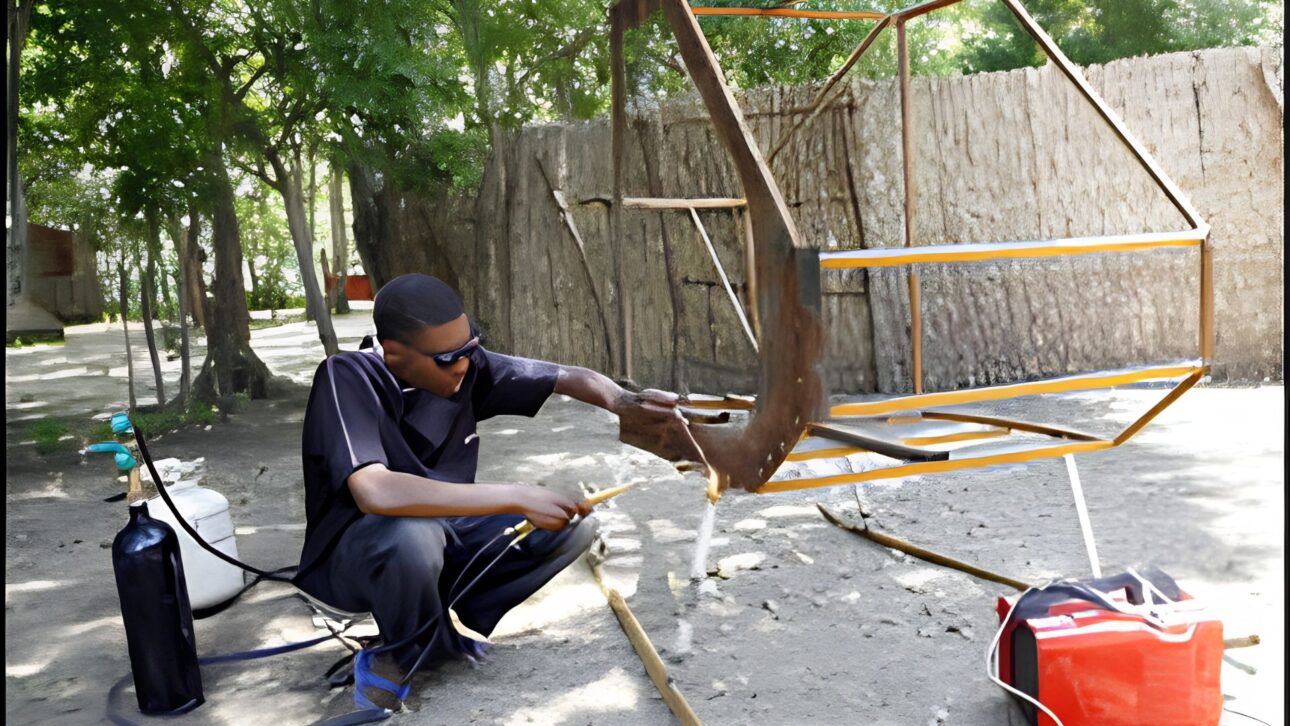
The Mail & Guardian reports also describe a small ground vision system. A camera installed under the helicopter was connected to a screen on the panel, while a radio transmitter completed the device’s communication set. This detail shows that Abdullahi did not limit himself to the external structure and tried to incorporate practical operational elements.
In the student’s own description, the operation began with the engine starting and continued with the gradual advancement of the lever until the upper rotor gained enough rotation for the aircraft to take off. It was a rudimentary solution, without the complete instruments of a professional cockpit, but based on consistent mechanical reasoning.
Helicopter flew six times but never rose above about 2 meters in height
It is important to address the feat accurately. Mail & Guardian indicates that Abdullahi’s helicopter flew briefly on six occasions, but never reached great altitude.
The limit recorded in the reports was about seven feet, something close to 2 meters, which places the prototype much more in the category of functional demonstration than in that of an aircraft ready for real use.
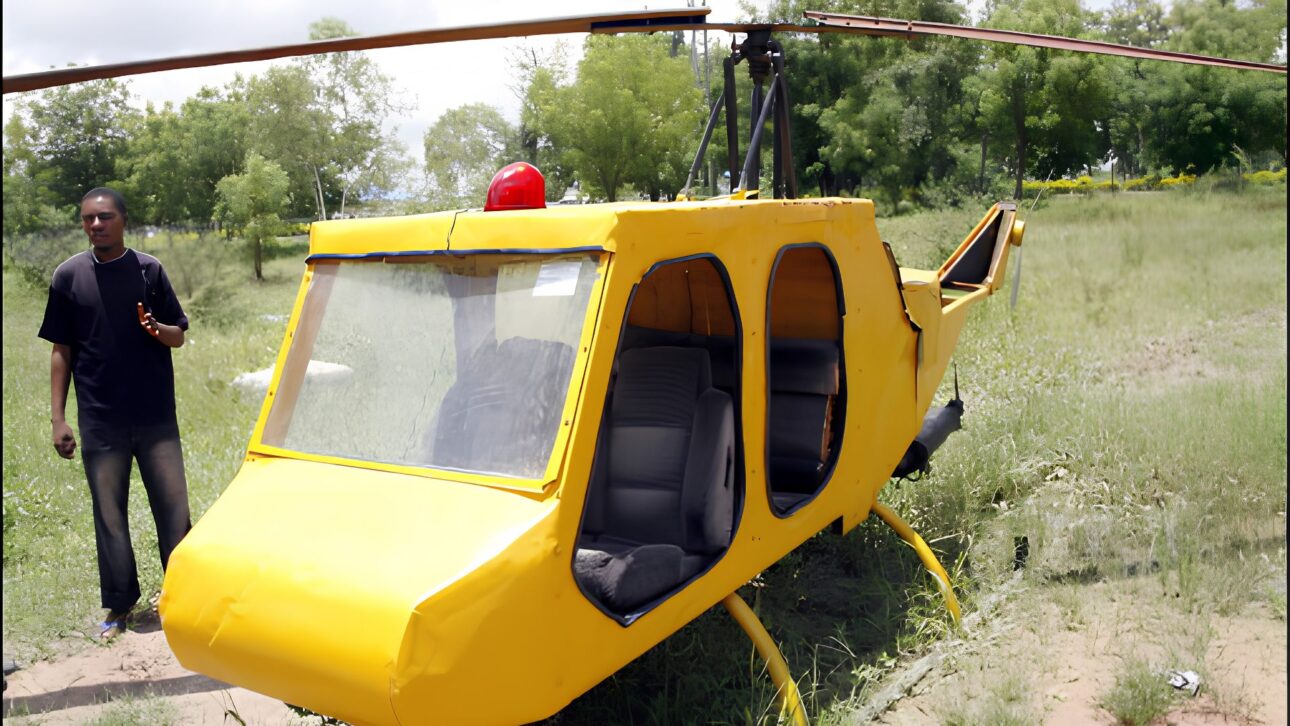
Even so, the technical merit remains impressive. Making a structure of this size lift off the ground, even for a few moments and at a very low height, was already a rare feat for a project assembled with scrap, without robust institutional support and without specific training in aeronautical engineering.
Abdullahi himself acknowledged the limitations of the first model. According to the Mail & Guardian, he admitted that the aircraft still lacked basic instruments to measure factors such as altitude, atmospheric pressure, and humidity, which shows that he treated the creation as a first stage, not as a finished product.
Lack of official support exposed the waste of talent in Nigerian aviation
If the construction of the helicopter revealed inventiveness, the official reaction showed another side of the story. The reports record that Abdullahi complained about the lack of interest from Nigeria’s civil aviation authority, even after demonstrations that aroused the curiosity of local authorities in another state of the country.
This contrast helps explain why the case gained symbolic strength. On one side, there was a university student assembling a flying machine with scarce resources. On the other, an institutional environment that, according to reports from the time, had not yet converted this demonstration of talent into technical support, formal validation, or development opportunity.
The story ended up becoming a powerful portrait of how innovation and precariousness can coexist. Abdullahi’s helicopter was not proof of industrial maturity, but of inventive capacity in its raw state, arising far from traditional research centers and without the infrastructure normally associated with aviation.
New helicopter was already underway and promised to be more sophisticated
Even with all the limitations of the first model, Abdullahi did not stop there. Sources from 2007 show that he was already working on a second helicopter, described as a more sophisticated project and more refined from an aesthetic and structural point of view.
According to the reports published by Mail & Guardian, this new version would be a two-seater model, with a new engine and with the ambition to reach about 4.5 meters of altitude and remain in the air for up to three hours.
It was a bold goal, still based on the inventor’s own projections, but enough to show that the first prototype was seen by him as just the beginning.
More than building a handmade helicopter with car parts and aircraft scraps, Abdullahi demonstrated a mindset of continuous development, treating his first low flight not as an endpoint, but as a rehearsal for something greater.