

 Portuguese
 Spanish


MIT researchers develop flying microrobot with onboard sensors that can land on a sunflower without external cameras; prototype still uses a joystick and tethered power.
A flying microrobot developed at the Massachusetts Institute of Technology (MIT) flew with position errors of just a few centimeters and landed on a sunflower without the external cameras that had guided it in the lab. It did so using sensors and processing systems installed on the device itself, according to a study published in Science Robotics. The result is a step toward small robots for precision agriculture, but with caveats: in the demonstration, an operator controlled the flight path with a joystick, and the robot still relies on a tethered power source.
The team started with a four-wing platform whose earlier version looked like a microcassette and weighed less than a paper clip. The challenge was to add electronics without sacrificing agility, collision resistance or the lift needed to stay airborne.
Flying microrobot achieves centimeter-level precision and could be used in agriculture
In tests, the robot maneuvered between predetermined points and hovered at different heights. Even without a conventional motion-capture system, its onboard position estimates were about as precise as those from flights tracked by cameras, the researchers reported.
-
German engineers create a concrete-free wood-and-granite bridge lasting up to five times longer than traditional wooden bridges

-
Columbia astronomer Viraj Karambelkar and his team watched a star 350 times wider than the Sun swallow its smaller partner in the Andromeda galaxy, and NASA’s Webb caught the aftermath just 47 days after the blast peaked.

-
Brazilian University Installs Giant 3D Printers Up to 9 Meters Long for Construction of Walls in 45 m² Homes

-
Paleontologist Yingqi Zhang has crawled through about a thousand caves in southern China, and eight teeth from two of them show Homo erectus lived in rainforest there until about 184,000 years ago, up to 200,000 years longer than thought.


The plant demonstration depended on this fine control of the robot’s movements. An operator used a joystick to guide it around the vegetation and land it on a sunflower. No pollination took place, and the experiment also does not show that the robot can already identify flowers and avoid obstacles on its own.
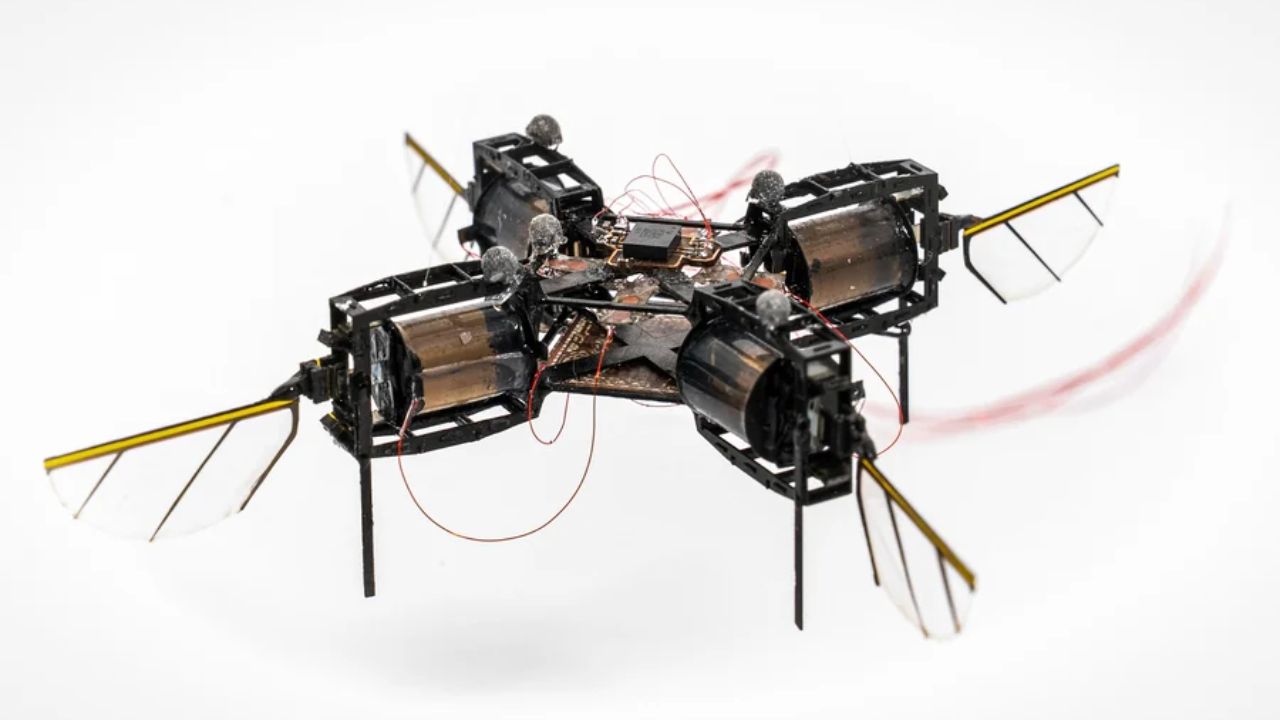
The team hopes to apply the technology to tasks that require a delicate approach, especially in places where larger vehicles are unsuitable. Agricultural uses will require further advances, but potential applications include monitoring crop conditions by flying close to plants without damaging them, detecting pests before they spread and, eventually, helping pollinate almond trees and blueberry bushes in areas where natural pollinators have declined because of habitat loss.
The authors also see potential uses in industrial surveillance. Kevin Chen, an associate professor at MIT and one of the project leads, considers the demonstration a milestone because it combines sensing and computing in an aircraft of this size. For the robot to operate more independently, however, it still needs a camera to recognize objects and avoid obstacles, as well as a battery system.
244-milligram sensors and larger artificial muscles enabled flight without external cameras
To enable the circuitry to track the wings’ movement, the team combined a microcontroller with three types of sensors in a package weighing just 244 milligrams. One calculates altitude based on time of flight, another uses optical flow to estimate speed and lateral position, and an inertial measurement unit reports the robot’s orientation. All the data are processed onboard and used to control the flight.
Without the laboratory cameras, however, another problem emerged. In the absence of an external reference for absolute position, small errors accumulate and cause the robot to drift along its path. To address this, the researchers simplified the algorithm that calculates orientation, angular velocity, and position. Frequent updates performed better than more accurate but slower estimates.

The electronics also required changes to the flight structure. The scientists altered the radius and length of the flexible actuators that move the four wings, making these artificial muscles 50% larger. This increased net lift by 46% and brought the lift-to-weight ratio to 1.9, enough to carry the components.

To keep vibrations from shifting the parts, everything was mounted on a fiberglass base. Although the electronics take measurements and perform calculations during flight, they account for about 6% of total energy use. The rest goes to moving the wings.
The researchers now want to reduce energy use further and install batteries and power electronics on the robot, a necessary step toward flying without an external power source.