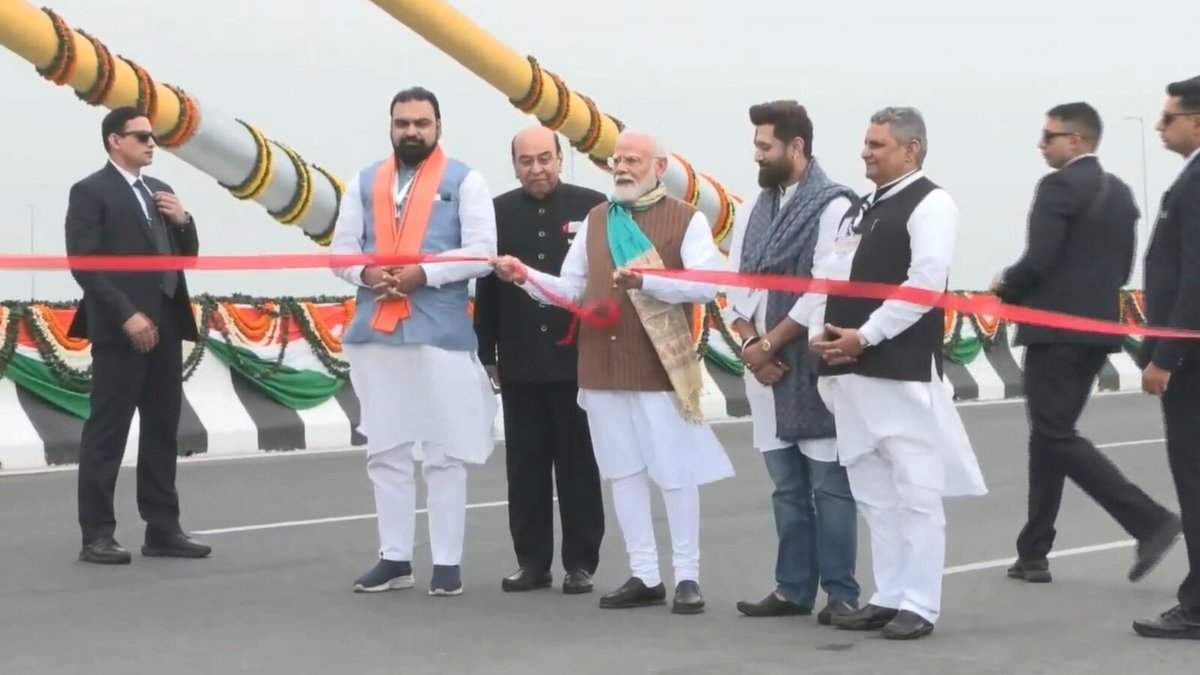
India’s Prime Minister Narendra Modi cut the ribbon on Saturday, November 21, on Nitish Setu, a six-lane road bridge across the Ganges in Bihar’s Vaishali district, and then walked along its deck.
The bridge is 9.76 km long and was built for about ₹4,280 crore, according to a statement from the Prime Minister’s Office quoted by the Hindustan Times. It links Bidupur in Vaishali with Kachchi Dargah, on the outskirts of the state capital, Patna.
Modi walked on the new deck with Bihar Chief Minister Samrat Choudhary and Deputy Chief Minister Vijay Kumar Choudhary, ETV Bharat reported. Before the ceremony he looked at a model of the bridge while state officials explained its design.
A 19.7-km corridor across the river
The bridge is the main part of a larger 19.7-km road project. That corridor runs from Kachchi Dargah on National Highway 22, in Patna district, to Bidupur on National Highway 322, in Vaishali.
-
Singapore Transport Minister Jeffrey Siow broke ground on Tuas Port’s third and largest finger, almost 400 hectares of reclaimed land with 21 mega berths 23 metres deep and an 8.6 km wharf that will start operating in 2028.

-
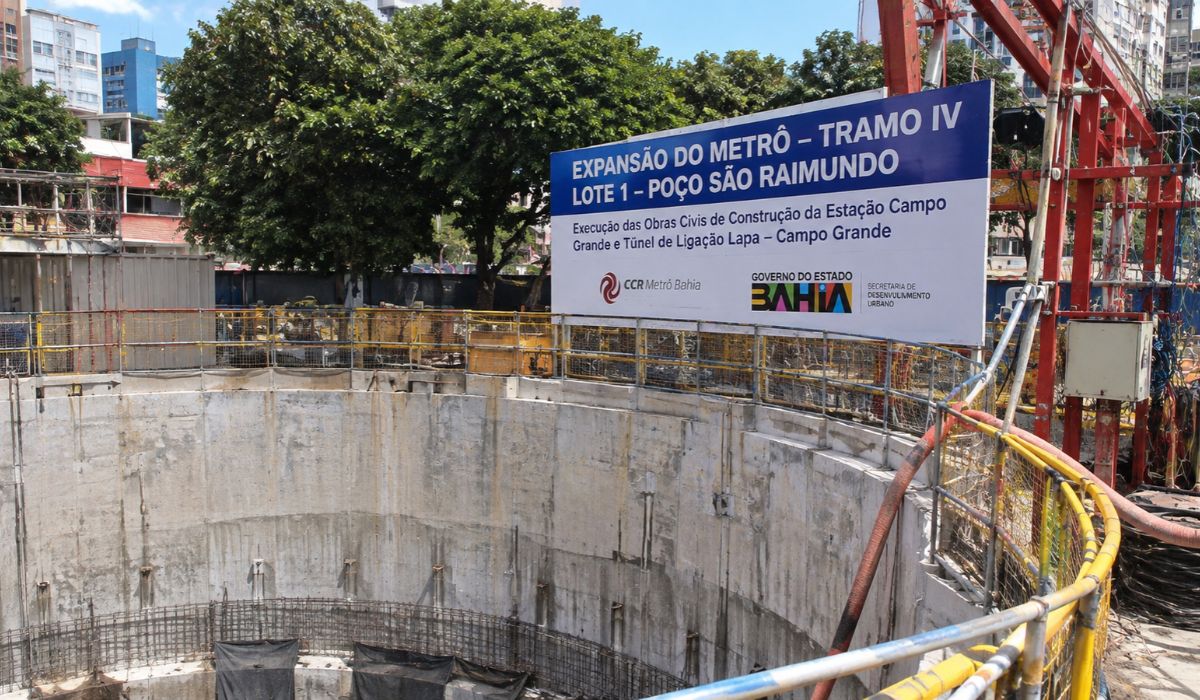
Salvador Metro digs 22-meter shaft beneath Barris to begin tunnel to Campo Grande as R$1.5 billion expansion advances

-
Brazil’s first immersed-tube tunnel requires six 48-hour closures of the Port of Santos shipping channel during R$6.8 billion project
-
Brazil to Develop Dubai Mall-Inspired Shopping Center with R$400 Million Investment in Santa Catarina



The rest of the corridor is made up of approach roads on both banks. Together they give drivers a continuous route from the Patna side of the Ganges to the farming districts on the northern side.
ETV Bharat described Nitish Setu as India’s longest river bridge. The government statement quoted by the Hindustan Times did not use that label, so the claim rests on the broadcaster’s report.
Cables over the Ganges
Nitish Setu is an extradosed cable-stayed bridge. In this design, short towers rise above the deck and cables run from them at a shallow angle, so the structure works as a mix between a girder bridge and a classic cable-stayed span.
Aerial images released for the opening show rows of yellow cables fanning out from concrete towers along the deck, with a wide sandbank and the river visible below.
The format lets engineers stretch longer distances between piers than a simple beam bridge would allow, which matters on a wide river like the Ganges, where the channel shifts between the dry season and the monsoon.
Taking pressure off two older bridges
The new crossing is expected to take part of the traffic now squeezed onto the Mahatma Gandhi Setu and JP Setu, the existing Ganges bridges serving Patna, the Prime Minister’s Office said.
It should also shorten journeys between north and south Bihar, especially for people who live in places with weak road links to Patna. The government did not publish an estimate of how many minutes the bridge will save on a typical trip.
An island community gets a road to Patna
One of the main beneficiaries is expected to be Raghopur Diara, an area in Vaishali district that is surrounded by the Ganges and has limited road access.
According to the official release, the bridge will give residents an easier route to Patna’s hospitals, schools and other essential services, which until now have often been a long and uncertain journey away.
Litchis, bananas and maize
The government also expects the bridge to help farmers and businesses in north Bihar reach markets faster. The region is densely populated and has fertile farmland.
Producers of litchis, bananas, maize and vegetables are among those expected to gain. Their goods currently face transport problems linked to poor connectivity, the release said.
Officials also expect the Bidupur-Kachchi Dargah corridor to attract investment and grow into a centre for tourism and logistics, the news agency PTI reported.
Fourteen years from plan to ribbon
The project was first commissioned in 2012 by Nitish Kumar, who was then Bihar’s chief minister. Construction only got under way in 2015.
The bridge now carries his name. Modi met Nitish Kumar at Patna airport before travelling to the bridge for the inauguration.
A name that started a political fight
The choice of name drew criticism from the opposition. Tejashwi Yadav, working president of the RJD party, said it was unusual to name a bridge after a living politician and suggested the move was meant to signal that Kumar’s career was over.
Yadav said his party had once proposed naming the bridge after Akshayvat Rai, a freedom fighter and close aide of former chief minister Karpoori Thakur. The BJP and Kumar’s JD(U) party rejected the criticism and said the bridge showed the development achieved under Kumar.
Part of a ₹34,000 crore package
The bridge was the centrepiece of a wider programme. Modi inaugurated or laid foundation stones for 227 development projects worth more than ₹34,000 crore in Bihar on the same day, ETV Bharat reported.
They included the second unit of the Buxar thermal power project, 26,917 permanent houses handed over to families, 106 health centres, drinking water supply in 11 cities and agricultural markets in Patna and Gaya.
100 electric buses and a waste-to-energy plant
Modi also flagged off 100 electric buses for public transport in Bihar, the Hindustan Times reported.
He laid the foundation stone for a waste-to-energy plant outside Patna. It is designed to handle more than 1,600 tonnes of waste from 13 municipal bodies within a 45-km radius and produce 15 MW of electricity, with a 100-tonne bio-methane unit and a 700-tonne compost plant.
What comes next for the corridor
With the ribbon cut, the real test begins on the deck itself: whether daily traffic shifts away from the Mahatma Gandhi Setu and JP Setu, and whether trucks from north Bihar’s farms start using the new route to reach Patna.
No traffic counts or travel-time measurements after the opening have been published yet.
If a 9.76-km bridge finally gives an island community and a farming region a direct road to the state capital, how long do you think it will take before drivers see the difference in their daily commute?