Portuguese
 Spanish


Rural roads in Paraná face drainage and maintenance problems, with an estimated R$2.2 billion needed annually to upgrade the priority network.
Rural roads in Paraná face infrastructure problems that hinder the transport of agricultural and livestock products and the movement of rural residents. A study by Esalq-Log and the Brazilian Confederation of Agriculture and Livestock (CNA) estimates that the state needs R$2.2 billion a year to maintain and upgrade its priority local road network, including R$1.9 billion to repair roads in poor condition.
With October rainfall above average in several municipalities and the summer harvest approaching, the FAEP System is calling for an emergency plan. In addition to the challenges facing producers, inadequate infrastructure disrupts school transportation and rural residents’ access to health services. The information comes from a report published by CNA Senar on November 23, 2026.
Paraná has the largest network of local roads in Brazil’s priority regions
Of the 39 microregions in Paraná analyzed in the study “Overview of Local Roads in Brazil,” 23 were classified as priority areas. Together, they have 136,600 kilometers of roads, putting Paraná ahead of every other Brazilian state in this category of the study.
-
Predilecta Group bets on processing tomatoes to weather agricultural price volatility

-
Cassava prices in Paraná rise 7% amid rain pressures on growers and processors
-
Ambev aims to more than triple barley production in Rio Grande do Sul to 50,000 hectares by 2030, reducing reliance on imports

-
End of the 6×1 Schedule: Agribusiness Must Adopt a 5×2 Workweek Without Sector-Specific Rules, Reducing to 42 Hours in December 2026 and 40 Hours in 2027


Including regions that did not receive this classification, Paraná’s local road network spans 170,000 kilometers, the fourth-largest in the country, including 16,900 kilometers of tertiary roads.
The need for investment can be seen in the Paranavaí microregion, known for producing poultry, pork and beef, as well as growing citrus and sugarcane. The study estimates that improving all priority local roads in the region would require R$116.44 million annually. Of that amount, approximately R$14.6 million would go toward upgrading and maintaining 527 kilometers of tertiary roads.
Although Paraná is in better overall condition than many other states, recurring maintenance problems remain, according to economist and Esalq-Log researcher Everton Lima Costa.
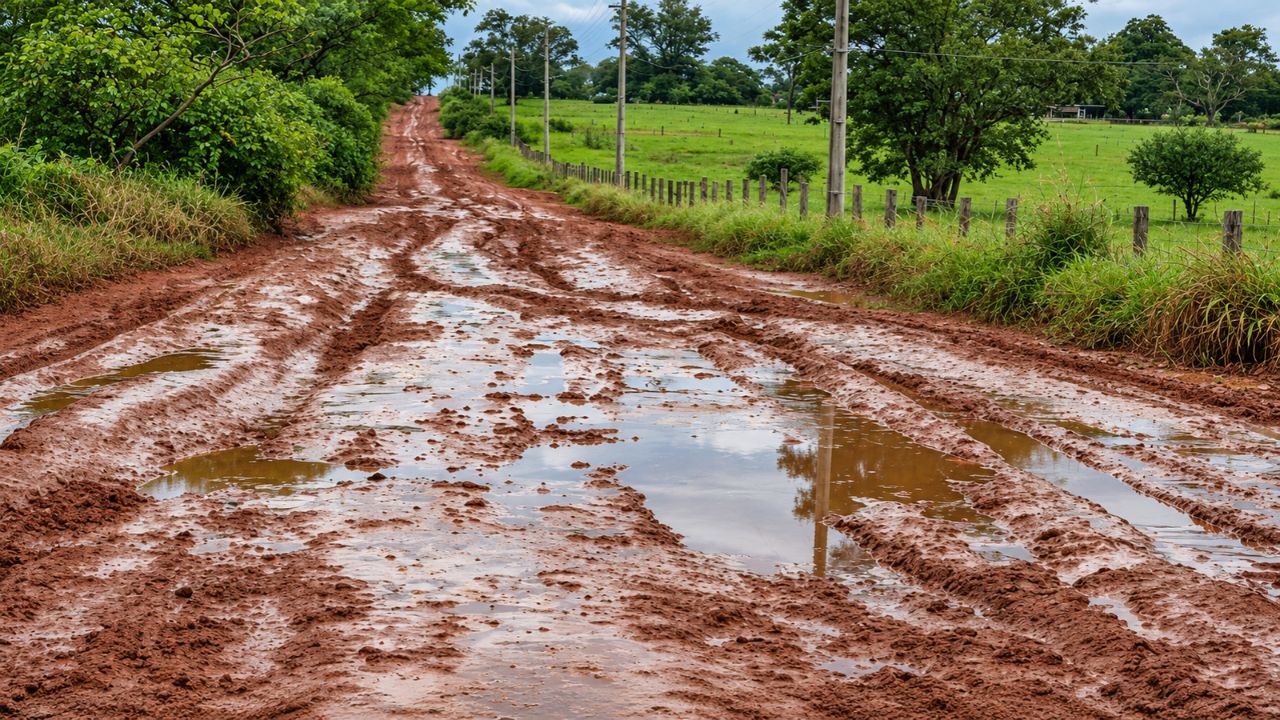
One problem is a lack of investment in drainage. Municipal crews often focus on filling potholes and grading road surfaces, without applying gravel as regularly as needed.
Nationwide, poor conditions on local roads account for about R$6.4 billion a year in operating costs, an estimate that does not include the educational losses suffered by students unable to reach school during rainy periods.
Above-average rainfall worsens infrastructure problems and hampers travel in rural areas
Maintenance challenges on rural roads intensified in October, when several parts of Paraná recorded rainfall above their monthly averages before the middle of the month.
Data from the Paraná Environmental Technology and Monitoring System (Simepar) show that Foz do Iguaçu received 372.4 millimeters of rain through October 13, compared with a monthly average of 262.2 millimeters. In Loanda, rainfall reached 285.2 millimeters over the same period, 64% above the benchmark for the entire month.
Paranavaí, Telêmaco Borba, Santa Helena and Assis Chateaubriand also exceeded their monthly averages. In Paranavaí, where about 40 of the more than 500 kilometers of rural roads were in poor condition, the city government set up eight service points with machinery and operators during the first half of October.
The emergency work prioritizes school transportation and moving agricultural production, but faces limits when excessive mud makes it impossible to do the work without further damaging the roads. On some occasions, municipal equipment had to help tractor-trailers carrying chickens.
Bridge infrastructure also needs attention. In Rolândia, farmers have difficulty crossing the bridge on Guaíra Road with machinery. The city government said the structure is made of concrete and that local producers added a wooden extension to make it wider.
In Maringá, debris clogging culverts along Guerra Road causes flooding and forces road users to take alternate routes. The city government said it had carried out maintenance work on the road in March 2026 and continues to conduct inspections and periodic work in the rural area.
Agriculture sector calls for ongoing planning to restore rural roads
With the summer harvest expected to move into full swing in early 2027, the FAEP System says investment in rural road infrastructure must be backed by planning and a steady source of funding.
In August 2026, the organization presented four proposals to Sergio Moro, then a candidate and now Paraná’s governor-elect. The measures aim to expand municipalities’ ability to maintain their roads and address problems that hinder the movement of food, equipment, supplies and workers.
The initiatives backed by the FAEP System include:
- Support for developing municipal plans to organize rural logistics;
- Creation of a state program to modernize and replace bridges;
- Establishment of a dedicated fund to finance improvements and maintenance work carried out by municipalities;
- Launch of a permanent rural roads program, with ongoing funding and technical criteria for setting priorities.
For state-level efforts, the State Secretariat of Agriculture and Supply (Seab) reported that 274 municipalities received support through 472 agreements formalized between 2025 and 2026 under the Integration Roads Program.
The projects cover approximately 2,850 kilometers of rural roads and are at various stages, from bidding procedures to completion. In total, the program has enabled more than R$3.8 billion in investment and provided municipal governments with dump trucks and yellow-line machinery.
As work progresses according to schedule, the approaching harvest is heightening concern across the agricultural sector about maintaining roads that connect rural properties to consumer markets and export corridors.