Portuguese
  Spanish


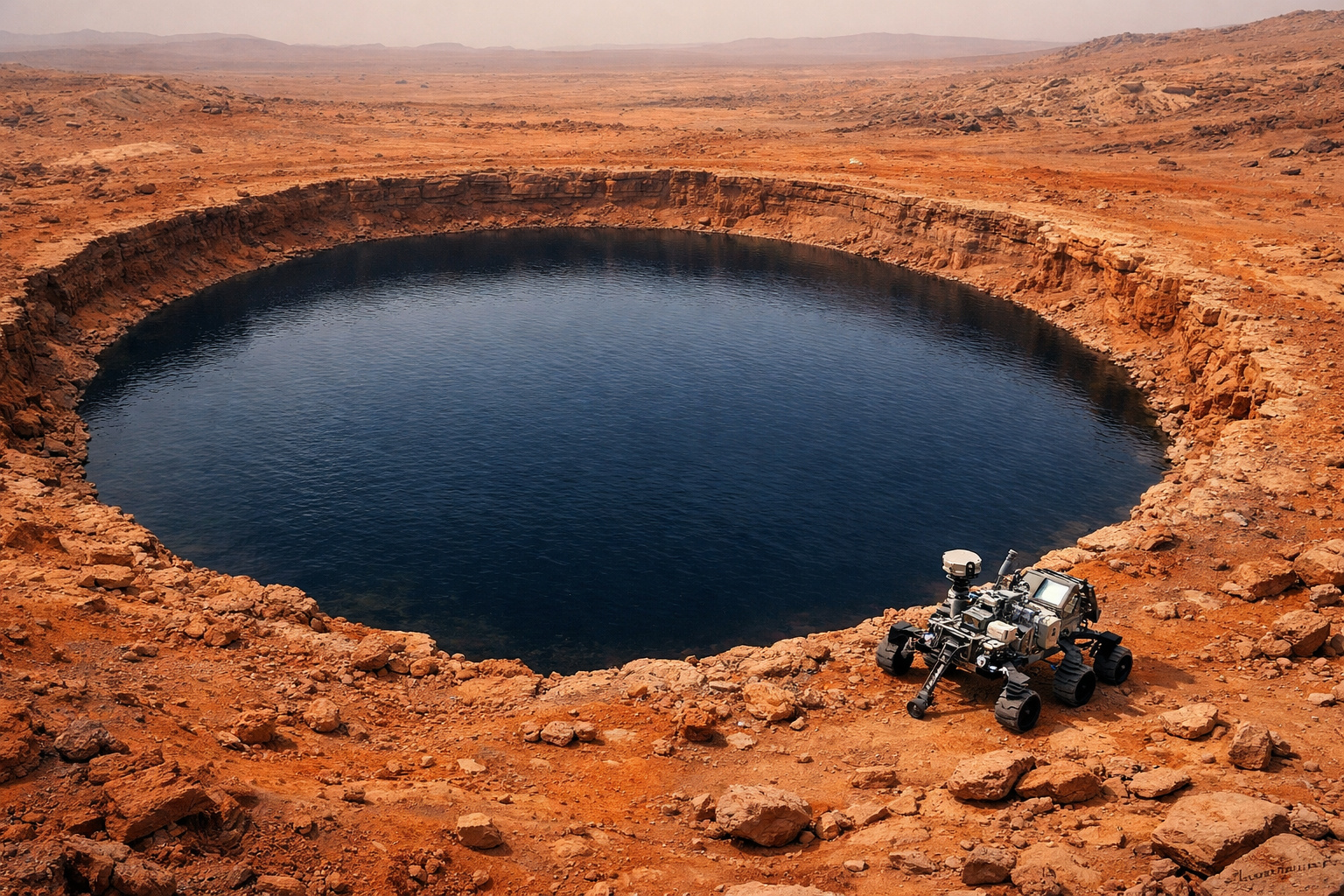


Unique Discovery Shows That Mars Had Shallow Lakes Without Ice on The Surface, Shaped by The Wind and Supported by A Denser Atmosphere Than Previously Thought
For decades, scientists debated whether primitive Mars was merely a frozen world, with water trapped under layers of ice, or whether it ever hosted real lakes of liquid water exposed to the atmosphere. Now, a new scientific discovery helps to settle this discussion. Tiny marks preserved in Martian rocks indicate that shallow, ice-free lakes existed about 3.7 billion years ago, being directly shaped by the action of the wind.
This information was disclosed by Science Advances, according to an article published on the Science.org, based on observations made by the Curiosity rover, from NASA. The evidence was found in Gale Crater, a region near Mars’ equator where the robot has been exploring since 2012. According to the researchers, this is the clearest evidence ever identified of liquid water exposed to the air on the ancient Martian surface.

These formations, called “wave ripples”, function as a true geological diary. They form when the wind blows over water, creating small waves that move sandy sediments on the bottoms of shallow lakes. Over time, these patterns are recorded in the rock, preserving detailed information about the environment in which they arose.
-
Brazilian Student Invents Low-Cost Rainwater Harvesting System Using Recycled Materials, Showcased at World’s Largest Science Fair

-
Italy Considers Next-Gen Nuclear Reactors for Warships, Aiming to Boost Naval Autonomy and Join Elite Maritime Powers

-
Extreme Heat in Antarctica Sets Record 15.4°C at Esperanza Base in June, Raising Concerns Among Scientists with Temperatures 20°C Above Normal, Rain Instead of Snow, and Unusual Melting Transforming the White Continent’s Landscape
-
UFG’s Innovative Use of Air Conditioner Drip Saves 400 Liters of Water Daily in Brazilian Public Building


Microscopic Waves Function as Climate Record of Ancient Mars
The researchers identified two distinct sets of ripples in rocky outcrops of Gale Crater. The first was photographed in 2022, in an area nicknamed Prow, while the second appeared in a nearby band known as Amapari Marker Band. Both locations point to different episodes when liquid water accumulated, instead of remaining frozen.
The ripples are extremely small: about six millimeters high, with an average spacing of four to five centimeters. These details are crucial for scientific interpretation. On Earth, ripples of this size only form in environments with shallow water and gentle waves, indicating relatively calm lakes.
Using computational models, researcher Michael Lamb, co-author of the study, estimated that these lakes were less than two meters deep, approximately the height of a person. According to geologist Claire Mondro, leader of the research at the California Institute of Technology (Caltech), “the shape of these ripples can only be explained by liquid water exposed to the atmosphere and influenced by the wind.”
Moreover, the symmetrical pattern of the marks reinforces that wind, sediment, and liquid water acted simultaneously, which is impossible in completely frozen environments. Therefore, the study describes these structures as “the most definitive examples of wave ripples ever found on another planet”.
Thicker Atmosphere and Warmer Climate Sustained Martian Lakes
Currently, Mars is a cold, dry planet shrouded in an extremely thin atmosphere. Under these conditions, liquid water cannot remain stable on the surface, evaporating or freezing quickly. However, the ripples found indicate that, in the distant past, the planet had a thicker atmosphere and higher temperatures, at least for prolonged periods.
This point is crucial for planetary climate models. For years, scientists have debated whether Mars experienced short episodes of warming or maintained relatively stable conditions capable of sustaining liquid water over long intervals. The new evidence favors the latter hypothesis, expanding the timeframe in which Mars could have been a habitable environment.
According to Mondro, “extending the period during which liquid water was present significantly increases the possibilities for microbial habitability throughout Mars’s history.” Although water is not a guarantee of life, it is considered an essential prerequisite for any known form of biology.
This discovery also aligns with other ongoing missions. The Perseverance rover, for example, operates in a different crater and collects samples of sediments formed in ancient river deltas. Future missions to return these samples to Earth may allow for the search for organic molecules or subtle chemical signatures of past life, including in rocks associated with ancient lakes like those in Gale Crater.
Discovery Guides Future Human Missions and Reveals Planetary Lessons
In addition to scientific interest, identifying regions where water accumulated in the past has practical implications for future crewed missions. Areas with a history of lakes may hide subsurface ice or hydrated minerals, resources that could be used to produce drinking water, oxygen, and even rocket fuel, reducing reliance on supplies from Earth.
More than mere marks on rocks, these ripples reveal how planets can change drastically by losing their atmosphere and climate balance. For researchers studying Earth’s climate, Mars serves as an extreme natural experiment, showing what happens when a world loses its capacity to retain liquid water.
Meanwhile, the Curiosity continues its slow ascent through the rock layers of Gale Crater, deciphering the past of the red planet centimeter by centimeter. The study published in Science Advances transforms a few centimeters of rippled sandstone into one of the most important records ever found regarding Mars’s climatic and environmental history.