






 Portuguese
  Spanish


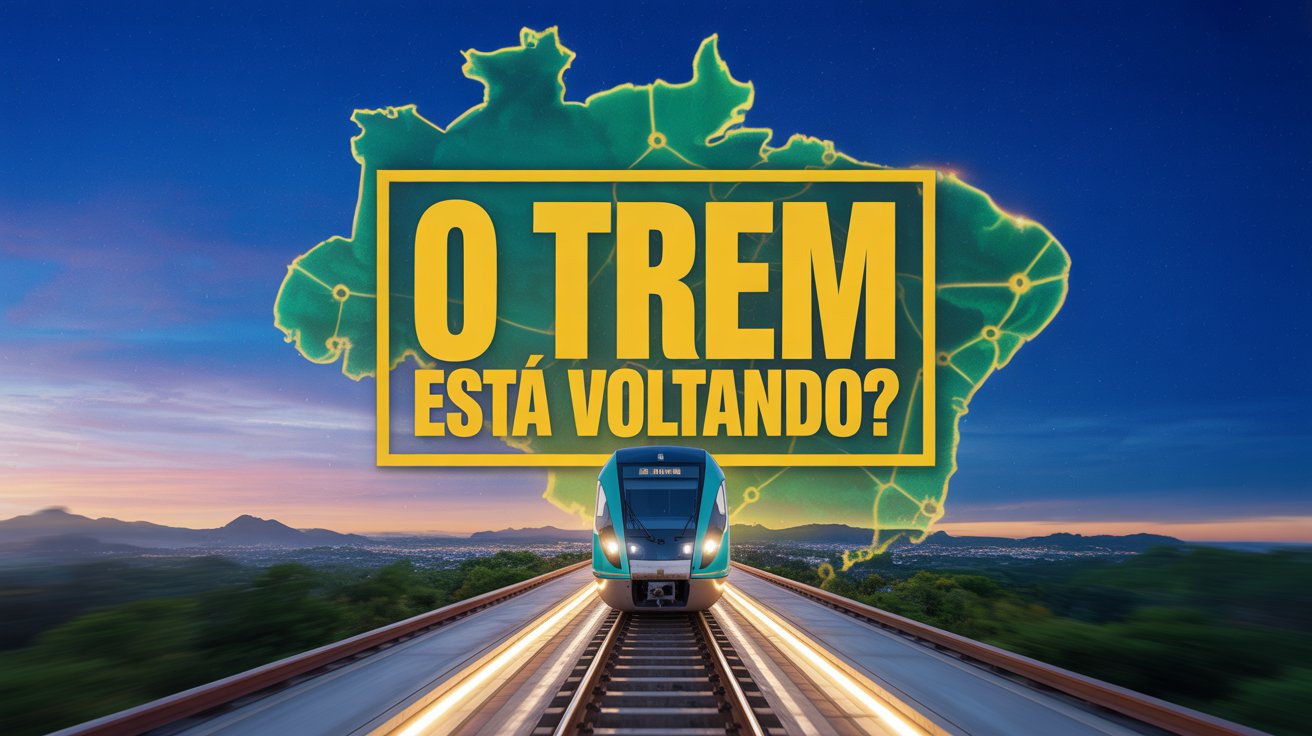

Government Prepares Railway Project With Six Regional Links Between Brazilian Cities, Reusing Idle Tracks, Prioritizing Integration With Other Modalities, and Promising to Transform Passenger Mobility From the New PAC.
The federal government has initiated the resumption of regional passenger rail transport with a package of six links between cities in different regions of the country.
Inserted into the New PAC and under study by the Ministry of Transport, the proposed corridors are Brasília–Luziânia, Londrina–Maringá, Pelotas–Rio Grande, Salvador–Feira de Santana, Fortaleza–Sobral, and São Luís–Itapecuru Mirim.
The guideline is to take advantage of existing stretches, integrate with urban systems, and offer an alternative to road transport in metropolitan areas.
-
Brazil’s Defunct Railway Network Leaves Over 100,000 Properties Abandoned for Nearly 30 Years, Facing Neglect and Safety Risks as Government Struggles to Regulate Assets Amid Degraded Stations and Unlawful Use

-
Belo Horizonte’s Beltway Project Risks Losing $5 Billion to Metro Expansion if Court Doesn’t Act Soon; State Government Plans New Lines with IDB Support

-
Brazil to Auction 9,000 km of New Railways, Aiming to Attract $28 Billion by 2026

-
Brazil Plans $160 Billion Investment to Revitalize Railways and Reduce Reliance on Long-Distance Trucking


New Railway Corridors Under Study
According to the ministry, the studies consider daily travel demand, availability of underutilized tracks, and the feasibility of insertion into regional mobility arrangements.
The state-owned company Infra S.A. is conducting the analyses and technical validation.
There is still no definition of final routes, travel times, stops, and fares, items that will be finalized at the end of the studies.
In three macro-regions, the routes will connect economic hubs to neighboring cities with intense passenger flow.
In the Midwest, Brasília connects to Luziânia.
In the Northeast, Salvador to Feira de Santana, Fortaleza to Sobral, and São Luís to Itapecuru Mirim.
In the South/Southeast, the planned connections are Londrina–Maringá and Pelotas–Rio Grande.
Public-Private Partnerships as a Model
The business model targets public-private partnerships (PPPs) with significant public involvement to reduce risks and attract private investment.
Reports from June indicate presentation of the portfolio in October 2025, when the financing and contracting guidelines should be made public.
The official operating schedule, however, has not yet been defined by the government.
Workshop in Brasília Highlighted Inspiration from the Intercity Train
On May 28, 2025, the Ministry of Transport held, in Brasília, the Passenger Railway Transport Workshop, in partnership with ANPTrilhos.
On the occasion, the National Secretary of Railway Transport, Leonardo Ribeiro, stated that the SP–Campinas Intercity Train is a model reference for the new projects.
He mentioned the need for design with public involvement to ensure viability and attractiveness.
According to Ribeiro, “the idea is to apply models with significant public participation, ensuring viability and attractiveness for investors.”
Reuse of Tracks and Initial Investment
The central strategy is to reuse the existing network, currently dedicated mainly to cargo, reducing costs and implementation times.
In this context, recent actions related to the Paulista Network — concession operated by Rumo — foresee R$ 600 million in the network itself and R$ 670 million allocated to the National Railway Plan.
The policy aims to reallocate resources from cargo concessions to projects of public interest.
Sector publications also mention an initial reallocation of around R$ 600 million for the inaugural phase of passenger initiatives.
Investments of the New PAC in the Railway Sector
In the aggregated plan, the New PAC allocates R$ 94.2 billion by 2026 for railway projects.
The focus is to expand, modernize, and resume strategic enterprises, positioning the tracks as an axis of mobility and logistics.
Current Railway Transport in Brazil
Today, Brazil maintains two regular long-distance passenger lines, both operated by Vale.
They are the Vitória–Minas (Cariacica–Belo Horizonte) and Carajás (São Luís–Parauapebas).
The services remain active, with daily operation and affordable fares.
However, they serve specific areas of the territory and are distant from some major urban centers.
Integration With Buses, Subways, and VLTs
The passenger policy aims for intermodal integration.
The proposal is to articulate the new regional links with municipal and metropolitan bus networks, subways, and VLTs.
The idea is to create corridors for efficient access to work, education, health, and public services.
Official discussions emphasize the alignment between the federal government, states, and municipalities as a condition for the railway offer to gain scale.
Next Steps for Implementation
The current stage involves demand studies, engineering, and economic-financial modeling.
Public consultations are also planned to gather contributions from users and operators.
Definitions regarding rolling stock, track rehabilitation works, and operation standards will be consolidated in the PPP documentation.
Until then, the start dates for services and the fare policy remain open, needing to balance affordability and financial sustainability.
With tracks being reactivated in regional axes and a focus on urban integration, the return of passenger trains could alter routines and shorten distances in daily life. In practice, which of these links would have the greatest impact in your region?








