Portuguese
  Spanish


Giant machine arrived via the São Paulo coast and will be used in the expansion of Line 2-Green, in a section involving underground technology, special logistics, and the future connection of the São Paulo Metro to Guarulhos.
The largest “mole” destined for subway works in Latin America has arrived in Brazil to operate in the expansion of the São Paulo Metro’s Line 2-Green, in the section that will take the system to Guarulhos.
The tunnel boring machine, manufactured in China, entered the country through the Port of São Sebastião, on the northern coast of São Paulo, after being transported by the ship Chipol Taihu.
Weighing approximately 2,600 tons, 133 meters long, and with an 11.67-meter diameter cutting wheel, the equipment will be used to open tunnels between the Penha region, in the capital’s east zone, and the future Dutra Station, in Guarulhos.
-
Engineering Feat in Brazil: 6.4 km Tunnel and Powerful Pumps Overcome 200-Meter Elevation to Save São Paulo’s Cantareira Water System

-
Engineering Students Build Off-Grid Tiny Home with Sustainable Features and Offer Free DIY Guide
-
Historic Brazilian Championship Stadium Demolished for New Supermarket and Shopping Center Development

-
Workers excavate one of the world’s longest railway tunnels beneath the Alps between France and Italy, stretching nearly 60 km, 600 meters deep, with an investment of 11 billion euros.


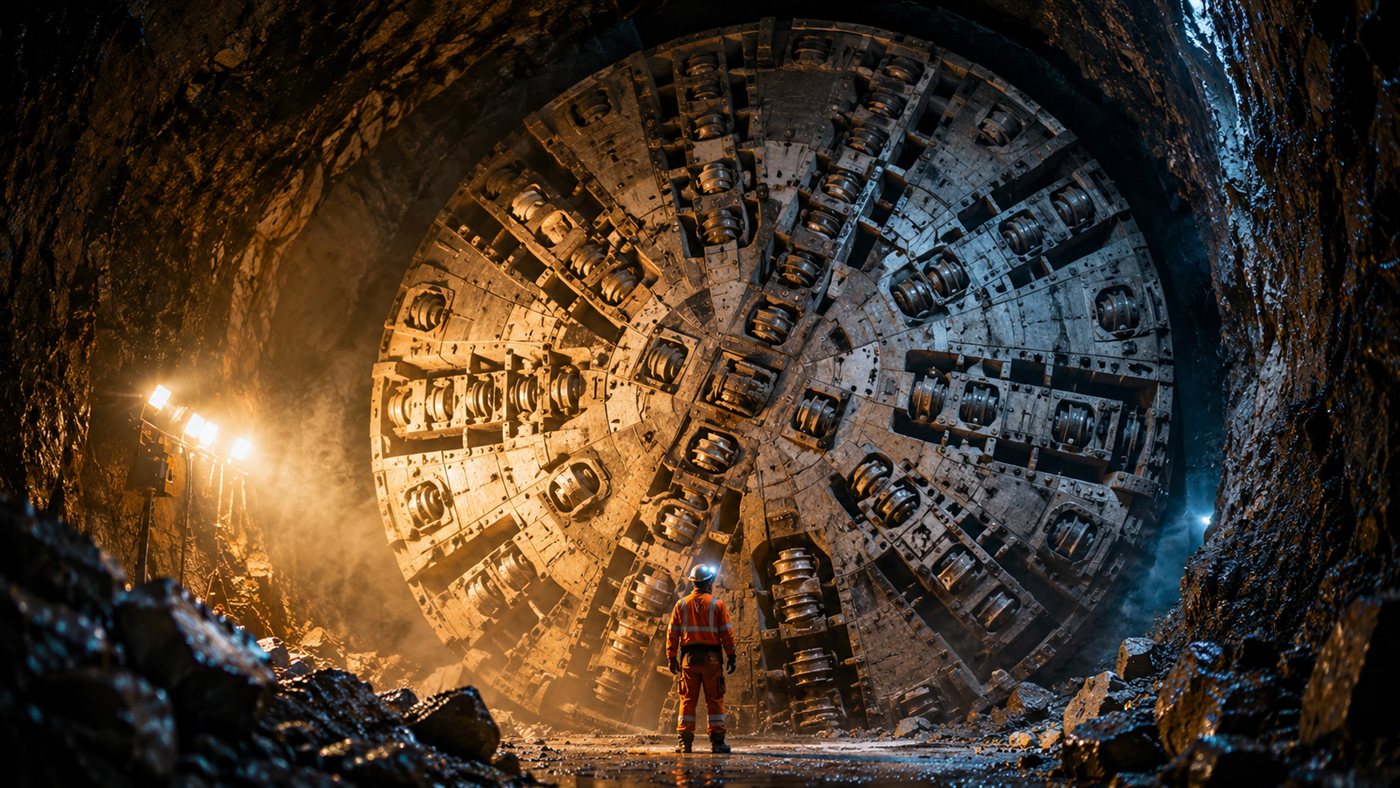
According to information released about the project, the machine is expected to excavate approximately 7 kilometers in the line’s extension.
Its arrival at the port occurred on March 6.
After disembarking, the tunnel boring machine went through customs clearance stages and a special logistical operation before being transported to the Penha Station construction site, where assembly is necessary before excavation begins.
How a São Paulo Metro Tunnel Boring Machine Works
Popularly known as a “mole,” the tunnel boring machine is a machine used to open underground tunnels in infrastructure works.
During operation, the equipment cuts through the ground, removes excavated material, and allows for the installation of the structures that line the tunnel.
The nickname refers to its ability to advance underground.
In urban works, however, the process depends on geological studies, constant measurements, and technical control of the excavation face, especially in areas with buildings, underground networks, and high pedestrian traffic on the surface.
At the front of the machine is the cutting wheel, responsible for fragmenting soil or rock.
The removed material travels through internal systems to the tunnel exit, while other mechanisms help maintain the stability of the excavated area.
The tunnel boring machine that arrived in Brazil is of the dual mode type, a technology that allows operation in more than one ground condition.
In EPB mode, an acronym for Earth Pressure Balance, the machine works in more unstable soils, with pressure control at the excavation face.
In rocky sections, it can operate in open mode, according to the characteristics of the rock mass.
According to project data, average production can reach 15 meters per day in soil and approximately 10 meters per day in rock.
Performance depends on factors such as geology, internal logistics of the work, equipment maintenance, and conditions encountered during advancement.

Port of São Sebastião received special cargo operation
The Port of São Sebastião was the entry point for the tunnel boring machine into the country.
Due to the weight and dimensions of the parts, the unloading of equipment of this size requires specific planning, adequate lifting and transport equipment, as well as coordination between port teams, logistics operators, and those responsible for the work.
The machine arrived disassembled, as is common in international transport operations for large tunnel boring machines.
Each module needs to be removed from the ship, stored, cleared by the competent authorities, and transported in stages to the construction site.
Only after this process does assembly begin for the future underground operation.
The president of the port authority, Ernesto Sampaio, stated that the movement demonstrated the capacity of the Port of São Sebastião to receive special cargo.
“Receiving equipment of this magnitude demonstrates the operational capacity of the Port of São Sebastião for complex and heavy movements. It is an operation that requires planning and adequate infrastructure and reinforces the strategic role of the port in important projects for the mobility and development of the State of São Paulo,” he said.
Before starting the excavation, therefore, the tunnel boring machine undergoes a logistical stage that is also part of the project.
The displacement involves maritime transport, port operation, document release, land movement, and site preparation.
Line 2-Green will have a section to Guarulhos
The tunnel boring machine will be used in the section between Penha and Dutra, passing through the future stations Penha de França, Gabriela Mistral, Fernão Dias, and Ponte Grande.
The final destination of this segment is the Dutra Station region, designed for Guarulhos.
The extension of Line 2-Green is part of the São Paulo Metro’s expansion plan for the east zone and the metropolitan region.
Currently, Guarulhos is served by CPTM lines, but does not yet have a Metro station in operation.
Dutra Station is planned as the city’s first subway station.
In March 2026, the state government announced the authorization for the construction of the station in Guarulhos, with an expected completion in 2032, as part of the Line 2-Green extension.
The expansion schedule is not uniform for all sections.
The implementation between Vila Prudente and Penha has its own stages, while the segment between Penha and Dutra follows a different schedule.
Therefore, the project should be treated in phases, and not as a single section with the same delivery date.
Cora Coralina and the new tunnel boring machine for Line 2-Green
The new machine joins the Cora Coralina tunnel boring machine, used in another front of the Line 2-Green expansion.
According to previously released information about the project, Cora Coralina was assigned to the section between Vila Prudente and Penha, while the newly arrived equipment will be used in the extension towards Guarulhos.
Division by work fronts is common in large-scale underground projects.
Instead of relying on a single excavation point, the project can advance in sections, according to the preparation of the sites, the release of areas, and the arrival of equipment.
In the case of Line 2-Green, this organization also reflects the different phases of the extension.
The section already under construction in the east zone connects to the stage that will continue to the future Dutra Station, a point planned to integrate the subway system with the municipality of Guarulhos.
Underground engineering combines soil, pressure, and precision
The operation of a tunnel boring machine involves information on geology, mechanics, automation, and civil engineering.
Before advancement, technical teams analyze the type of soil, the presence of water, rock resistance, underground interferences, and the conditions of constructions near the alignment.
This data guides the pressure applied at the front of the machine, the excavation speed, and the tunnel lining method.
In urban areas, this control is necessary to reduce risks associated with settlements, vibrations, and changes in the terrain.
EPB mode allows excavation to be done with controlled pressure in more sensitive soils.
When the section presents rock with suitable characteristics, open mode can be used, always in accordance with the technical evaluations made during the work.
Although the equipment receives a popular nickname, its operation depends on constant monitoring.
Sensors, internal controls, and specialized teams monitor the machine’s progress, while the excavated material is removed and the tunnel receives the structures that will allow future train passage.


Metro expansion involves technology and logistics
The arrival of the 2,600-ton tunnel boring machine expands the scale of equipment used in the expansion of Linha 2-Verde.
The size of the machine is directly linked to the tunnel’s diameter, the section to be excavated, and the conditions foreseen in the route between Penha and Guarulhos.
Beyond subterranean engineering, the project shows the relationship between mobility works and large-scale logistical operations.
The machine’s journey began outside the country, involved maritime transport, had a port stage on the São Paulo coast, and will proceed to assembly in the capital.
When in operation, the TBM will open part of the tunnels planned for the arrival of Linha 2-Verde in Guarulhos.
Until then, the machine remains one of the main pieces of equipment for the project and an example of how subway expansion depends on processes that occur even before excavation begins.