Portuguese
 Spanish


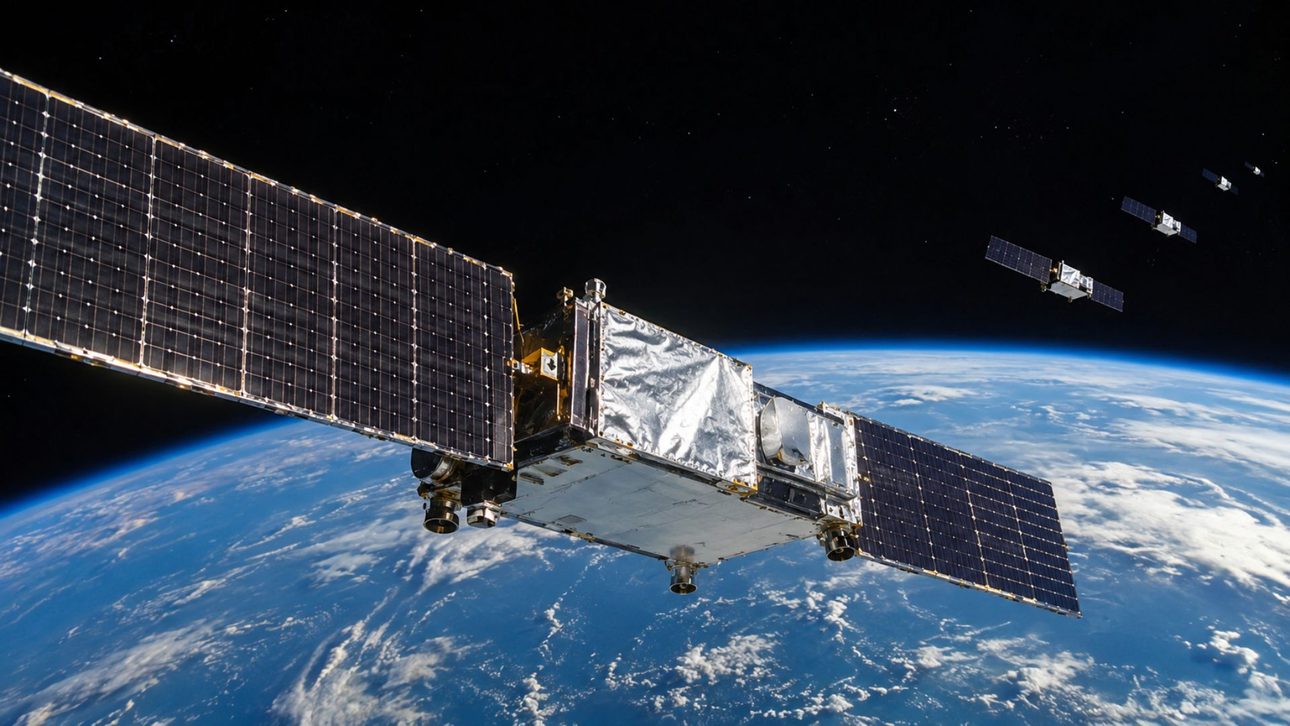

The U.S. communications regulator has set milestones for deploying the Starmind data-processing constellation, designed to process data and run artificial intelligence applications in space, while questions about equipment disposal remain under review.
The U.S. Federal Communications Commission (FCC), the agency setting the initial authorization terms, granted SpaceX conditional partial radio-frequency authorization on Wednesday (25) for its project to install data-processing centers in Earth orbit.
The decision allows the company to use backup and emergency communications channels to monitor and control the equipment, which is expected to form a constellation of up to 1 million satellites.
-
To measure graphene properties and analyze gases used in industry, Brazil’s Inmetro opens seven-laboratory complex in Xerém with 1,240 square meters of indoor space

-
Smartphone doubles as a two-way radio with a push-to-talk button, set for Brasília testing
-
From 44-kWh modules to 440-kWh packs, BorgWarner plans battery assembly in Piracicaba with projected capacity of 5,000 units a year
-
Astronomer Julien Wolf and his team used Euclid to find a quasar seen just 630 million years after the Big Bang, powered by a black hole of about 360 million Suns that puts pressure on models of how the first giants grew




Called Starmind, the project calls for deploying the equipment in orbital bands between 500 and 1,002 kilometers in altitude, creating a data-processing constellation linked by optical communications systems.
The FCC’s initial authorization order, DA 26-1273, requires at least one satellite to be in its designated orbit and operational by November 25, 2033. This regulatory deadline is separate from the company’s projected launch schedule.
According to Space.com, a publication specializing in space, the company plans to launch the first Starmind satellites in the third quarter of 2027 using the Starship rocket.
SpaceX has until 2040 to complete the constellation
Under the initial deployment terms set by the FCC, the U.S. communications regulator, SpaceX must have 10% of the maximum authorized number of satellites in operation by November 2035, or 100,000 satellites, and reach 50% of that total by November 2038.
The final milestone sets November 2040 as the deadline to complete the authorized constellation, requiring another 500,000 satellites to enter service between the last two regulatory milestones.
The initial authorization will expire if the company fails to meet the deployment and operational requirements for each milestone.
The license will remain in effect for 15 years, starting on the date SpaceX certifies to the FCC, the agency that issued the initial authorization, that the first satellite is operational in its designated orbit and meets the authorization’s requirements.
How space-based data-processing centers will work
Unlike conventional telecommunications satellites, which are used mainly to transmit information between different points on Earth, the Starmind satellites are designed to perform computing tasks in orbit.
In a terrestrial data center, servers perform tasks that can include storing information, training artificial intelligence models and processing user requests.
SpaceX’s proposal involves moving computing capacity to orbital platforms, which need their own power, thermal-control and communications systems.
One technical challenge for operating this equipment is dissipating heat generated by electronic components. In the vacuum of space, air cannot circulate as it does in terrestrial facilities.
For information transmission, Starmind satellites will rely primarily on optical connections, a technology that uses beams of light to establish communications between devices.
Authorization covers emergency communications
The radio frequencies authorized by the FCC, the U.S. communications regulator, are in the Ka band and cover ranges from 18.8 to 19.3 gigahertz for space-to-Earth transmissions and from 28.6 to 29.1 gigahertz in the opposite direction.
These frequency ranges will be used for operations known by the acronym TT&C, which stands for telemetry, tracking, and command systems.
Telemetry makes it possible to monitor information about how equipment is functioning, such as temperature, power availability, and the condition of electronic components, while tracking provides the data needed to determine its location and trajectory.
Command systems enable instructions to be sent to satellites to modify operating parameters or correct problems identified during the mission.
The radio frequencies will serve as a backup in the event of a failure in optical connections, provided that SpaceX does not cause harmful interference to other operators using those frequency ranges.
If it receives a documented report of harmful interference, the company must halt the operations responsible for the problem until it is resolved.
Satellite disposal remains under FCC review
FCC regulations require satellites that end their missions below an altitude of 2,000 kilometers to be removed from orbit through atmospheric reentry within five years after operations end.
SpaceX requested flexibility to use alternative disposal methods for equipment located above an altitude of 600 kilometers, including Earth orbits designated for disposal and heliocentric trajectories, in which objects would orbit the Sun.
The agency found the information submitted insufficient to assess these alternatives and deferred its decision on the request.
While it found the space-debris mitigation plan adequate for equipment operating below 600 kilometers, the FCC set additional requirements for deploying satellites at higher altitudes.
Before deploying this equipment, the company must submit a request to modify its authorization, accompanied by its final space-debris mitigation plan.
Starmind could have 91 times as many satellites as Starlink
According to Space.com, the Starlink constellation has about 11,000 satellites, while the total number of objects sent into space by humanity since 1957 is around 28,000.
Given the scale of the Starlink network, Starmind, if fully deployed, would have about 91 times as many satellites as SpaceX’s current orbital internet infrastructure.
During the regulatory process, requests to deny the proposal were filed by Amazon Leo, satellite operator Viasat, and the American Astronomical Society. SpaceX submitted a joint response to the requests.
The requirements imposed on the company include submitting semiannual reports to the FCC with information on close approaches between objects in orbit, maneuvers performed, equipment taken out of service, atmospheric reentries, and use of the authorized emergency frequencies.