






 Portuguese
  Spanish


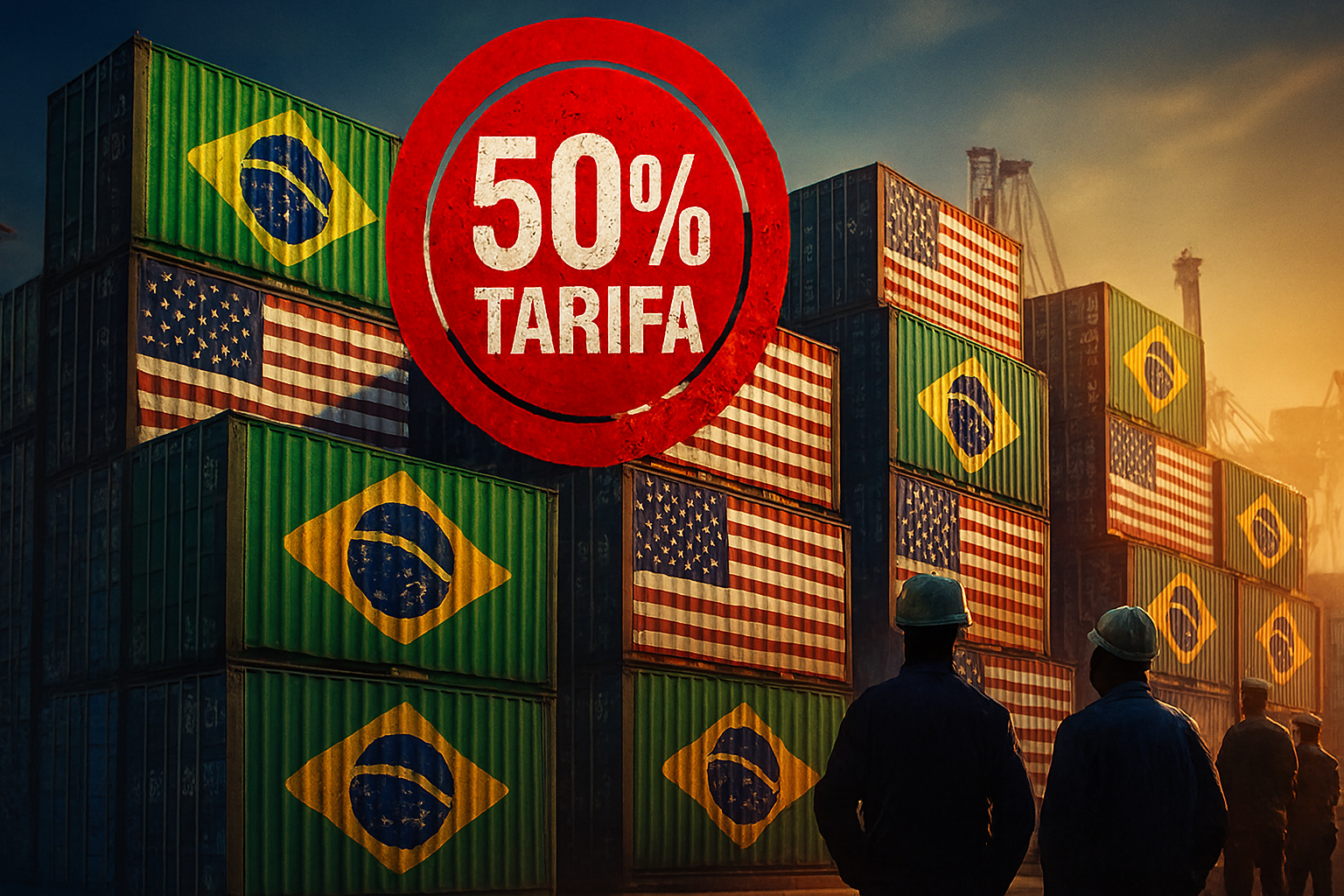


50% Tariff From the U.S. Threatens Brazilian Industry: CNI Forecasts 100,000 Jobs Lost and a 0.2 Percentage Point Drop in GDP, Triggering Alarm in Government.
The U.S. government’s decision to impose a 50% tariff on Brazilian products has raised a red flag in the national economy. The measure is not just a bureaucratic obstacle: it strikes at the heart of the Brazilian industry, reduces competitiveness, and threatens the survival of entire sectors that depend on exports to the United States.
According to the National Confederation of Industry (CNI), the immediate impact could be devastating. The agency estimates that up to 100,000 jobs may be eliminated if the barriers remain in place, in addition to causing a 0.2 percentage point drop in GDP. This tariff shock, described by experts as one of the most severe in decades, puts Brazil in a delicate position in international trade.
CNI Warns of the Risk of 100,000 Jobs Lost and GDP Decline
The numbers presented by the CNI show that the tariff has a cascading effect. Each US$ 1 billion exported to the U.S. represents more than 24,000 jobs in Brazil, in addition to half a billion reais in wages and billions in industrial production.
-
Brazil to Introduce B16 Diesel with Increased Soybean Oil Content for Trucks by 2026
-
Brazil’s July Bolsa Família Payments May Include Extra $150 and $50 for Families with Children, Pregnant Women, and Updated CadÚnico Registration

-
Brazilian Woman Buys €1 House in Sicily, Clears 50 Truckloads of Debris, and Transforms Ancient Ruin into Inspiring Life Project by 2026

-
Havan Competitor Expands in Brazil with 170 Stores, Offering Everything from Stationery to Asian Food and Focusing on Affordable Products to Attract Shoppers



By halting this flow, the tariff threatens not only large exporters but also thousands of suppliers and workers spread across the country.
For the organization, the effect will be direct on sectors such as steel, meat, coffee, orange juice, aviation, and auto parts, which are at risk of losing ground in a strategic market.
The estimate of 100,000 layoffs shows that this is not just a problem restricted to statistics: it is a concrete threat to the jobs and income of thousands of families.
Reciprocity Law Authorizes Brazil to Retaliate Against Tariffs and Restrict Patents
The Brazilian government, pressured by the productive sector, decided to invoke the Economic Reciprocity Law, recently approved. This legislation allows the country to retaliate against foreign tariffs with equivalent measures, but goes further: it paves the way to restrict patents, investments, and concessions of American companies in the national territory.


Behind the scenes, the Itamaraty and Camex are studying proportional responses. President Luiz Inácio Lula da Silva has already stated that “Brazil does not humiliate itself,” making it clear that diplomacy will seek a solution but will not rule out tough reprisals.
At the same time, Finance Minister Fernando Haddad stated that the country could resort to American courts and even take the dispute to the World Trade Organization (WTO).
Brazilian Companies Seek Alternatives in Mexico, India, and China
While the government and diplomacy set the strategy, Brazilian companies are already starting to adapt. Some are studying transferring part of their production to Mexico and India, countries that have more favorable trade agreements with the U.S.
Others are looking to intensify exports to markets like China, Europe, and the Middle East, diversifying clients and reducing dependency on the North American market.
This movement shows that the 50% tariff does not only affect the present but forces the industry to redesign its future. In the short term, the effects are of uncertainty and contraction. In the medium term, they may mean structural changes in the destination of Brazilian exports.
Social Impact of the Tariff Concerns Industrial Cities and Workers
If at the top the discussion involves GDP and exports, at the base the problem translates into unemployment and loss of income. Entire cities that depend on industrial production or agribusiness directed to the U.S. are already contemplating mass cuts.
The CNI’s warning, which speaks of 100,000 jobs lost, represents thousands of families without income and a cascading effect on commerce, transportation, and local services.
This social impact worries the government, which sees the tariff as a threat not only economic but also political. Employment crises tend to leave deep scars and can last for years before being reversed, even if the trade dispute finds a diplomatic solution.
The 50% tariff imposed by the United States is not just another chapter in the global trade dispute. It is a test of resilience for Brazil. The country needs to find a balance between firmness and caution: retaliate when necessary, negotiate when possible, and, above all, protect its industry and its workers.
The CNI’s warning reinforces that the dispute is not abstract. It already threatens jobs, income, and growth. The outcome of this crisis could define not only the GDP performance in 2025 but also the place Brazil will occupy on the global economic chessboard in the coming years.


