






 Portuguese
  Spanish


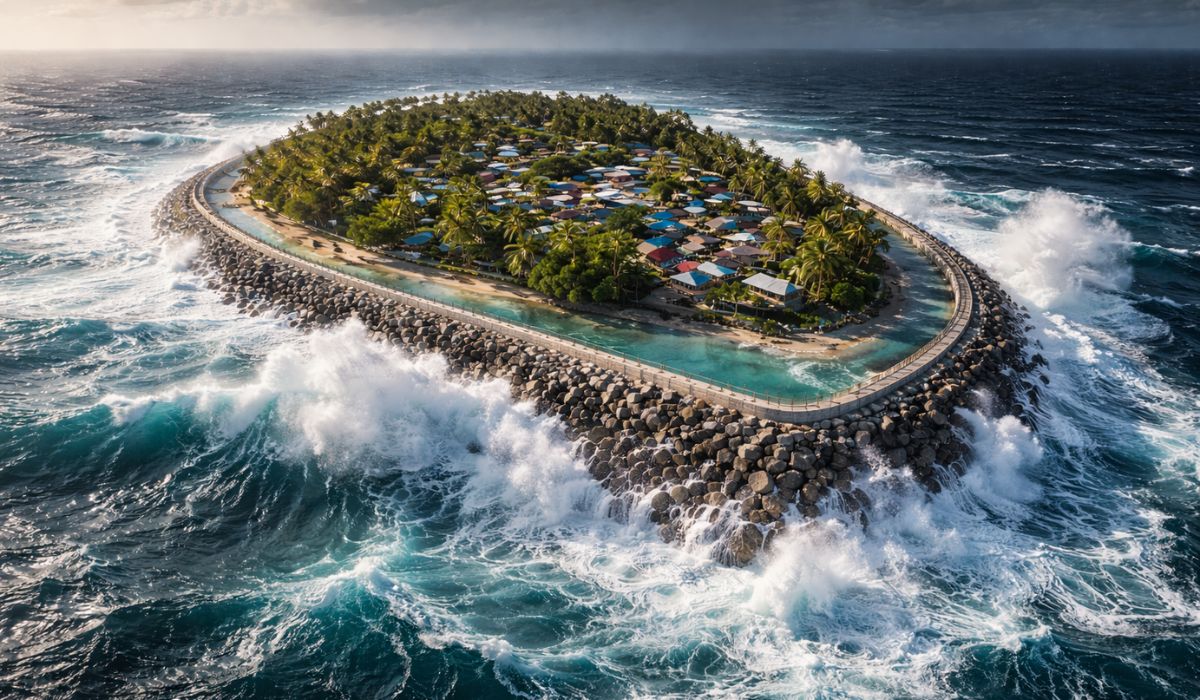


Between walls, erosion, and climate adaptation, Pacific islands test the limits of engineering to contain sea level rise and protect inhabited areas, in a scenario that mobilizes communities, governments, and experts.
In several Pacific islands, sea level rise has ceased to be merely a climate projection and has begun to guide construction, public policies, and local decisions.
In Samoa, the Marshall Islands, and Tuvalu, coastal communities have turned to walls, riprap, and reclaimed land to try to reduce erosion and contain flooding caused by tides, storm surges, and storms.
In Nanumea, an atoll in Tuvalu, the proposal discussed by residents goes beyond protecting isolated sections of the coast: the plan calls for a barrier around the entire island.
-
At 54, Brazilian Artisan Turns Textile Waste into a Successful Handbag Brand, Earning Over $6,000 Monthly

-
Brazilian Entrepreneur Sells $50,000 Monthly in Sustainable Luggage Made from Recycled Bottles, Eyes International Market
-
Chinese Man Transforms Home into 10-Story Pyramid Over 8 Years, Defying Authorities Before Demolition

-
Faced with College Costs, Brazilian Student Lived in a Minivan for Nearly Two Years to Graduate Debt-Free

The initiative exposes one of the main impasses of climate adaptation in small island states.
On one hand, coastal works provide immediate protection for homes, roads, and essential structures.
On the other hand, researchers and international organizations point out that this type of intervention requires constant maintenance, demands high investment, and does not stop the trend of rising sea levels, which is expected to continue for the long term.
How sea level rise changed the routine in Pacific islands
In the village of Lauli’i, in Samoa, the pressure from the sea had already become part of the routine before the most recent construction.
The water began to invade homes and surpassed an old coastal structure built in the sea.
The damage affected residences and also the graves of families in the community.
In May 2025, the completion of a new wall funded by the New Zealand government was received by residents as a protective measure against storm surges.
The case of Lauli’i helps explain why this type of construction has multiplied in parts of the Pacific.
In low-lying islands, small variations in sea level already expand the reach of waves, accelerate erosion, and favor the intrusion of saltwater into occupied areas.
When homes, roads, churches, and cemeteries are close to the coastline, any loss of land has a direct impact on daily life.
In this context, the construction of barriers often emerges as an immediate response.
Coastal engineering and climate adaptation experts, however, note that the behavior of the coastline does not depend solely on the presence of a wall.
Rigid structures can alter wave dynamics, intensify erosion in neighboring areas, scour the seabed in front of the structure, and shift the problem to other points along the coast.
The limits of coastal walls against sea level rise
Researchers also report maintenance difficulties, especially in rural and remote locations.
In smaller islands, where equipment, materials, and technical resources are scarcer, many structures end up deteriorating rapidly.
A study published in 2021 described sections of the rural Pacific coastline as areas marked by remnants of coastal walls that did not withstand the sea.
In previous work, researcher Patrick Nunn pointed out that, on average, these structures can collapse in a relatively short time when they do not receive maintenance compatible with their function.
The discussion, therefore, is not limited to the technical feasibility of erecting a wall, but to the capacity to sustain it over time.
Countries like the Netherlands use dikes, dams, and hydraulic systems as a central part of land occupation.
In the Pacific islands, however, the context is different.
There is less land available, lower fiscal capacity, and high logistical costs to transport machinery, stones, and concrete to isolated areas.
In Ebeye, one of the most populated areas of the Marshall Islands, this challenge appears concretely.
The ongoing project calls for the use of about 65,000 tons of rock transported from the United Arab Emirates.
The work, supported by the World Bank and the Green Climate Fund, was planned to reduce erosion and flooding on an island where homes and urban infrastructure are very close to the ocean.
The case shows that coastal engineering can be applied in low-lying islands, but also highlights the material and financial cost of these interventions.
In addition to execution, these structures require continuous monitoring and repairs, especially in regions prone to storms and intense tidal variations.
For this reason, researchers in the field often treat coastal walls as a localized protective measure, rather than a definitive solution to sea level rise.
Why land remains at the center of climate adaptation
Still, the insistence on this type of construction does not stem solely from technical calculation.
Research on adaptation in small islands shows that land plays a central role in social organization, collective memory, and ways of life.
In many communities, the decision to try to protect first the place where families have always lived precedes any debate about moving to other areas.
This aspect frequently appears in studies on planned displacement in the Pacific.
According to researchers in the field, before considering relocation, many villages attempt to exhaust alternatives for physical protection of the territory.
The construction of a wall, in this scenario, is seen by some residents as a way to buy time and postpone the need to abandon areas of historical, cultural, and familial value.
The Nanumea proposal to enclose the whole island
It is at this point that the case of Nanumea draws attention.
In Tuvalu, a country made up of low-lying islands and atolls, recent works have already reinforced sections of the coast and expanded protected areas.
The coastal adaptation project included the creation of about seven hectares of reclaimed land in Funafuti, the capital of the country, in addition to interventions in Nanumea with interconnected concrete blocks and reinforcement of coastal structures.
Even with these works, a group of residents argues that protection in isolated segments is not enough.
The proposal known as Nanumea Salvation Seawall Project calls for a continuous barrier around the entire island.
According to the proponents of the idea, a structure of this type could reduce the impact of strong waves and extreme events at different points along the coast.
So far, however, the project still depends on funding for feasibility studies.
This detail is central.
Enclosing an entire island does not simply mean expanding an existing wall.
An intervention of this scale would require analysis of currents, sediment transport, drainage, water circulation between ocean and lagoon, and effects on the coastal dynamics itself.
Experts note that, in such situations, the work needs to be treated as a permanent engineering system, with ongoing technical and financial requirements.
Nature-based solutions and other options under discussion
At the same time, other strategies continue to be discussed in the region.
Researchers mention the restoration of coastal ecosystems, the use of mangroves, less vertical rocky slopes, and vegetation as part of approaches that try to reduce wave force without relying solely on rigid structures.
These solutions, however, also vary according to the type of island, population density, and existing infrastructure.
In more densely populated urban areas, where airports, hospitals, schools, and administrative offices are concentrated, coastal defense is often treated by governments and technicians as a priority.
In volcanic islands with higher terrain, or in locations where there is the possibility of internal displacement, researchers point out that gradual movement to higher areas may be considered as a longer-term alternative.
In the Pacific, climate adaptation does not follow a single model.
In some cases, the response involves large-scale works.
In others, it involves nature-based solutions, land use reorganization, or relocation planning.
Sea level rise, however, poses the same question to island communities: what should be protected first when available territory is limited and coastal pressure continues to increase?





Nanumea was devastated by Tropical Cyclones Pam in 2015 and Tino in 2020, causing significant damage. A large church built in the 30s was threatened. The UNDP and government of Tuvalu spent $38 million building a 6 meter high concrete barrier to protect it, as well as artificially raising the dunes with large sand bags.
Coastal processes are extremely complex. Building sea walls and barriers in one place can cause erosion in others, exacerbating the problem elsewhere. The solution may appear to be to concrete the entire island. However, the reverse is true.
Imagine coral sand like a herd of sheep being rounded up by sheep dogs. Waves constantly push sand in towards the middle of the reef until it builds into an island. Trees and vegetation bind this sand together to form a picturesque coral island like Nanumea.
The sands can shift. For example during El Nino, sea levels are generally higher and trade winds weaker, changing the wind and waves and causing the sand to move. Occasionally trees are washed away and the sand dumped elsewhere.
As the El Nino weakens and reverts to neutral or La Nina, the sand returns.
So like a herd of sheep, it moves around.
As sea levels rise, the waves are pushed in further, depositing the sand higher up. Hence the island keeps up with sea level rising (albeit that the island is now a little bit smaller). This process has happened for hundreds and thousands of years- a perfect balance between ocean and atoll.
If the surrounding reefs are healthy enough, then sufficient new sand is created from the growing coral breaking off, or being eaten and ejected by parrot fish, and washing up on the beach. This supply of additional sand may even be sufficient to prevent the islands from shrinking due to ongoing sea levels rising. Nature’s perfect balance is maintained.
Once sea walls are built, this free flow of sand is stopped. Sand no longer piles onto beaches during storms, and is no longer bound together by vegetation. It may form new offshore islands, or be washed off the reef to be lost forever.
The island is not topped up with new sand to keep up with sea level rising. As water tables continue to rise, the ground becomes water logged and vegetation starts to die.
Waves bounce off the seawalls causing more erosion. Reef water is no longer filtered by the beach sand, so the water in the lagoon goes turbid. Water temperatures increase due to reduction of shade and creation of hard heat absorbing surfaces.
To put it bluntly, the coral atoll will die.
Nanumea is the most remote island of Tuvalu, which itself is the least visited country in the world. Nanumea is therefore literally the most remote island on earth.
It has a population of just 610 and a density of 160 per square kilometre- about the same as Wales. There is no lack of land in Nanumea.
Its total GDP of $3million per annum is about the same as a small farm. There is no expensive infrastructure or farmland that needs to be protected.
Obesity and diabetes in Tuvalu is already the highest in the world due to low activity and the replacement of traditional food (fish, breadfruit etc) with ultra processed foods. Once the sea is cut off from the villages, less local harvesting will occur, further increasing the reliance on imported processed food. This will further reduce resilience and self reliance in the event of an emergency.
Building a sea wall around the perimeter of Nanumea will not make it more resilient to climate change. The reverse is true.
The only solution is adaptation.
Move the church back (it was always built too close to the beach).
Stop building new infrastructure near the beach. This will only create problems the next time a large storm comes. Climate change can’t be held responsible for their destruction when infrastructure keeps getting built in the wrong place. This is not a new problem.
Learn lessons from the past. Use Tropical Cyclones Pam and Tino as a guide to how far inland these storm surges can go. Expect and plan for worse. Build your most treasured infrastructure to be resilient to these storm surges. Large walls won’t be required so far inland- small stilts will do.
The problem of aquifers getting contaminated by storm surges has existed since humans inhabited these islands. This is not a new problem. Collect rain water in tanks for emergency supplies.
Enhance the lagoon by removing sea walls, rubbish and other contaminants to improve the quality of water and promote coral growth. Protect parrot fish that eat the coral and turn it into new sand. This will ensure the beaches are constantly replenished with fresh sand.
Enhance coastal vegetation to entrap more sand washed in by waves and blown in by the wind. This will maintain a buffer for the next time a large storm threatens, just like it has for thousands of years.
Building a sea wall around the perimeter of Nanumea would be an environmental, social and economic disaster. It will ruin everything.
The best engineering solution is nature itself. It has ensured the perfect balance between ocean and atoll on thousands of coral atolls all over the world, for hundreds and thousands of years. Its performance is unmatched.
Think of sponges