






 Portuguese
  Spanish
  5 min of reading
  0 comments


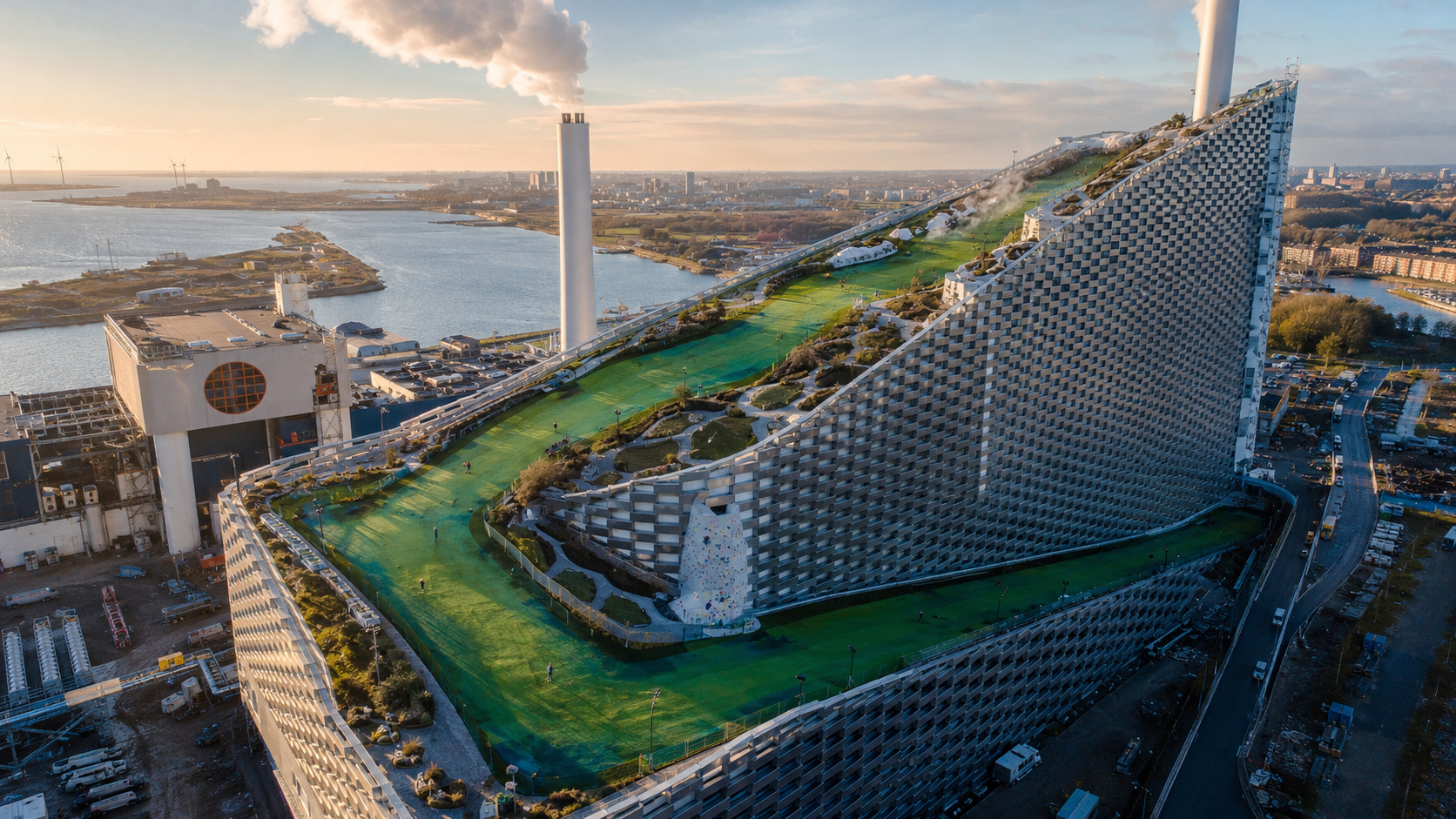
CopenHill in Copenhagen shows how a waste plant can move from a hidden place to become industrial architecture open to the public and combine energy recovery, urban leisure, rooftop ski slope, trail, and climbing wall in the same building of about 41 thousand m².
The building that looks like an urban mountain in Denmark is a real plant. CopenHill processes 440 thousand tons of waste per year and, at the same time, welcomes people on a ski slope installed on the roof.
The construction is located in Copenhagen and draws attention because it changes the common image of a plant. Instead of being a closed and distant structure, it has become a public space with a trail, leisure, and a climbing wall on the facade.
The report was published by ArchDaily, an international architecture, urbanism, and design portal. The project showcases an energy recovery plant that also functions as an urban landmark, recreation center, and example of visible industrial architecture.
-
Brown scar tearing through the blue of the ocean seen from space stretches over 8,000 km in the Atlantic, reaches the route of Northern Brazil, and raises an alert about sargassum on the beaches.

-
The woman who heard a silent alert in the villages of Kenya and transformed the lack of firewood, water, and food into a movement that began with simple seedlings and grew to over 51 million trees planted.

-
Brazil launches the new national identity in Paraguay, where more than 250,000 Brazilians live, and the document eliminates the need for a passport in 8 South American countries and provides access to 5,000 digital government services.
-
17-year-old balances manual labor on the farm, up to 10 hours of study per day, and gets into Medicine at UFT through Sisu.





How CopenHill transforms a waste plant into an urban mountain
CopenHill was born with an unusual idea: to transform the very shape of the plant into an artificial urban mountain. The building’s volume was not disguised. It became part of the experience.


Inside, the building maintains the heavy function of a plant. Outside and on top, the construction hosts uses that normally appear in parks, sports centers, or leisure areas.
This combination explains why the project draws so much attention. The waste plant in Copenhagen does not try to disappear from the city. It stands out, occupies the landscape, and invites the public to use the building.
The hybrid word helps to understand the case. CopenHill mixes different functions in the same place: industry, energy, architecture, and urban leisure.
What functions inside the building while people ski on the roof
The image of people skiing over a power plant is impressive, but the main function of the building remains active. Inside CopenHill are furnaces, turbines, and energy systems related to waste processing.
The scale of the construction also helps to understand the impact. It is about 41,000 m² in a building designed to accommodate technical activities and, at the same time, create an inclined surface on the top.
This design allows the roof to be more than just a cover. It becomes part of the city, with a ski slope, trail, and leisure areas.
For those unfamiliar with the term, energy recovery means utilizing waste in processes that generate energy. In the case of CopenHill, this industrial function coexists with public use in the same building.
Why a ski slope was placed on the roof of a power plant
The roof of CopenHill was transformed into a ski slope on the roof because the project aimed to give a new function to an area that, in common industrial buildings, would remain unused by the public.
The inclination of the building became part of the solution. Instead of hiding the technical requirements of the plant, the architecture took advantage of the volume and created an artificial topography, that is, a form of terrain built over the building.
The result is straightforward and easy to understand. Below, the plant works with waste and energy. Above, the public uses a leisure area that resembles a mountain within the city.
This choice makes the project more than an environmental agenda. CopenHill is a case of visible urban infrastructure, where a heavy installation also becomes a public use space.
The industrial facade became a climbing wall and reinforces the contrast of the work
The facade of CopenHill also participates in the proposal. The construction maintains a strong industrial appearance but transforms this scale into something that can be used by people.
The climbing wall on the facade clearly shows this contrast. What in another building might be just a technical surface has become part of the urban experience.
ArchDaily, an international architecture, urbanism, and design portal, highlighted CopenHill as a work that combines an energy recovery plant, urban recreational center, and architectural landmark. The publication also notes the presence of trails, physical activity areas, and a ski slope on the roof.
A statement by Bjarke Ingels, founder of BIG, summarizes the proposal: “its facade is climbable, its roof is walkable, and its slopes are skiable.” The phrase shows how the work transforms a technical structure into an active part of urban life.
Why this project goes beyond urban sustainability
CopenHill often draws attention for the theme of waste and energy, but the strongest point is in how the infrastructure was treated. The plant was not hidden. It became public architecture.
This detail changes the perception of the project. A heavy industrial plant, with machinery, technical systems, and large scale, also became a place for visiting, sports, and city observation.
In Brazil, works of this type usually appear as structures removed from everyday life. CopenHill shows another path: urban infrastructure can also be designed for people’s use.
This does not mean transforming every plant into a tourist spot. The case shows that urban equipment can be designed with more presence, more public use, and more relation with the surrounding city.
What Denmark’s urban mountain teaches about industrial architecture
CopenHill teaches that industrial architecture does not need to be only functional and closed. It can fulfill its technical task and, at the same time, create a new experience for city dwellers.
The building processes 440 thousand tons of waste per year, has about 41 thousand m², and includes a ski slope, trail, and climbing wall. These elements explain why the work became known worldwide.
The strength of the project lies in the contrast. A heavy plant, usually associated with restricted areas, became an urban mountain where the public can circulate, climb, walk, and ski.
In the end, CopenHill shows that a city can handle its large infrastructure works differently. Instead of hiding everything technical, it can transform part of this system into landscape, public use, and urban identity.
If a plant can become an urban mountain in Denmark, what kind of Brazilian infrastructure could stop being just concrete and become part of people’s lives?


-

-

-

6 people reacted to this.