Portuguese
  Spanish


O’Shea Ltd. bought a huge stock of Atari 2600 and 7800 cartridges in the early 1990s and kept millions of sealed games in an old limestone mine in Missouri. The lot, cited by sources such as Wired, Game Developer, and The Pitch KC, became a curious case of forgotten surplus that gained historical value over time.
Millions of Atari cartridges remained sealed for years in an underground warehouse in the United States, forming one of the most curious forgotten stocks in video game history.
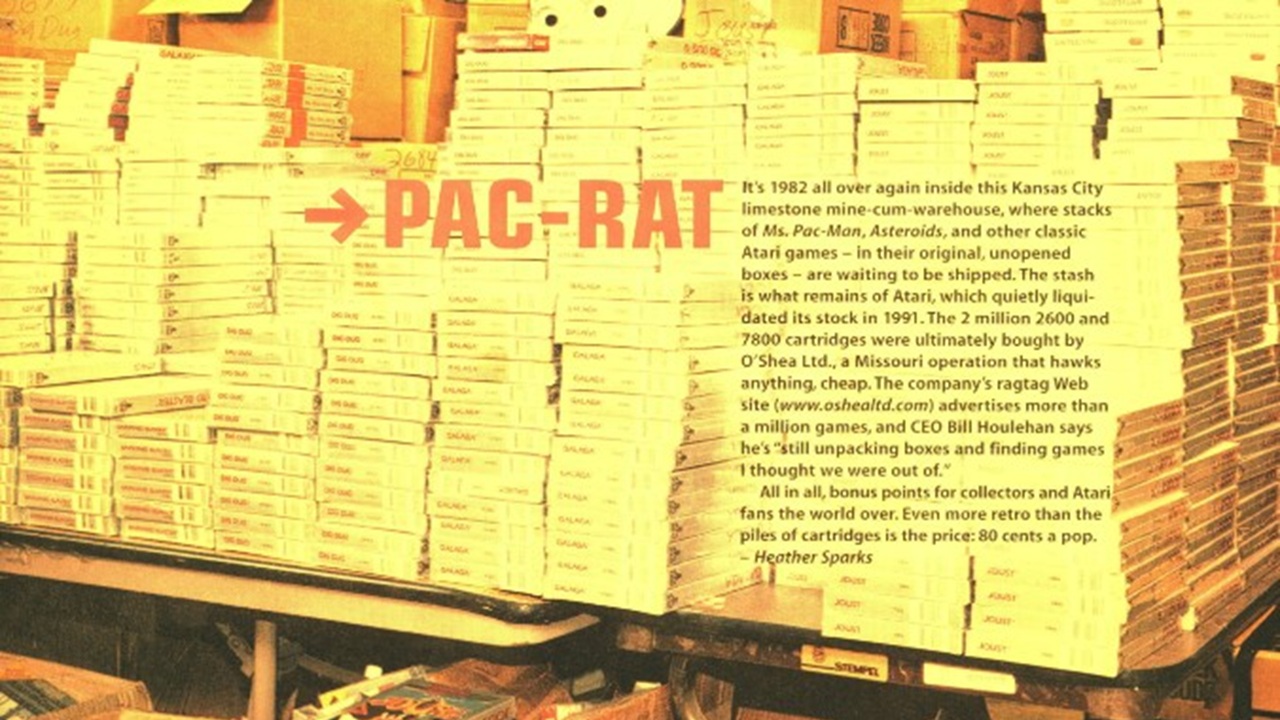
The scene seemed straight out of the 1980s: sealed boxes of games like Ms. Pac-Man, Asteroids, Joust, Galaga, and Pole Position stacked in a structure installed in an old limestone mine in Missouri.
The story involves O’Shea Ltd., a liquidation company based in Missouri, which bought a large lot of Atari 2600 and Atari 7800 cartridges after the manufacturer disposed of unsold stocks in the early 1990s.
-
Collector adapts forklift electric motor in a Kombi Corujinha pickup, hides 16 batteries under the bed, and makes the Brazilian classic run silently with up to 90 km of range.

-
Goodbye traditional vacuum: Samsung surprises and launches 2-in-1 robot with steam, AI that recognizes floors and stains, self-cleaning station, hot air drying, automatic emptying, water refill, and app control.
-
Brazil is transforming acerola waste discarded by the pulp industry into an ambitious and surprising project that could forever change the way the country utilizes one of the most invisible by-products of the fruit sector.
-
Scientists have created a colossal digital twin to predict tsunamis in real time, a simulation of 55.5 trillion unknowns run on 43,520 GPUs that reduced 50 years of calculation to 0.2 seconds and could change the defense of coastal cities.


The exact quantity varies according to the source. The magazine Wired reported in 2000 that there were 2 million cartridges bought by O’Shea Ltd. Meanwhile, , formerly Gamasutra, and the newspaper The Pitch KC cited about 3 million sealed units stored by the company.
A retro treasure kept underground
The detail that made the case even more unusual was the location chosen to store the games. Instead of a common warehouse, O’Shea kept the cartridges in an underground facility built in a repurposed limestone mine space.
According to Game Developer, the stock was about 150 feet deep, equivalent to approximately 45 meters below the surface. The area used was about 20,000 square feet, roughly 1,850 square meters.
Wired described the place as a mix of limestone mine and warehouse in Kansas City, where original and sealed boxes of classic Atari games waited to be shipped. The publication stated that the stock was a remnant of the liquidation made by Atari in 1991.
Games sold for pennies
The most surprising part of the story was not just the quantity, but also the price. In the year 2000, Wired reported that the O’Shea website advertised more than 1 million games for sale at about $0.80 each.
For collectors, it was a rare situation: old games, still sealed, sold for extremely low prices. The report also quoted Bill Houlehan, an executive at O’Shea, saying that the company was still opening boxes and finding games they thought had already run out.
Years later, O’Shea’s own website still maintained an Atari game order page, associating the company with the underground limestone mine warehouse. The page listed Atari games for $5 each, plus shipping and handling.
Stock born from the end of an era
The case helps tell a curious chapter of the gaming industry. Atari was one of the most important brands at the beginning of the popularization of home video games, especially with the Atari 2600. But over time, part of its stock ended up stuck.
When the company disposed of large quantities of unsold cartridges, O’Shea Ltd. saw a business opportunity in the surplus. According to Game Developer, the company bought the lot in the early 1990s and began selling the games over the following years.
The newspaper The Pitch KC also treated the case as a local find. The report stated that Bill Houlehan bought the inventory of about 3 million Atari games in the early 1990s and that the stock included between 40 and 50 titles.
From forgotten surplus to collector’s item
What started as a stock liquidation turned into a kind of time capsule. For years, mass-produced cartridges considered surplus were stored in an underground environment, preserved in their original packaging.
The story of O’Shea Ltd. is not the same as the buried E.T. cartridges in New Mexico, another famous episode linked to Atari. Here, the games were not discarded in a landfill, but stored and resold slowly.
The case draws attention precisely because it shows how products considered common or without commercial appeal can gain new value over time. For Atari fans, those underground lots were not just stagnant merchandise: they were sealed pieces of a remarkable phase in video game history.
Sources consulted: Wired, Game Developer/Gamasutra, AtariAge, The Pitch KC, and O’Shea Ltd. commercial page.