






 Portuguese
  Spanish


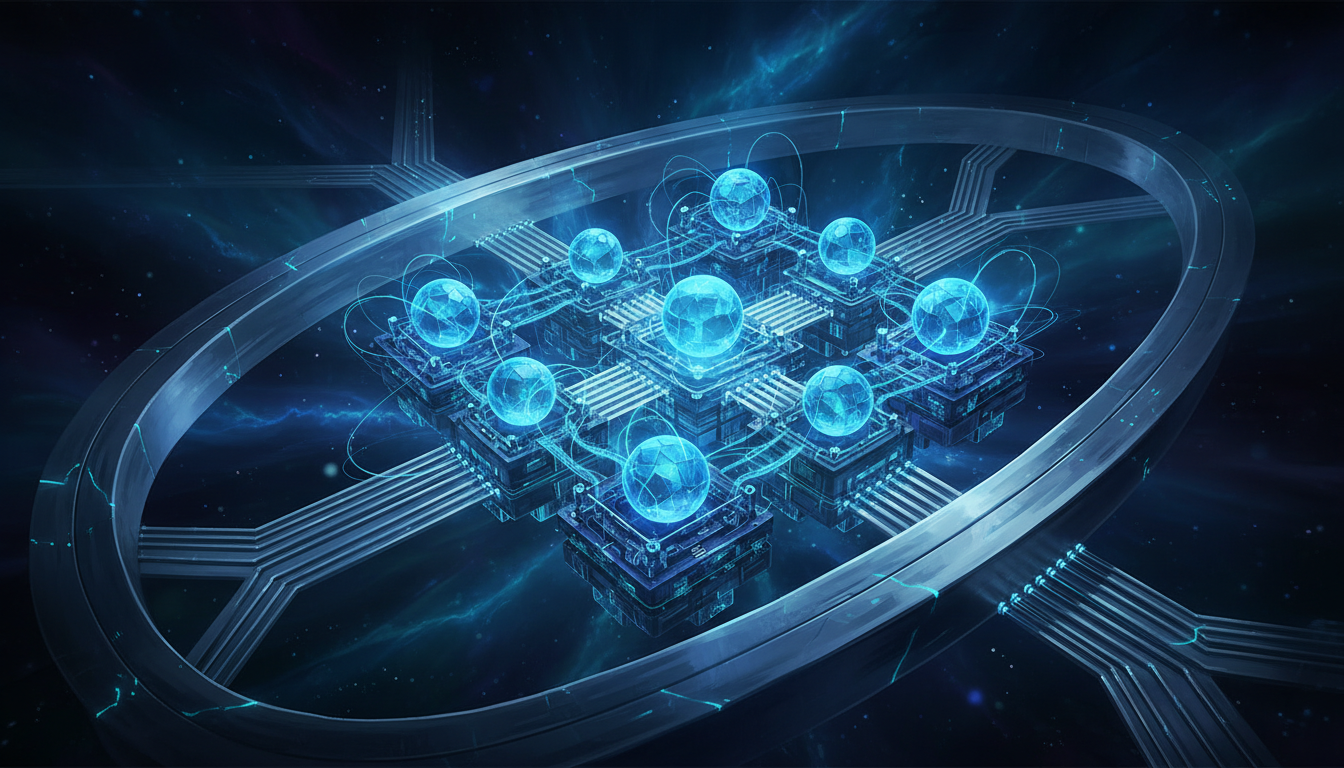

Researchers from the Australian agency CSIRO, in partnership with the University of Queensland and the Okinawa Institute of Science and Technology, have demonstrated that quantum batteries based on entangled qubits can quadruple the capacity of quantum computers. As published in January 2026 in CSIRO News, the study appeared in the journal Physical Review X.
The concept breaks a basic intuition of classical physics. According to the team, N entangled qubits are N times more powerful for charging than N qubits that do not interact with each other. In other words, the larger the system, the faster the charging gains an advantage.
This effect receives the technical name “quantum super-extensivity”. There is no parallel in the macroscopic world. Despite this, the numerical experiment published by the team shows that the rule holds true in accessible superconducting circuits.
-
China Develops Custom 140-Ton Electric Mining Truck with 770 kWh Swappable Battery, Deploys 290 Units in Xinjiang’s Largest Zinc Mine

-
Meta to Launch Arena, a New Prediction App Targeting 3.56 Billion Users, Competing with Polymarket and Kalshi

-
Scientist Challenges Famous Human Evolution Theory, Argues Homo Sapiens Evolved Gradually Over Thousands of Years
-
15-Year-Old American Builds Ocean Generator with PVC Pipe and 3D-Printed Propeller for $12, Wins National Prize, Presents at White House, and Makes Forbes 30 Under 30 List




How the Quantum Battery Powers the Quantum Computer
Traditionally, quantum computers require a dedicated control line for each qubit. This multiplies cables, heat, and cryogenics cost. The new approach replaces these individual lines with a single shared resonator.
The resonator functions like a battery. The qubits draw energy from it in a coordinated manner thanks to entanglement. As a result, it is possible to line up to four times more qubits within the same cryogenic refrigerator.

According to the specialized portal The Quantum Insider, this could redesign the architecture of quantum data centers. Today, a thousand-qubit machine requires thousands of control channels. The quantum battery reduces this number.
Why Entanglement Delivers the Time Gain
Entanglement is a correlation that links particles even at a distance. When a qubit changes state, its entangled partner responds instantly. The team specifically explored this coordination so that the battery delivers energy in parallel, rather than in sequence.
Indeed, in classical systems, the sum of the parts is just the sum of the parts. In quantum systems with proper entanglement, the whole becomes faster than the sum of the individual parts. This is the aspect that still surprises veteran physicists.
On the other hand, the effect comes at a cost. Maintaining entanglement requires temperatures close to absolute zero. According to Phys.org, any thermal disturbance reduces the advantage.
What This Could Mean for the Energy Sector
The result is still theoretical-experimental. Despite this, the CSIRO team has already signaled the next step: demonstrating the approach in a real prototype. If it works, the impact will go beyond quantum computing.
The energy sector is beginning to look at quantum sensors for monitoring platforms, pipelines, and wind farms. These sensors require compact and stable power sources. A quantum battery is exactly that.
In Brazil, the topic is emerging. Universities like UFRJ, Unicamp, and USP have research groups in quantum information. Ultimately, mastering the control of entangled qubits will be a basic requirement for anyone wanting to participate in the next generation of energy technology.






