






 Portuguese
  Spanish


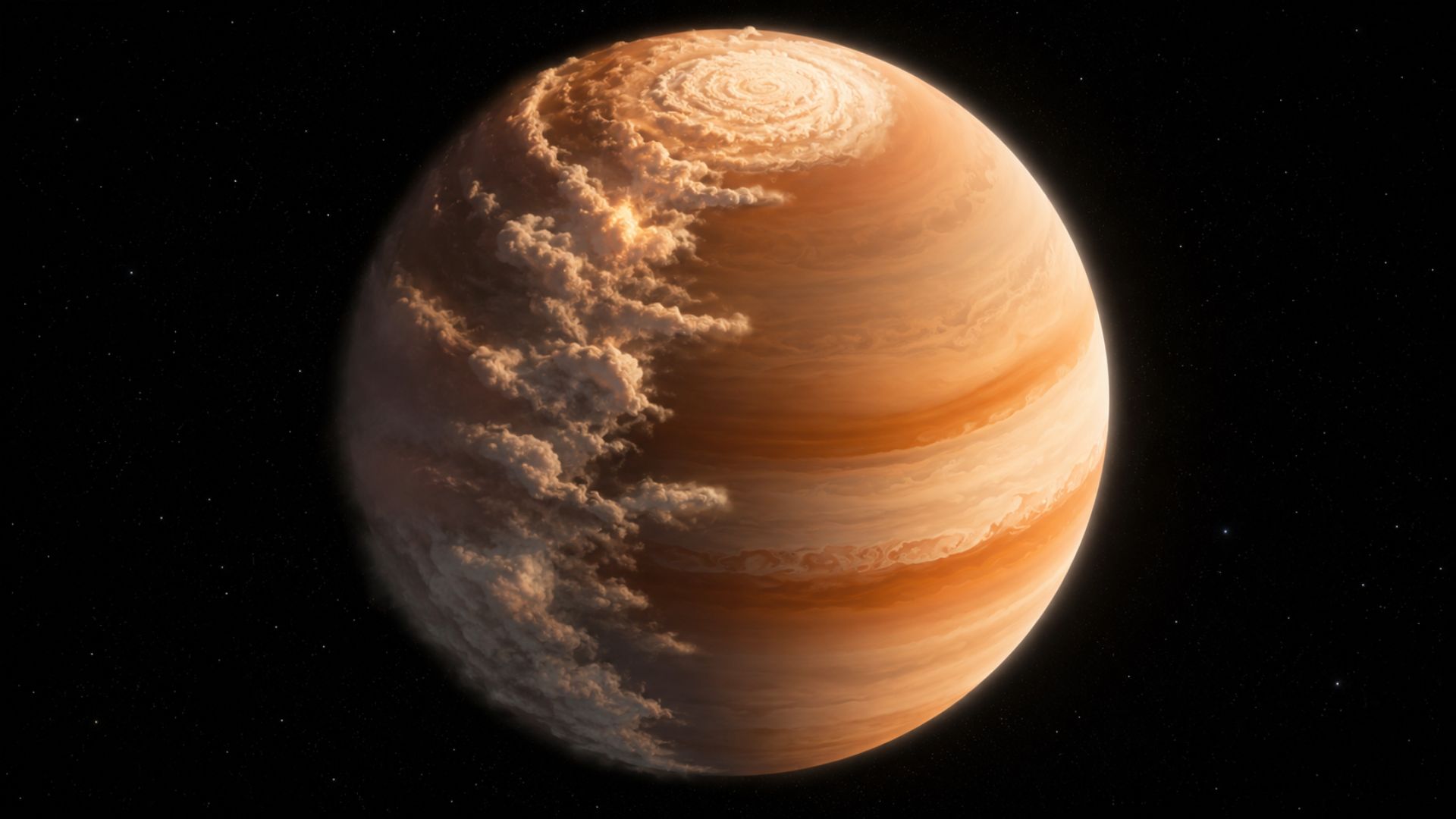


The James Webb Space Telescope identified a giant gas planet called WASP-94A b, located about 700 light-years away in the constellation Microscopium, where mornings are dominated by clouds filled with minerals and nights present clear skies. Researchers from Johns Hopkins University discovered that the temperature difference between the planet’s hemispheres reaches 170°C, creating a cycle where clouds form on the cold side, circulate until morning, and evaporate during the day.
The James Webb found a planet where the weather is both predictable and extreme. WASP-94A b, a gas giant orbiting its star in the constellation Microscopium, presents a weather pattern that researchers from Johns Hopkins University managed to map for the first time: permanently cloudy mornings, with clouds loaded with mineral aerosols, and completely clear night skies, with intense water vapor absorption. The temperature difference between the planet’s two hemispheres reaches 450 Kelvin, equivalent to approximately 170°C, and it is this variation that drives the entire cloud cycle.
The planet is about 700 light-years from Earth and is classified as an exoplanet, meaning it orbits a star different from the Sun. The James Webb observed the atmosphere of WASP-94A b during its “morning” and “night” phases, analyzing how aerosols behave in each hemisphere. The clouds form in the planet’s colder region, during the night, circulate to the morning side, and evaporate during the day when temperatures reach their peak. It is a continuous cycle that ensures the morning always has dense clouds and the night always has clear skies.
What are the sand clouds of this planet

The clouds that cover the morning hemisphere of WASP-94A b are not made of water like those on Earth. They are composed of mineral aerosols, microscopic particles of silicates and other minerals that float in the planet’s atmosphere like a dense and opaque mist. These clouds are so thick that they prevent telescopes from accurately identifying the complete chemical composition of the planet’s gaseous atmosphere.
-
Engineers Develop Fridge-Sized Machine to Produce 95-Octane Synthetic Fuel from Air and Water, Aiming to Sustain Combustion Engines Without Oil

-
Two-Armed Robot Uses AI to Reassemble Destroyed Pompeii Frescoes, Solving an “Impossible” Puzzle
-
New Law in Brazil Requires Breaks for Type 1 Diabetes Management at Work, School, and Public Exams

-
Scientists Confirm “Greening” of Antarctica: Ice on the World’s Coldest Continent Turns Green as Mosses Multiply Over Tenfold in Four Decades


In the night hemisphere, where temperatures are lower, the scenario is different. The sky remains clear, with greater absorption of water vapor and without the aerosol barrier that obscures the view. This asymmetry between the two sides of the planet is what allowed researchers to understand how the climate works: by comparing the light spectra of the two faces, the James Webb revealed that the planet’s atmospheric dynamics are governed by the 170-degree difference between the hemispheres.
How the James Webb managed to observe this planet
The James Webb Space Telescope has infrared spectroscopy instruments that allow it to analyze the light passing through the atmospheres of exoplanets when they transit in front of their stars. In the case of WASP-94A b, researchers observed the planet at different moments of its orbit, capturing separate data from the morning and night phases.
This technique, called phase-resolved transit spectroscopy, is what differentiates the James Webb’s observation from previous studies. Instead of obtaining an average spectrum of the entire atmosphere, the telescope was able to distinguish the properties of each hemisphere individually. The result was the discovery that the planet has two completely distinct atmospheric “faces,” something theoretical models predicted but had never been observed so clearly in an exoplanet.
What this planet teaches about atmospheres on other worlds
The discovery of the cloud cycle of WASP-94A b has implications that go beyond this specific planet. If mineral clouds form, circulate, and evaporate due to temperature gradients, the same mechanism may be occurring in dozens of already cataloged exoplanets that present similar conditions of temperature and atmospheric composition.
For astronomers, the main lesson is that observing only one side of a planet can give an incomplete and misleading picture of its atmosphere. The morning hemisphere of WASP-94A b appears cloudy and opaque, while the night hemisphere is transparent and rich in water vapor. If the James Webb had analyzed only one side, the conclusion about the planet’s composition would be radically different.
A planet that will never have a sunset
WASP-94A b likely has a synchronized rotation with its star, meaning that the same side of the planet is permanently facing the light, while the other remains always in the dark. The “mornings” and “nights” observed by the James Webb are not periods of rotation like on Earth, but fixed regions of the planet that receive different amounts of stellar radiation.
This configuration creates the 170°C gradient that moves the clouds from one side to the other. The daytime side heats up so much that it evaporates the minerals, while the nighttime side cools down enough for them to condense again into clouds. The planet lives in a perpetual cycle of cloud formation and evaporation that never stops because the conditions that generate it are permanent. It’s equivalent to a climate where the weather forecast is always the same: cloudy morning, clear night sky, 170 degrees difference.
Did you imagine there are planets where the clouds are made of sand and minerals? What impresses you the most: the 170-degree difference between the hemispheres, the permanently cloudy mornings, or the fact that the James Webb can see all this from 700 light-years away? Tell us in the comments.






Stop making fool the common people. Secondly I have a question. From where it gets it’s light as showing from the pictures and written as planet with sandy days and clear nights.
I am totally fascinated with this stuff, this planet is 6.6 quadrillion kms from earth according to chat gpt…light from this planet to earth started out in the 1300s…..wow!
More fairy tales