






 Portuguese
  Spanish


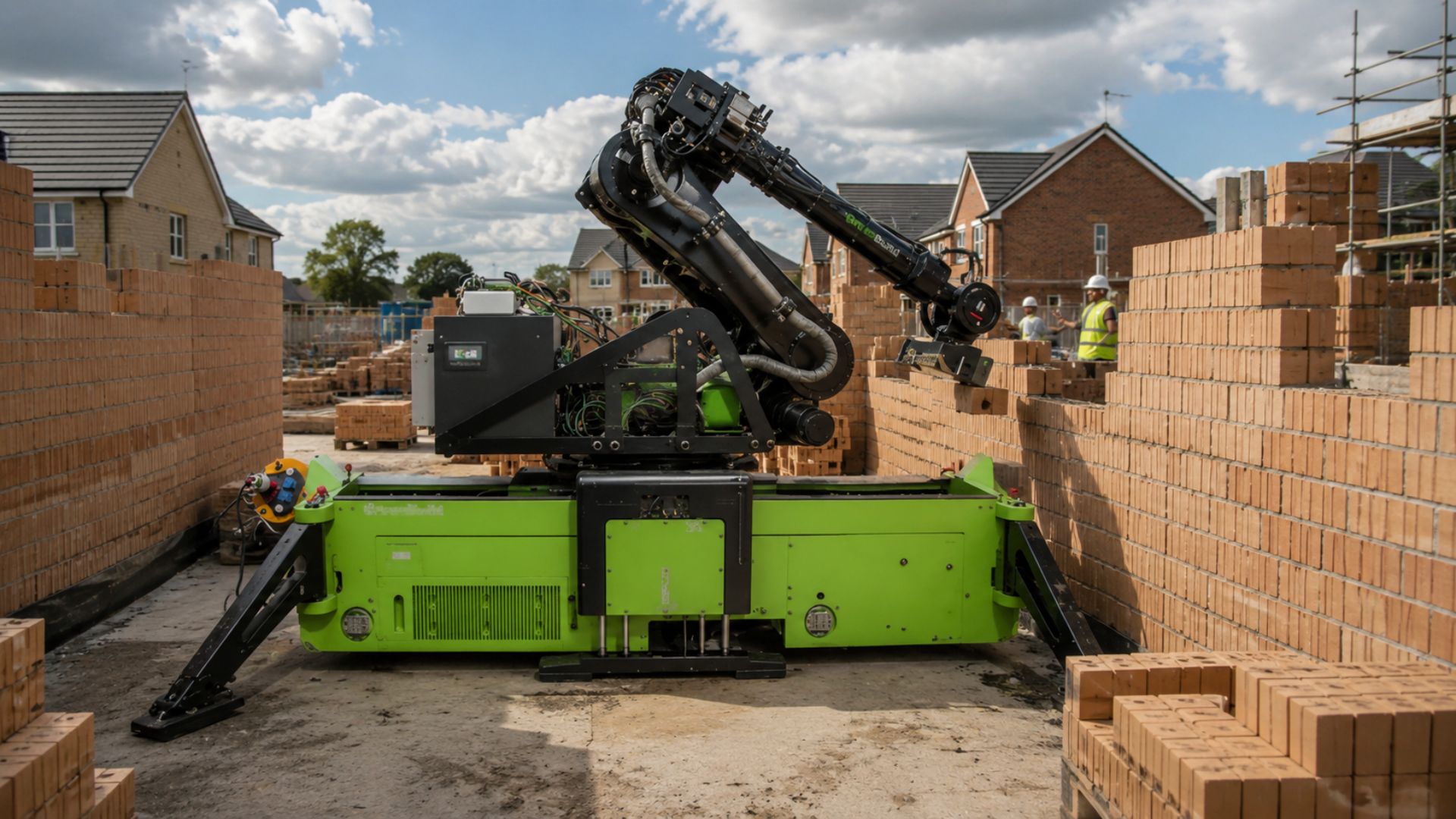


A bricklaying robot called Walter is building houses in the UK for the first time and could transform British construction. Developed in the Czech Republic by GreenBuild and operated by JT Lifestyle Homes, the robot lays up to 200 square meters of masonry per day, ten times more than a human bricklayer. Walter builds walls up to 3.5 meters without scaffolding, works in rain and wind, and uses glue instead of cement mortar, reducing CO2 emissions on site.
A robot that lays bricks with 2-millimeter precision is redefining what it means to build a house in the UK. According to Reuters, WLTR, nicknamed Walter, is a semi-autonomous robotic system powered by artificial intelligence that was developed in the Czech Republic and arrived at British construction sites in 2025. The robot is being operated by JT Lifestyle Homes in a 27-house development in Thornley, County Durham, marking the first time such a system is used on British soil. Walter lays up to 200 square meters of masonry per day, equivalent to the output of five bricklayers and a helper per hour.
The arrival of the robot comes at a time of crisis for British construction. The sector has over 35,000 vacancies, the highest vacancy rate among all industries in the country, according to the National Statistics Office. The average age of masonry professionals in the UK is 46 years, and almost no one is entering the trade. Dr. Jan Telensky, founder of JT Lifestyle Homes and responsible for bringing the robot to the country, stated that in 20 years there will not be enough bricklayers to build houses if the sector does not find new solutions.
What the robot Walter does and how it works

Walter is classified as a semi-autonomous bricklaying robot, operated by a single person. The system receives architectural designs digitally, calculates the position of each block, and performs the laying with a tolerance of 2 millimeters. Only 1% of human bricklayers can consistently achieve this level of precision, according to Telensky.
-
China Uses 432 Robots to Move a 7,500-Ton Historic Building in Shanghai, Preserving Architecture While Creating Space for Underground Center

-
World Cup Ball Chip Uses Technology to Detect Invisible Touches, Confirms Offside, Secures Portugal’s Victory Over Croatia

-
36-Meter Hydrogen-Powered Superyacht Arrives in Brazil to Debut German Engines and Showcase Future of Clean Navigation
-
Indian Students from Jaipur Win Top Prize at World’s Largest Science Fair with EcoFog, an Affordable Mesh to Harvest Fog Water Without Energy




The robot uses special grooved blocks, designed to be mechanically grabbed, lifted, and positioned. Walter requires a first layer of bricks prepared by a human worker and must be monitored by trained workers during operation. But from the base, the robot works alone: it builds walls up to 3.5 meters high without the need for scaffolding, with plans to extend this capability to 5 meters. The engineering behind the system allows it to operate in any weather condition, including rain, wind, and extreme temperatures.
The glue that replaces cement and reduces emissions
One of the most innovative aspects of the robot is not its speed, but the material it uses to fix the blocks. Walter uses industrial glue instead of cement mortar, eliminating the need for one of the most polluting materials on the planet. The manufacture and use of cement account for approximately 6% of global CO2 emissions, according to industry data.
The replacement of mortar with industrial adhesive also simplifies operation on UK construction sites. There is no need for a concrete mixer, no mortar waste scattered on the ground, and the curing time is faster. For a robot that needs operational efficiency, the glue is functionally and environmentally superior. JT Lifestyle Homes presents itself as a specialist in smart, affordable, and sustainable construction, and the use of glue instead of cement is part of this strategy.
The crisis that made the robot necessary


The British government, led by Prime Minister Keir Starmer, set the goal of building 1.5 million new homes to address the country’s housing crisis. Chancellor Rachel Reeves announced a £600 million package to train 60,000 bricklayers, electricians, engineers, and carpenters over the next four years. But even with this investment, the labor shortage is so great that technological solutions like the Walter robot are seen as an inevitable part of the response for the construction industry.
The aging workforce is the central problem. With an average age of 46 and few young people interested in manual labor, the construction sector faces a demographic curve that no training program can reverse in time. Telensky estimated that a single robot can build hundreds of houses per year, and that the first phase of the project in Durham, UK, with seven luxury four-bedroom residences, demonstrated that the technology works on a real scale.
The robot does not replace bricklayers, it creates operators
JT Lifestyle Homes is keen to emphasize that the robot was not created to replace workers, but to attract new ones. Telensky summarized the strategy: “We won’t say you will be a bricklayer. We will say you will be a robot operator that builds with bricks. Young people love it. For them, it’s like playing a video game.”
The argument is that automation transforms a manual, physically demanding profession seen as unattractive into a high-skilled technological role. Design, planning, inspections, and final finishes remain human tasks. The robot takes care of the repetitive and heavy part, while operators supervise, adjust, and ensure quality. The company is already planning to expand the use of Walter in future projects in Hull, Southampton, and Nottinghamshire, consolidating the presence of the robot in the UK’s construction industry.
Do you think robots like Walter will solve the construction industry crisis or eliminate jobs that are still needed? What impresses you the most: the 2-millimeter precision, the glue that replaces cement, or the speed ten times faster than a bricklayer? Tell us in the comments.





Call me a luddite but this will eventually lead to a loss of jobs, lifestyles and skill sets. The age of machines takes another step closer
Every company that employed eastern European rats will have to buy a walter now! Theres nowt great about Britain!
Mind boggling. Would love to be first importer