






 Portuguese
  Spanish


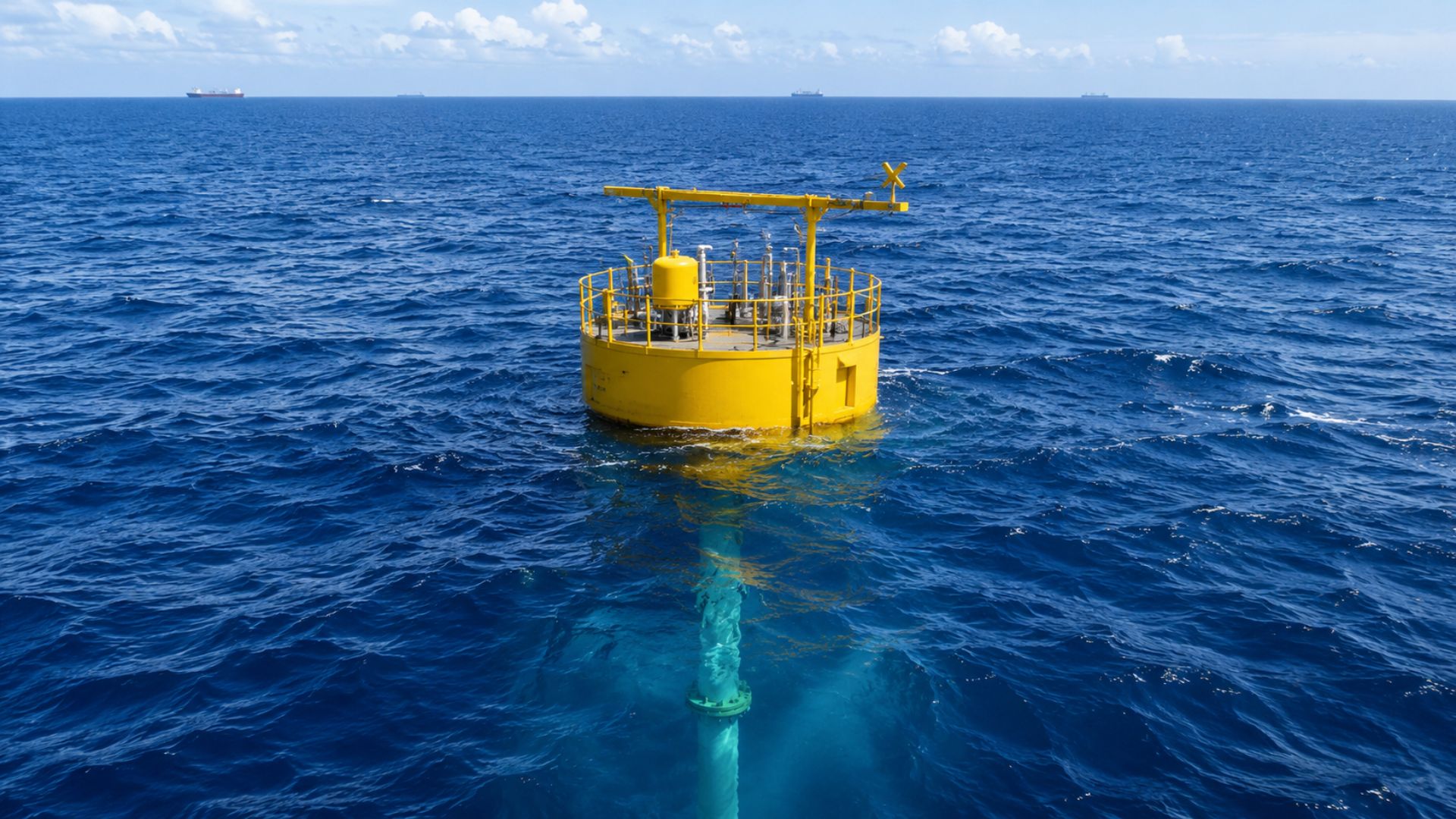


The Global OTEC, a UK company, has installed in the waters of the Canary Islands the world’s first floating platform capable of continuously generating electricity from ocean heat. The system takes advantage of the temperature difference between the warm surface and the cold depths of the Atlantic to drive turbines 24 hours a day, without relying on weather conditions. The platform is designed to withstand hurricanes, produces carbon emission-free energy, and also desalinates fresh water.
The ocean has just become an electric power plant that operates day and night. The British company Global OTEC achieved what no other had done before: installing in the Atlantic, in the waters of the Oceanic Platform of the Canary Islands, a floating system that extracts energy directly from ocean heat. The technology, called Ocean Thermal Energy Conversion, takes advantage of the temperature difference between the warm sea surface and its icy depths to evaporate a special liquid, drive a turbine, and generate electricity continuously. It is not a laboratory prototype: it is in the ocean, functioning.
What makes this achievement relevant is what it solves. Unlike wind and solar energy, which depend on wind and sunlight and stop when conditions change, ocean energy is constant. The temperature difference between the surface and the depths remains stable 24 hours a day, 365 days a year. Experts call this “base load energy,” the type of generation that can power electric grids without intermittence, something that no common renewable source could offer until now without storage batteries.
How the platform transforms ocean heat into electricity
The system operates in a closed circuit that exploits the basic physics of thermodynamics. The warm water from the ocean surface heats a liquid with special chemical properties that boils at very low temperatures. When boiling, this liquid turns into vapor, which drives a turbine generating electricity. Then, cold water drawn from the ocean depths through a pipeline cools the vapor, which returns to a liquid state and restarts the cycle.
-
China Accelerates Global Expansion of Robotics: From Smart Vacuums to Industrial and Humanoid Machines, Millions Exported to Over 150 Markets

-
Polar Air Mass to Hit Brazil: Temperatures to Plummet in Nine States, Near Freezing in the South with Frost Risk Until Monday
-
Chinese “dark factories” produce electric cars 24/7 with minimal human intervention, as Zeekr assembles 800 units daily, raising concerns in Brazil.

-
Spectacular Green Aurora Seen from Space Illuminates International Space Station, Captivates French Astronaut





The process repeats indefinitely as long as there is a temperature difference between the surface and the depths, which in the tropical ocean is a permanent condition. The main innovation of Global OTEC was to move the platform to the sea instead of building facilities on the coast. Previous land-based prototypes required kilometers of piping to pump cold water from the depths to the land, making the project so expensive that it became unfeasible. By installing the platform directly in the ocean, the company eliminated 80% of the necessary piping and created a model that, for the first time, seems scalable for commercial use.
Why the Canary Islands were chosen

The platform was installed at PLOCAN, the Oceanic Platform of the Canary Islands, an infrastructure managed by a consortium funded by the Spanish government and the regional government. The Canary waters offer the combination of factors that ocean energy technology requires: high surface temperature, accessible depths with cold water, and favorable regulatory conditions for maritime technology testing.

The Canary Islands have become an international technological hub for offshore energy. Besides the Global OTEC project, the region will host the floating wind energy demonstrator WHEEL, led by the Spanish company ESTEYCO, by the end of 2026. The Spanish Ministry of Science and Innovation recognizes the archipelago as one of the main European locations for the development and validation of ocean technologies.
The salvation for islands that depend on diesel
The project was not designed to power large continental electrical grids. The focus is on Small Island Developing States, which currently rely on polluting and expensive diesel generators for their electricity. The European consortium PLOTEC, which funds the development, estimates that there are more than 25 gigawatts of diesel capacity in tropical islands that could be replaced by ocean energy.


In addition to generating electricity without carbon emissions, the platform offers a valuable additional benefit for island territories: freshwater desalination. The cold water drawn from the depths can be used in the desalination process, providing two essential resources, electricity and drinking water, from a single infrastructure. The platform was specifically designed to withstand extreme tropical storms, a mandatory condition for operating in regions on the hurricane route.
What is needed for ocean energy to become commercial

Dan Grech, founder and CEO of Global OTEC, stated that this is the moment when the technology moves from controlled environments to the real world. The company’s next step is to install the first commercial energy module in Hawaii, an island market that meets all the conditions that ocean technology requires.
The transition from prototype to commercial scale is historically the point where promising technologies fail. Grech compares the learning curve of ocean energy to that of solar and wind energy, which took decades to reduce costs to competitive levels. The difference is that the platform is already operational in the Atlantic, generating real electricity. For a sector that has spent decades promising that the ocean would be the battery of the future, having a functioning system is an achievement that changes the level of the conversation.
Did you know that it is possible to generate electricity 24 hours a day using only the ocean’s temperature difference? Do you think this technology could work on the Brazilian coast, where the water is warm all year round? Tell us in the comments.





KRISO in Korea is building a 50kWh OTEC demonstration plant in Majuro , Marshall Islands as I type
I live in Zamboanga City, South of Mindanao The Philippines, we have vast water sources in our Islands, will that be effective in between Islands? Would love to see you work in our parts as well. Our Islands and coastal areas have really great potential, please try and conduct a feasibility here. This will contribute so much for our development and energy requirements.
I live in Freetown, Sierra Leone and the Atlantic water surface is constantly warm.
Can OTEC be effective here?