Portuguese
  Spanish


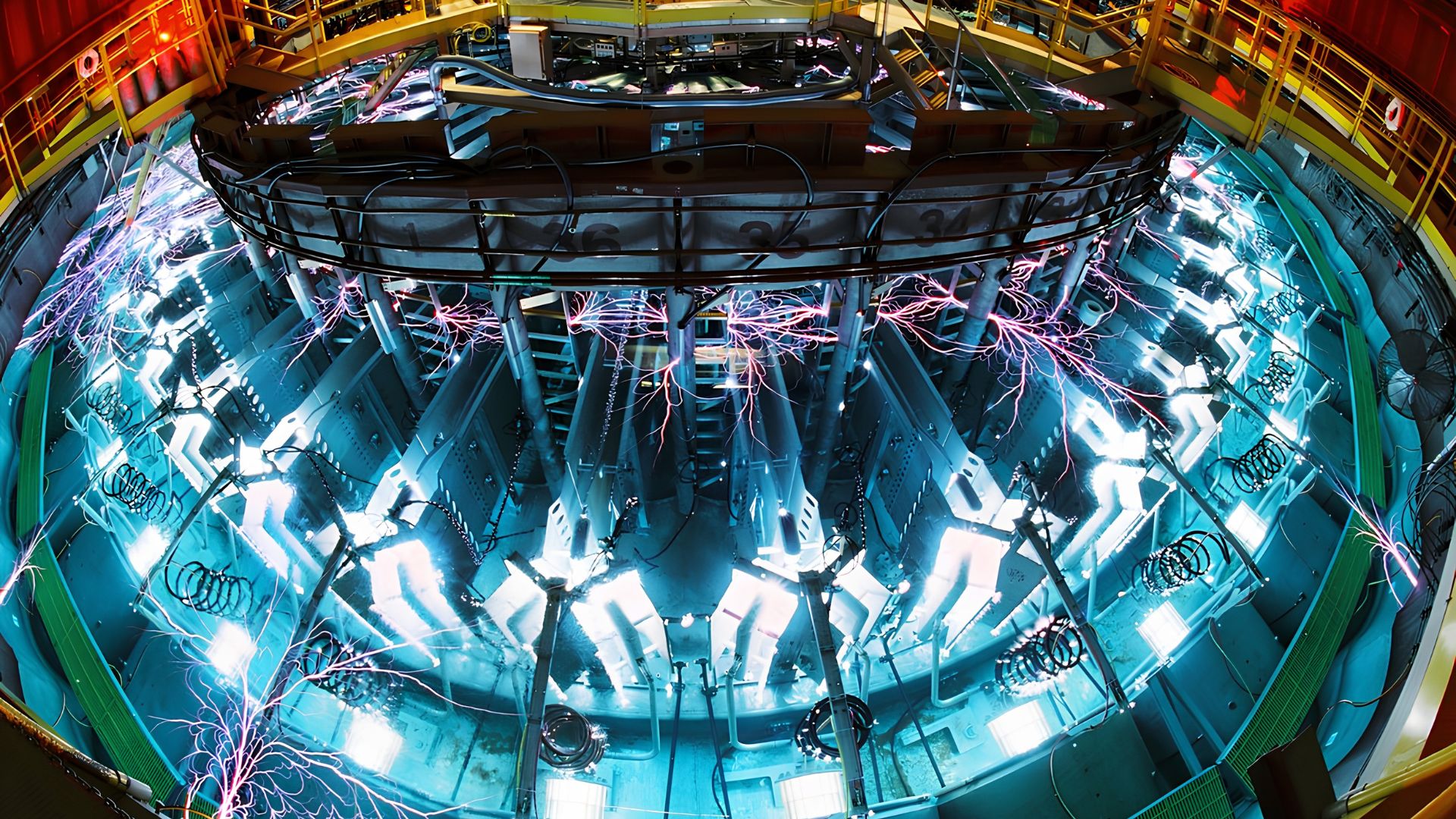

Z Machine in the USA recreates extreme conditions with 26 million amperes to study fusion, materials, and high-energy physics.
In New Mexico, USA, the Sandia National Laboratories operates one of the most extreme scientific machines ever built: the Z Pulsed Power Facility, known as the Z Machine. The facility fires about 26 million amperes in ultra-short pulses to generate X-rays with a peak of 350 trillion watts, recreating in the laboratory physical conditions found in stars, planetary interiors, and nuclear fusion experiments.
The machine does not exist to generate commercial electricity. It serves to study matter under temperatures, pressures, and radiation so intense that almost no other laboratory can reproduce, aiding research in high-energy density physics, extreme materials, nuclear fusion, and the safety of the American nuclear arsenal without real explosive tests.
The Z Pulsed Power Facility compresses energy in time and space to create one of the most powerful X-ray sources on Earth
The Z Machine operates as a pulsed power facility. Instead of releasing energy continuously, it stores electricity in large internal systems and discharges it all in an extremely short interval, concentrating power in a tiny fraction of a second.
-
Ship Returns from Brazilian Coast with Thirty Newly Discovered Life Forms

-
Nigerian Professor Invents Electricity-Free Refrigerator Using Clay Pots and Wet Sand, Extending Shelf Life of Vegetables to 27 Days; 7,000 Units Distributed in Energy-Deprived Villages

-
Flower Farms Supplying London and Amsterdam Face Backlash for Environmental Impact on African Lake, Threatening Jobs for 50,000 Workers

-
World’s Largest Container Ship Departs Shanghai with 24,000 Containers, Set to Debut in Europe in July





This principle allows reaching intensities that would not be possible in conventional operation. According to Sandia National Laboratories, the Z compresses energy in time and space to produce powers and intensities found in few known natural environments on Earth.
The result is an extremely powerful radiation source. Sandia itself describes the facility as the world’s most powerful laboratory source of radiation and pulsed power, used to create high temperatures, high pressures, and intense X-rays.
The 26 million amperes transform metal wires into plasma and initiate a violent magnetic compression
During a shot, the Z Machine sends a gigantic electric current through extremely thin metallic structures. The intensity is so high that the material heats up, vaporizes, and transforms into plasma, a state of matter formed by charged particles.
The electric current also creates very strong magnetic fields. These fields compress the plasma inward, in a process known as Z-pinch, which gives the facility its popular name.
This compression occurs on an ultra-fast scale. In just a few nanoseconds, the matter undergoes heating, magnetic collapse, and intense X-ray emission, creating a physical environment used to study extreme processes.
The X-rays reach 350 trillion watts and simulate environments impossible to reproduce in common laboratories
The most colossal data point of the Z Machine is its instantaneous power in X-rays. According to Sandia, the facility reaches peaks of approximately 350 terawatts, or 350 trillion watts, during its shots.

The total energy emitted in X-rays reaches about 2.7 megajoules per shot. The power is gigantic, but it lasts for an extremely short period, making the system suitable for high-intensity, short-duration scientific experiments.
These pulses allow samples, materials, and experimental targets to be exposed to conditions similar to those generated in high-energy events. This is why the facility is used in research involving radiation, plasma, compression, and matter in extreme regimes.
The machine is used to study nuclear fusion, the same process that powers stars like the Sun
One of the main uses of the Z Pulsed Power Facility is related to nuclear fusion. Fusion occurs when light atomic nuclei unite, releasing energy, a process that powers stars like the Sun.
On Earth, reproducing this process in a controlled manner is extremely difficult. It is necessary to heat and compress matter to levels where the nuclei have enough energy to overcome the electrical repulsion between them.
The Z Machine allows the investigation of pathways related to inertial confinement fusion and approaches like plasma magnetic compression. The facility appears in scientific reviews as a central tool for fusion research, dynamic material science, X-ray radiation, and pulsed power engineering.
The facility tests materials under brutal pressures to understand how they behave in extreme regimes
The Z Machine is also used to study materials subjected to violent conditions. When a material is compressed by intense shocks, radiation, or extreme magnetic fields, its properties can change completely.
This type of research helps to understand how metals, alloys, insulators, and other materials behave when forced beyond normal limits. Applications range from basic physics to strategic technologies and computational modeling.
According to Sandia, the facility creates high temperatures and high pressures for research in high energy density physics. This field studies matter under conditions comparable to those found in planetary interiors, stars, and extreme energetic events.
The Z Machine also helps to study phenomena related to nuclear security without real detonations
The facility is part of the set of scientific tools used by the United States to evaluate nuclear phenomena experimentally and computationally. This includes research on radiation, materials, and the behavior of matter under extreme conditions.
The goal is not to make real nuclear explosions. The idea is to obtain physical data in the laboratory to feed computer models and understand high-energy processes with scientific control.
Technical sources describe the Z Machine as a facility used to gather data that aids in the modeling of nuclear systems and the study of future pulsed power fusion plants.
Each shot destroys experimental targets and requires careful preparation before a new round
The energy involved in the shots is so intense that the targets used in the experiments usually do not survive. Metal wires, capsules, samples, and components near the central point can be vaporized, compressed, or damaged.
Therefore, each shot requires detailed technical preparation. Researchers need to assemble the target, calibrate sensors, review electrical systems, prepare diagnostics, and ensure that all data is captured at the exact moment of the event.
Sandia reports that the Z performs approximately 200 shots per year. This number shows that the machine does not operate as continuous equipment, but as a highly complex experimental platform, where each “shot” is planned to answer specific physical questions.
The experiments happen in nanoseconds and require sensors capable of recording almost instantaneous events
The scientific challenge of the Z Machine is not only in generating extreme energy. It is also necessary to measure what happens during time intervals almost impossible to visualize.
The main phenomena occur in nanoseconds, or billionths of a second. In this interval, the current rises, magnetic fields form, the plasma is compressed, and X-rays are emitted.
To transform this event into science, researchers use ultra-fast diagnostics. These systems record radiation, temperature, plasma movement, material response, and other physical variables before the target is destroyed.
The strength of the Z Machine lies in creating conditions found “nowhere else on Earth”
The official description from Sandia summarizes the importance of the facility: the Z Machine creates conditions found nowhere else on Earth. This does not mean it is the only extreme machine in existence, but that its combination of current, X-rays, and magnetic compression is unique.

This type of facility allows testing theories that, without it, would remain restricted to simulations. In extreme physics, computational models need real data to be calibrated, and this is precisely where the Z Machine becomes strategic.
By reproducing regimes of temperature, pressure, and radiation far removed from everyday life, it helps scientists understand how matter reacts when pushed to the limit.
The Z Pulsed Power Facility shows that modern science also depends on colossal machines hidden in laboratories
The Z Machine does not appear in the popular imagination like space telescopes, famous accelerators, or more media-friendly fusion reactors. Even so, it occupies a central place in one of the most challenging areas of experimental physics.
Your function is to create, measure, and control extreme events long enough for science to extract reliable data. In each shot, tens of millions of amperes pass through the system and transform stored electricity into plasma, magnetic fields, and X-rays of colossal power.
In the end, the Z Pulsed Power Facility shows a little-known face of modern technology: giant machines that do not produce consumer goods, but recreate conditions of stars, planets, and nuclear systems to understand how matter behaves when all human scales cease to make sense.