Portuguese
  Spanish


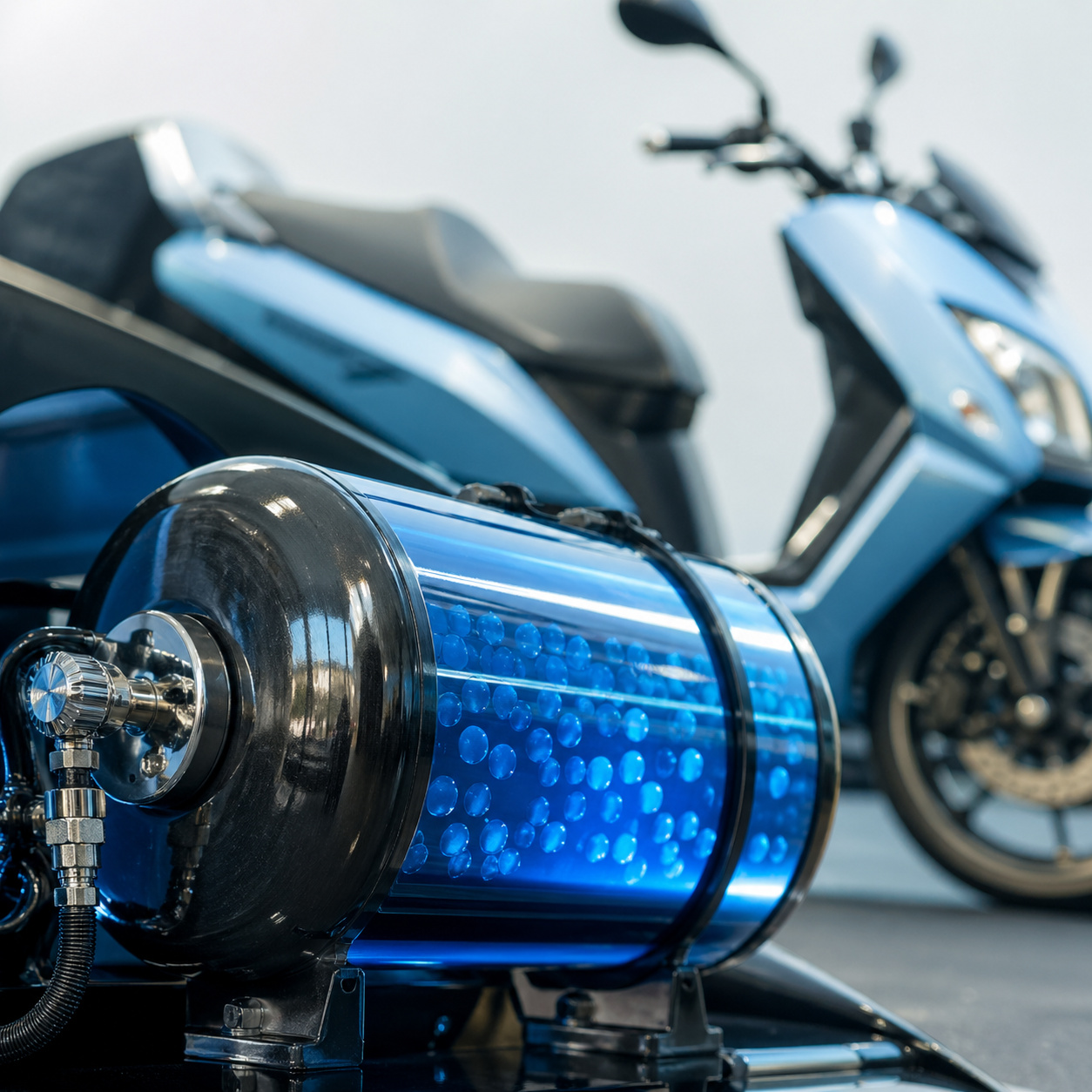


Toyota patent reveals hydrogen scooter with fast refueling and potential to transform sustainable urban mobility without relying on long recharging times
Toyota is back at the center of clean energy discussions after registering a patent for a hydrogen-powered scooter in Japan. The document, reposted by sites like Motonline on April 28, does not announce a ready product but reveals a robust technical concept with innovative solutions that could directly impact the future of urban mobility.
The proposal stands out for combining a fuel cell, zero pollutant emissions, and a refueling system using interchangeable cartridges — something uncommon in this type of technology. Even without a launch forecast, the project reinforces the company’s strategy of not relying exclusively on battery electric vehicles.
Toyota’s hydrogen scooter patent reveals innovative urban concept
The patent registered by Toyota details a two-wheeled model aimed at urban commuting. There is no confirmation of production, but the level of detail indicates an advanced study, not just a simple conceptual idea.
-
British Factory Transitions from Mechanical Parts to Producing 420,000 Electric Power Units Annually, Supplying 70% of Ford’s Electric Cars Sold in Europe

-
Toyota Shifts from Hybrid Cars to Electric Air Taxis with Joby’s 6-Rotor Aircraft, Capable of 322 km/h, Aiming for Mass Production to Electrify Urban Skies

-
Ferrari Unveils Limited Edition 12Cilindri Manuale: 6.5-Liter V12, 830 HP, 0-100 km/h in 2.9 Seconds, Top Speed Over 340 km/h, Only 1,499 Units Available

-
Discover the 2021 Fiat Cronos 1.3: Affordable Maintenance, Reliable Mechanics, and Fuel Efficiency of Up to 15.6 km/l


The document shows how Toyota’s hydrogen scooter could work in practice, including its structure, component positioning, and refueling solutions. This type of registration is typically used to protect technologies even before any commercial announcement.
It’s worth noting that the Japanese automaker has been betting on hydrogen for years, with consolidated projects in passenger cars, such as the Mirai sedan. Now, this vision is beginning to expand to the two-wheeled segment as well.
How the fuel cell transforms hydrogen into clean energy
At the heart of Toyota’s hydrogen scooter is the fuel cell, a technology that generates electricity from the reaction between hydrogen and oxygen.
Unlike traditional internal combustion engines, this process does not burn fuel. Instead, an electrochemical reaction occurs that produces electrical energy, with water vapor as the only byproduct.
This means that Toyota’s hydrogen scooter can operate without emitting carbon dioxide, nitrogen oxides, or other atmospheric pollutants — an increasingly relevant point in large urban centers.
Among the main benefits of this technology are:
- Zero pollutant emissions during use
- Silent operation
- Potential for high energy efficiency
- Faster refueling than electric vehicles
Even with these advantages, large-scale use still depends on infrastructure advancements and cost reduction.
Toyota’s hydrogen scooter uses a base inspired by the Suzuki Burgman
An interesting detail of the project is the choice of structural base. Toyota’s hydrogen scooter uses the Suzuki Burgman as a reference, a model that emerged in the mid-2000s and gained a fossil fuel-powered version presented at the Tokyo Motor Show in 2011.
This choice is not random. The Burgman has dimensions and proportions that facilitate the integration of new propulsion systems, such as the fuel cell and hydrogen tanks.
By using an already known platform, Toyota demonstrates a practical approach, leveraging existing solutions to accelerate the development of new technologies.
The game-changer: interchangeable hydrogen cartridges
The most innovative aspect of Toyota’s hydrogen scooter is its refueling system. Instead of using fixed high-pressure tanks, the project proposes the use of removable cartridges.
These cartridges function as sealed cylinders that store hydrogen and can be easily replaced when empty. The idea is to simplify refueling and eliminate dependence on specialized stations.
The process would be simple:
- The user removes the empty cartridge
- Inserts a new charged cartridge
- The vehicle immediately resumes operation
Additionally, the patent describes an articulated mechanism that facilitates access to the compartment. There are two variations in the document:
- One with a front hinge, which moves the cartridge sideways
- Another with an articulated arm, which moves the compartment parallel to the frame
This solution solves a common problem in hydrogen vehicles, where tanks are often integrated into the chassis, making maintenance and refueling difficult.
The real challenges that still limit Toyota’s hydrogen scooter
Despite its potential, Toyota’s hydrogen scooter still faces significant barriers before becoming a commercial reality.
Infrastructure is one of the main obstacles. Currently, hydrogen distribution is limited in much of the world, which hinders the widespread adoption of this technology.
Another critical point is cost. Hydrogen production, especially so-called green hydrogen, is still expensive compared to other energy sources.
Furthermore, there are challenges related to energy efficiency throughout the entire chain, from production to final use.
Among the main obstacles are:
- Low availability of refueling stations
- High cost of hydrogen production
- Logistical complexity
- Need for cartridge standardization
These factors explain why the technology is still in the development and testing phase.
Technological dispute: hydrogen versus electric vehicles
Toyota’s hydrogen scooter emerges at a time when battery-electric vehicles dominate the debate on sustainable mobility.
However, hydrogen presents characteristics that can make it competitive in certain scenarios.
While electric vehicles depend on recharging, which can take time, hydrogen allows for quick refueling. Furthermore, it can offer greater range in some cases.
On the other hand, electric vehicles currently have clear advantages:
- More advanced infrastructure
- Falling costs
- Higher direct energy efficiency
Toyota’s strategy indicates that these technologies can coexist, meeting different needs and usage profiles.
Toyota’s hydrogen scooter reinforces strategy beyond batteries
The decision to invest in hydrogen is not recent. Toyota has already made it clear that it does not intend to follow only the path of battery-electric vehicles.
The company is betting on a diversified approach, which includes different energy solutions. This strategy seeks to reduce risks and increase flexibility in the face of global market changes.
By bringing this vision to the two-wheeler segment, Toyota’s hydrogen scooter expands the scope of this proposal, especially targeting urban mobility.
What this patent really indicates about the future
It is important to emphasize that Toyota’s hydrogen scooter is not yet a real product available on the market. The patent does not confirm production or launch.
However, this type of registration serves as a clear indication of technological direction and industry bets.
Even if the model never reaches the streets, the solutions presented can influence future projects, both from Toyota itself and from other manufacturers.
A transforming scenario for urban mobility
Toyota’s hydrogen scooter represents more than an isolated concept. It is part of a larger transformation movement in the transport sector.
With pressure for emission reduction and the advancement of new technologies, the market tends to become increasingly diversified.
In this context, solutions like hydrogen can gain ground, especially if they manage to overcome current challenges.
For consumers, this means more options in the future. For the industry, it represents an open competition, where different technologies compete to define the future of sustainable mobility.
With information from Motonline.