






 Portuguese
  Spanish
  5 min of reading
  1 comment


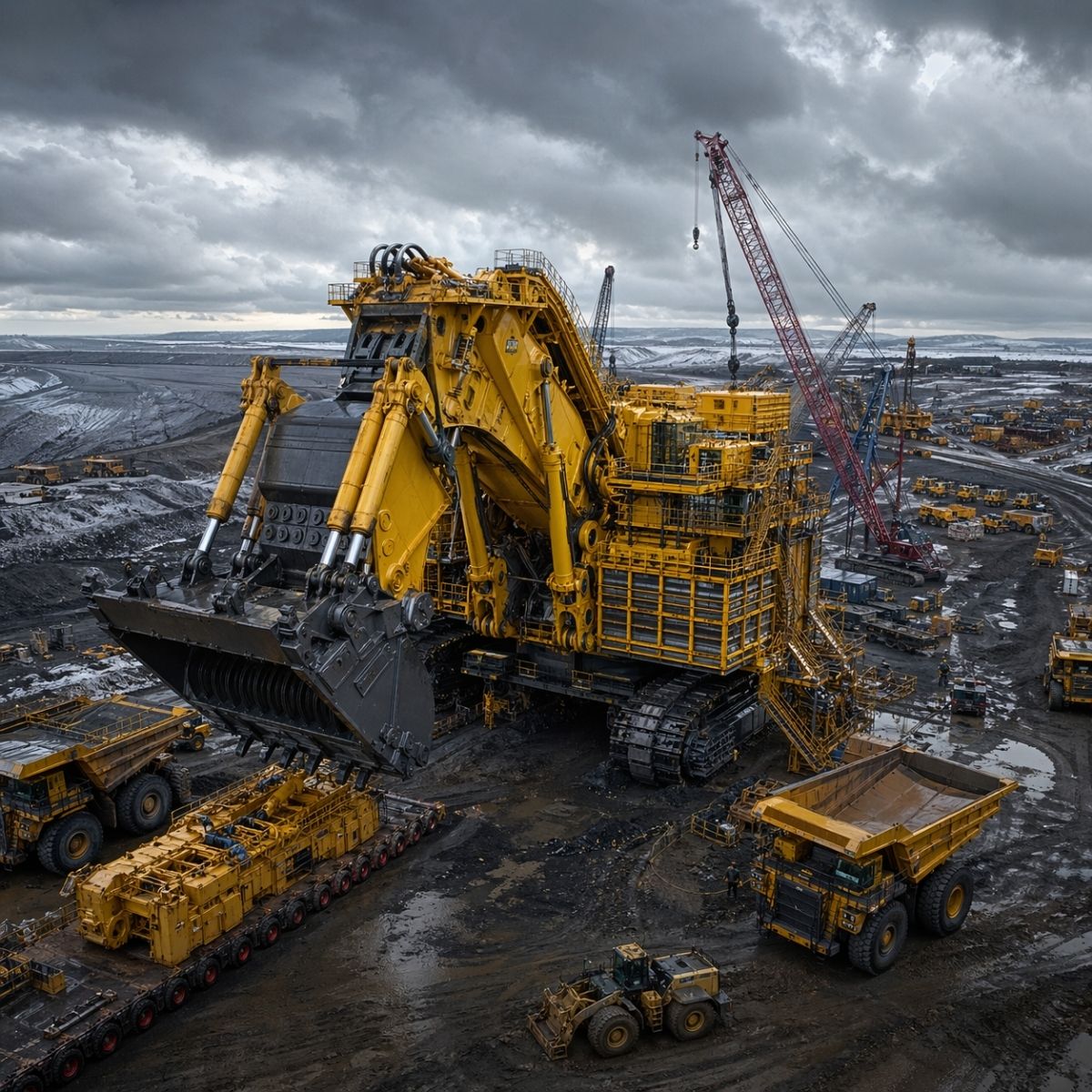


Komatsu built in Düsseldorf the largest mining excavator of the company, the PC9000, which was dismantled and transported by river, sea, and road from Germany to the oil sands of Canada, covering thousands of km before being reassembled in 6 weeks by SMS Equipment in Alberta.
Komatsu Mining presented to the world the largest hydraulic mining excavator it has ever manufactured: the PC9000, a prototype machine built, assembled, and tested at the company’s 27-acre factory in Düsseldorf, Germany, before being dismantled and embarked on an intercontinental journey to the oil sands of Alberta, Canada. The mining excavator was transported overnight by trucks through the city to the banks of the Rhine River, where it was loaded onto a barge and traveled downstream to the North Sea, crossed the English Channel, traversed the Atlantic Ocean, and reached the Gulf of Mexico, landing at the port of Galveston, Texas. The heaviest component, the superstructure, weighs 89 tons and, mounted on the transport trailer, reached a total weight of 153 tons with a length of 53 meters and a width of 5 meters.
From Galveston, the mining excavator continued overland in multiple loads on a 19-axle Famonville platform trailer pulled by a Kenworth W900, crossing Oklahoma, Colorado, Wyoming, and Montana before crossing the Canadian border into Alberta. The final destination was 90 kilometers north of Fort McMurray, at an oil sands mine where the PC9000 traveled along the route that bypasses the former site of the Great Canadian Oil Sands, the country’s first large-scale extraction operation, and crossed the Athabasca River via the Peter Lougheed Bridge. On-site, SMS Equipment took approximately six weeks to reassemble the complete machine, conduct operational tests, and commission it for the customer.
The story that led Komatsu to build this mining excavator

The PC9000 did not come out of nowhere. Its origin dates back to 1986, when Demag introduced the H485, the largest hydraulic mining excavator prototype the world had ever seen, equipped with a 23-cubic-meter bucket, and sent the first three units to the oil sands of Canada for testing in diesel and electric variants. In 1994, with transport trucks growing in size, Demag developed the H685 SP, a 585-ton prototype with a 33-cubic-meter bucket designed specifically for the region, a machine that still operates today with over 110,000 hours accumulated on the structure.
-
Survivor of 1966 SS Daniel J. Morrell Shipwreck in Lake Huron Recounts 38-Hour Ordeal in Extreme Cold

-
The Greatest Hoax in World Cup History? The Film That Denied Brazil’s 1958 Victory and Exposed How Fake Evidence Can Seem Convincing on TV
-
Fake South Korean Online Stores Offer Shopping Thrill Without Spending Money or Receiving Products
-
The War of Jenkins’ Ear: How a Severed Ear Sparked One of the 18th Century’s Most Unusual Conflicts


The evolution continued with the H740 OS, weighing 635 tons, where the acronym OS stands for “oil sands.” In 1996, Komatsu and Demag formed a joint venture called Demag Komatsu GmbH, and in 1999 Komatsu took full control, creating Komatsu Mining Germany. All these learnings fueled the development of the PC8000-6 in 2002, a mining excavator weighing 771 tons with a bucket capacity of 42 cubic meters, and it was precisely the accumulated experience with the PC8000 in oil sands that provided the technical foundation for the creation of the PC9000.
What the PC9000 mining excavator was designed to do

The PC9000 was designed to load ultra-class haul trucks, vehicles with a payload capacity of 300 short tons or 270 metric tons, such as the Komatsu 980E, the Liebherr T274, and the Caterpillar 794 and above. The mining excavator was sized to fill one of these trucks in five bucket passes with a fill factor of 90%, a speed that maximizes operational productivity and reduces the time trucks spend waiting to be loaded. The exact bucket capacity and strength specifications have not yet been officially disclosed, as the machine operates as a prototype whose performance is being validated in the field.
One of the decisive advantages of the PC9000 is its ability to operate with bilateral loading. While one truck is being filled from one side, another can position itself on the opposite side, eliminating idle time for the mining excavator and maintaining a continuous productive cycle. This feature is particularly valuable in autonomous operations, such as those already functioning in the oil sands with fleets of driverless Komatsu 980E trucks since 2018, allowing the shovel to never stop working as long as there are trucks available to load.
Why oil sands prefer hydraulic excavators to rope shovels


The choice of hydraulic format over the traditional cable shovel is not casual. Hydraulic mining excavators offer superior selectivity in excavation: if the operator needs to remove a layer of waste material above the ore, access a different quality section, or clean the floor of the pit, the hydraulic machine performs these tasks with a precision that the cable shovel cannot achieve. The cable shovel operates on a fixed excavation trajectory, efficient for bulk volumes, but limited when the work requires refinement.
The penetration force is another differentiator. In particularly hard and abrasive deposits like oil sands, the hydraulic mining excavator applies direct and controlled pressure on the material, a capability that cable shovels do not replicate with the same efficiency. Additionally, cable shovels rely on auxiliary equipment to manage the drag cable that extends through the pit, an additional logistics that hydraulic excavators eliminate by not using a cable. The combination of flexibility, penetration force, and operational independence explains why Canada’s oil sands invested in four units of the PC9000 with an option for a fifth.
What the PC9000 Means for the Future of Large-Scale Mining Excavators
The machine operating in the oil sands is classified as a “possession machine,” or inaugural prototype, whose role is to provide field data for the commercial models that Komatsu plans to make available starting in 2026. The lessons learned from this first PC9000 mining excavator, including the ideal bucket size, durability of hydraulic components, and performance in abrasive material, will be incorporated into the series units produced at the Düsseldorf factory. The other three ordered units, with serial numbers 1502, 1503, and 1504, will receive adjustments based on the experience accumulated by the first machine in real operation.
For the mining industry as a whole, the PC9000 represents a milestone. If validation in Canada’s oil sands confirms that the mining excavator can operate reliably in one of the planet’s most severe applications, with temperatures reaching minus 40 degrees and material that corrodes mechanical components at an accelerated pace, the global market gains a hydraulic alternative in the size range that has so far been exclusively dominated by cable shovels. The journey from Düsseldorf to Fort McMurray was not just a logistical operation: it was the first chapter of a product that could redefine what it means to excavate at maximum scale.
And you, did you imagine that transporting a machine like this involved crossing oceans and traversing entire countries by truck? Do you think hydraulic excavators will replace cable shovels in heavy mining? Leave your opinion in the comments.





Germany North of Canada, Equipment from Germany sent South to Galveston, TX Then Travel North to Albetha Canada an absolute Logistical Science, and the overall cost, Liebermann./¿¿.?