Portuguese
  Spanish


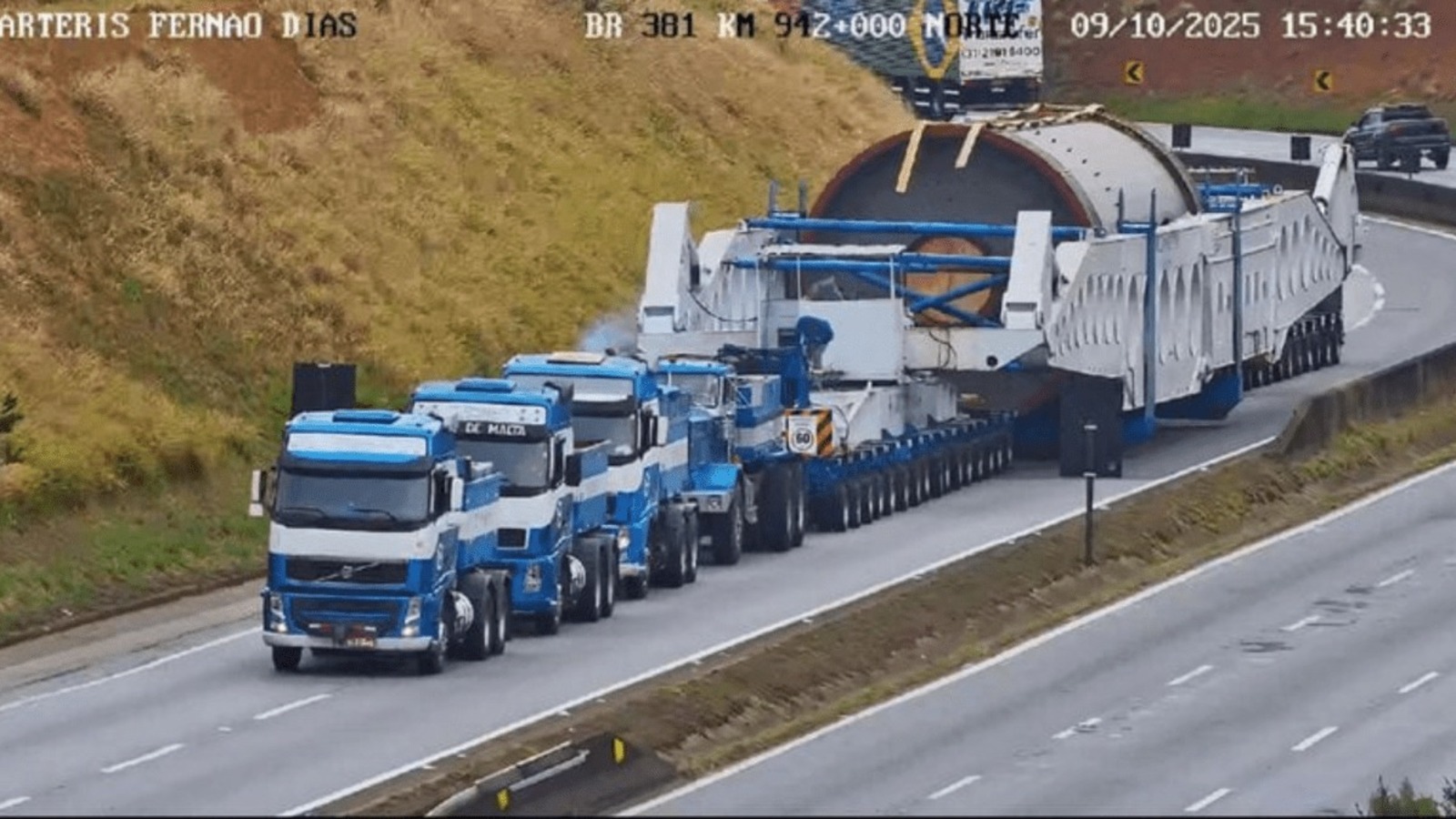


With 123 Meters Long and Weighing 850 Tons, the Truck That Left Atibaia Toward Goiás Was Stopped for 25 Hours on Fernão Dias, Completely Blocking Traffic in Camanducaia Until the Full Release of the Lanes
A truck weighing 850 tons interrupted traffic on the Fernão Dias Highway in Camanducaia, in the south of Minas Gerais, since the afternoon of Monday (13). According to the concessionaire Arteris, the vehicle had a malfunction and was stopped for about 25 hours.
The incident with the megatruck occurred at kilometer 916, heading toward Belo Horizonte. The lanes were completely blocked, causing delays in the stretch until the full traffic release on Tuesday (14).
In addition, a specialized team hired by the company responsible for the cargo had to carry out repairs to ensure the transport could proceed safely. The services were completed on Thursday (16).
-
Brazilian Company Known for Brooms Grew for 95 Years to Become One of Latin America’s Largest Brush Manufacturers, with Over 300,000 Sales Points and Revenue of $150 Million

-
World’s Largest Piano Manufacturer Produces Over 100,000 Units Annually in China, Each with 12,000 Parts

-
Meet the HMS Eagle: A Colossal 34,000-Ton Aircraft Carrier of the British Royal Navy with a 247m Length, Capacity for 55 Aircraft, and 2,750 Personnel
-
“Ghost Bird” Thought Extinct for 86 Years Reappears, Disappears Again, but New Recording Sparks Global Effort to Save One of the World’s Most Sought-After Species


The truck, measuring 123 meters in length, had left Atibaia, in São Paulo, on Thursday (9). The final destination is the state of Goiás, and the expected arrival is only in January 2026, due to the slow movement and technical stops along the route.
Based on reports from the press, it is possible to state that this truck has 44 axles and 264 tires.
Arteris reported that the flow on the highway was normalized in both directions after the repositioning of the megatruck.
With information from CNN.
You May Also Like: The Soviet Truck With a Jet Engine That ‘Breathes Fire’ Even Today — Russians Are Washing Tanks With It

The Soviet Union is known for its bold creations during the Cold War. Among them, one machine stands out for its size, function, and appearance: a military truck with a jet fighter engine installed in the rear. Originally created for chemical decontamination, the vehicle is still in use in Russia, even after decades.
An Uncommon Idea
During the Cold War years, the advancement of chemical weapons led the Soviets to seek solutions to clean exposed equipment.
It was in this context that the TMS-65U emerged, a military vehicle that seems to have come out of a science fiction movie.
The structure of the system is formed by a Ural 375 truck, with six-wheel drive and a large cargo capacity. At the rear, engineers installed a 900-liter tank and a turbojet engine.
The most curious detail is the origin of this engine. It is the Kilmov VK-1, previously used in combat aircraft like the MiG-15, MiG-17, and the Il-28 bomber.
After these models were replaced by more modern fighters like the MiG-19 and MiG-21, the old engines became obsolete. But instead of being discarded, they were repurposed.
How It Works
The operation of the TMS-65U is straightforward. The VK-1 turbojet is modified to release a stream of hot air mixed with decontamination fluid.
The result is a powerful blast of gas at high temperature, capable of quickly cleaning contaminated surfaces.
This jet is directed by an adjustable turret, allowing the operator to aim it precisely.
The system is effective in removing chemical and biological substances adhered to tanks, aircraft, or ships. The combination of heat with the fluid makes cleaning faster and deeper than traditional methods. It is like a turbocharged pressure washer, but adapted for military use.
Despite its efficiency, the TMS-65U has drawbacks. Fuel consumption is high due to the power of the jet engine.
Another risk is the possibility of spreading chemical contaminants into the surrounding environment if not operated carefully. Still, the vehicle continues to be used, including in present-day Russia.
More Than Decontamination
In addition to its original decontamination function, the TMS-65U also has other applications. One of them is in the battlefield, where it can launch dense smoke curtains.
This mist prevents the enemy from visualizing troop movements, functioning as a temporary shield.
Another relevant use occurs in runway cleaning. The VK-1 engine, utilized in the TMS-65U, is also used to remove snow or debris in places like aircraft carriers, such as the famous Russian ship Kuznetsov. Its power allows for quick cleaning of large areas.
Legacy of the VK-1 Engines
The VK-1 engine, created based on the British Rolls-Royce Nene, has a long history. Its use began in Soviet military aviation in the 1950s.
Even after more than 80 years since its creation, it still finds space in different functions. In addition to the TMS-65U and runway cleaning, it has also been used in an experimental train in the 1970s that reached 250 km/h.
The versatility and resilience of the engine are remarkable points. Even with the passage of time and technological advancements, it continues to be useful in various situations.
TMS-65U: A Solution That Survived the Test of Time
The TMS-65U is one of the most curious machines developed during the Cold War. The idea of transforming a truck into a platform with a turbojet for decontamination may seem extravagant, but it has proven functional.
Even with over 60 years of age, the system remains in use. And the engine that powers it, with over eight decades of history, continues to blow hot air wherever needed.
With information from Xataka.