






 Portuguese
  Spanish


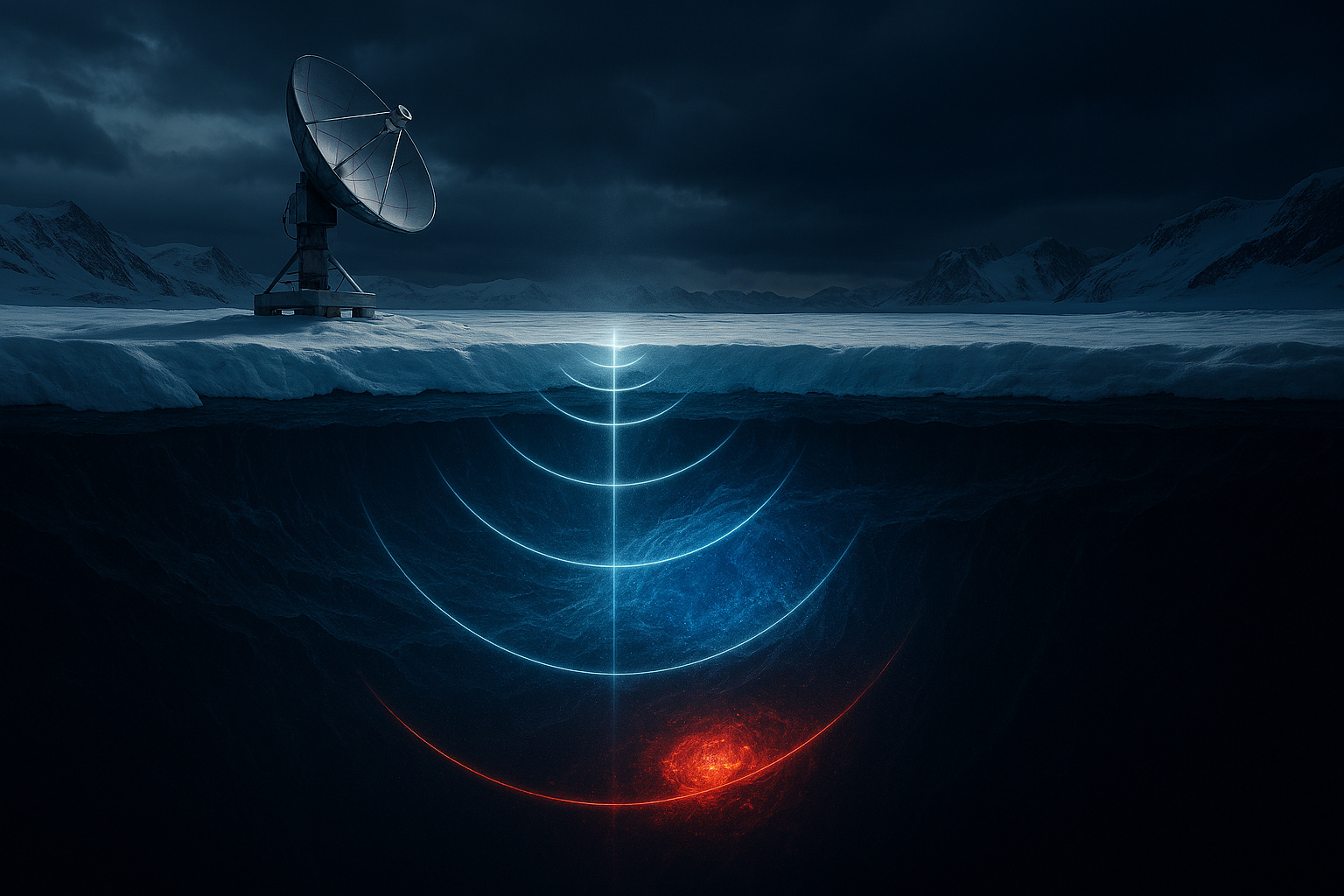


NASA Radars Detected Anomalous Reflections 1.5 Km Beneath the Antarctic Ice, Indicating Possible Liquid Water and Internal Heat Able to Accelerate Melting.
Far beyond the white and seemingly motionless surface, Antarctica is beginning to reveal signs of a much more dynamic internal behavior than science imagined just a few years ago. Data collected by NASA’s ice-penetrating radars identified extremely unusual reflections at about 1.5 kilometers below the surface, a signal that does not match the expected pattern of solid ice. Among researchers, the phenomenon has come to be described as a true “impossible echo”, something that simply should not exist at that depth according to traditional models.
The discovery did not arise from a single isolated measurement. It appeared consistently in mapping campaigns conducted by missions such as Operation IceBridge and supplemented by analyses from satellites like ICESat-2, which monitor the thickness, internal structure, and variations of Antarctic ice with unprecedented precision.
What NASA Radars Really Found Beneath the Ice
The radars used by NASA are designed to differentiate ice, rock, and water based on the way the electromagnetic signal is reflected. Solid ice has a well-known signature, with weak and predictable returns. In contrast, liquid water reflects the signal much more intensely.
-
Sixth-grader in Miami wins Lemelson Young Inventor Prize for creating water-absorbing concrete using discarded oyster shells and charcoal.

-
Brazilian Researchers Develop Portable, Painless, Radiation-Free Breast Cancer Tracker Using Microwaves, Costing Around $200 and Potentially Replacing $240,000 Mammograms
-
Beer as a Vaccine? Scientist Develops Experimental Method with Live Yeasts, Tests Own Brew, and Publishes Results on Zenodo

-
Brazilian Researchers Develop ‘Rapha’ Device Using Natural Latex and LED Light to Heal Diabetic Foot Ulcers and Prevent 50,000 Annual Amputations



The problem is that, at 1.5 km deep, the radar recorded exceptionally high reflectivity, inconsistent with pure ice. In technical terms, the signal return resembles that of liquid water or saturated sediments, something extremely unexpected in a region where temperatures should keep everything frozen.
This type of signature has previously been associated with subglacial lakes, but the location and intensity of the echo drew attention because they occurred in an area where such structures were not anticipated.
Why This “Impossible Echo” Challenges Current Climate Models
For decades, climate models assumed that Antarctic melting occurs primarily in two ways: at the surface, influenced by air temperature, and at the base of ice shelves in contact with the ocean. What the new data suggest is a third relevant mechanism: melting from the bottom up, driven by internal processes of the Earth.
If large areas of ice are being internally warmed, it means that current models may be underestimating the rate of mass loss from the continent. This factor is especially critical because Antarctica holds about 90% of the planet’s ice and is currently the biggest source of uncertainty in the IPCC’s sea-level rise projections.
The Geothermal Heat Hypothesis Beneath Antarctica
One of the most debated explanations involves geothermal flow, the natural heat rising from the Earth’s interior. Research published in journals such as Nature Geoscience indicates that parts of East Antarctica rest on a thinner and more geologically active crust than previously thought.
This heat, although invisible at the surface, may be sufficient to maintain pockets of liquid water under immense pressure, even at sub-zero temperatures. When combined with salts and sediments, this water drastically alters the radar response and creates exactly the kind of “echo” observed.
Subglacial Lakes: A Hidden System Beneath the White Continent
Antarctica is not a uniform block of ice. Today, science has mapped over 400 subglacial lakes, some extending for tens of kilometers, such as the famous Lake Vostok. These lakes remain liquid thanks to the pressure from the ice and geothermal heat.
The differential of the new finding lies in the fact that the signal appears in a region where the presence of large volumes of water was not expected. Additionally, studies show that some subglacial lakes can drain and replenish rapidly, altering the pressure at the base of the ice and facilitating the sliding of glaciers towards the ocean.
The Direct Impact on Global Sea Level
Even without representing an immediate collapse, the phenomenon has profound implications. The presence of liquid water beneath the ice acts as a natural lubricant, reducing the friction between ice and rock. This can accelerate the flow of large masses of ice into the sea.
Recent reports from the IPCC already indicate that minor changes in Antarctic dynamics can result in a rise of several centimeters in sea level over this century. Hidden processes like this further increase the risk, precisely because they are difficult to monitor and model.
How Scientists Plan to Investigate What Exists 1.5 Km Deep
Confirming the exact nature of this “impossible echo” is not simple. Deep drilling in Antarctica requires extreme logistics, million-dollar costs, and years of planning. Still, researchers advocate a combination of strategies:
- New aerial campaigns with higher resolution radars
- Cross-referencing data with gravitational and thermal sensors
- Seismic studies to map crustal structures
- Targeted drilling at critical points
Each advance in this type of investigation helps refine global climate models and reduce uncertainties about the planet’s future.
A Continent That Still Hides Fundamental Secrets
The finding reinforces an unsettling conclusion: we know very little about what happens beneath the Earth’s largest ice reservoir. Antarctica is not just a frozen desert, but an active system influenced by internal, geological, and hydrological processes that challenge simplistic predictions.
The “impossible echo” detected at 1.5 km deep is more than a scientific curiosity. It may be the key to understanding why some regions of Antarctic ice are accelerating their movement and how unseen factors are shaping the future of sea level.
And as instruments advance, it becomes increasingly clear that the white continent still holds answers capable of redefining not only polar science but the very climate balance of the planet.





Muito boa a reportagem.
Até quando esses imbecis, vão esconder que existe vidas extraterrestres nesses locais?