Portuguese
  Spanish


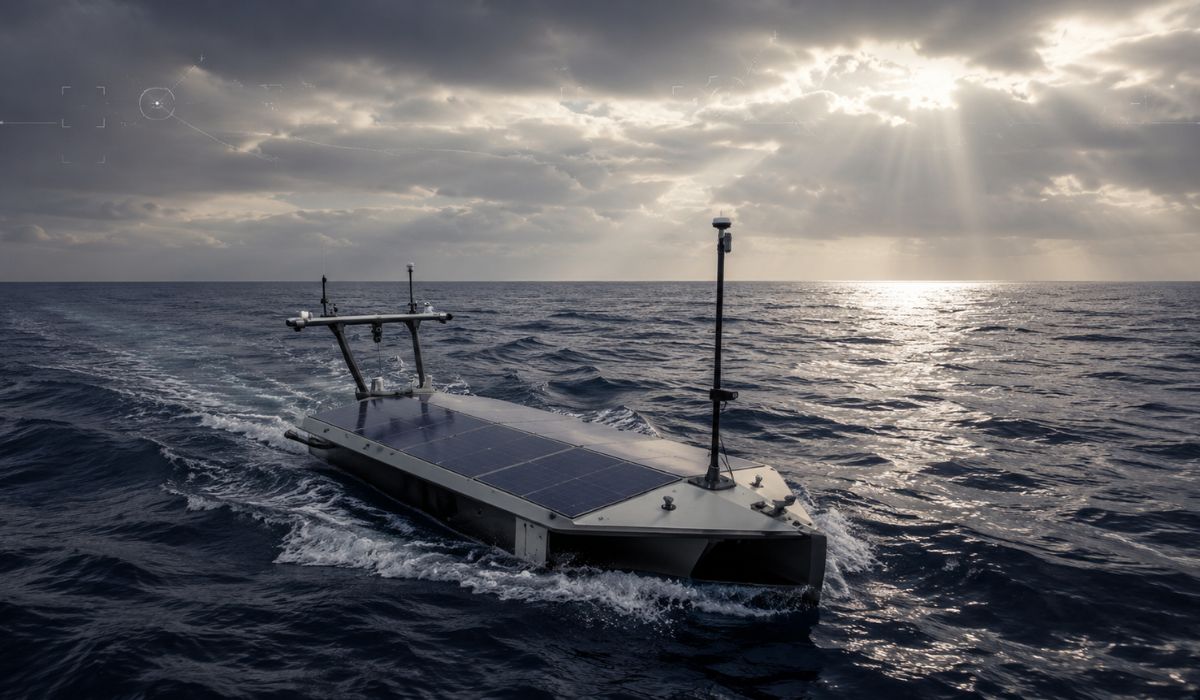


Small autonomous solar boat crosses the Atlantic in naval test that combines uncrewed navigation, remote monitoring, and embedded sensors, in a demonstration of technology applied to ocean surveillance and maritime research.
A small autonomous boat powered by solar energy, called Lightfish, completed a crossing of approximately 4,000 miles across the Atlantic between the United States and Portugal without human physical intervention during the journey.
The vessel, supported by the U.S. Navy, departed from Sullivan’s Island, South Carolina, on June 30, 2025, and arrived in Tróia, Portugal, on September 9 of the same year, after 62 days of navigation.
According to the Naval Information Warfare Center Atlantic, a U.S. Navy agency, it was the fastest known transatlantic crossing made by an uncrewed surface vehicle.
-
China’s Water Project in Southern Chad Delivers Over 500 Wells and 57 Stations, Aiding Over 600,000 Residents

-
Frustrated by Floods Damaging His Power System, Brazilian Man Builds His Own Dam and Micro-Hydroelectric Plant to Live Off-Grid

-
7,500-Year-Old Salt Production Traces in Bosnia Uncover Rare Prehistoric Technology and Shed Light on Food History

-
Man Discovers 2,000-Year-Old Roman Cistern with Drone in Brazil





The case brings together elements of autonomous technology, solar energy, embedded sensors, and long-distance remote command.
Although there was no crew on board, the Lightfish was accompanied by teams on land and by different naval commands along the route, using cameras, telemetry, and control systems.
The test integrated efforts to evaluate how uncrewed vessels can operate in prolonged maritime observation missions.
Autonomous solar boat in ocean crossing
The Lightfish is an uncrewed surface vehicle, a category known by the acronym USV, in English.
This type of vessel can navigate without people on board, follow predefined routes, transmit data, and be monitored or commanded remotely by operators in control centers.
Manufactured by Seasats, the model is described by the company as a solar-electric autonomous platform aimed at long-duration missions.
The technical sheet reports a weight of 305 pounds, equivalent to about 138 kg, a maximum speed of 5 knots, autonomy of up to six months, and an internal payload capacity of 66 pounds, about 29.9 kg.
The manufacturer also reports that the Lightfish combines solar panels, electric propulsion, battery, and hybrid reserve.
In the model released by Seasats, the vessel features communications via Iridium and Starlink, high-definition cameras, AIS, GPS, satellite communications, and onboard processing for data analysis.
These characteristics help explain the technical viability of a long crossing without a crew.
Instead of relying on frequent refueling or continuous human presence, the boat uses energy captured throughout the mission, onboard navigation systems, and remote supervision to maintain operation.
Lightfish was monitored by US Navy commands
The operation of the Lightfish did not eliminate human participation.
According to the US Navy, the crossing was conducted by the Unmanned Naval Innovation Team, linked to NIWC Atlantic, with support from Task Force 66, a unit of the 6th Fleet focused on the development and integration of robotic and autonomous systems.
Michael Grass, chief scientist and program manager of the team, stated in material released by the agency that the goal was to demonstrate the capability to execute command and control of a USV during the Atlantic crossing, including crossing different areas of responsibility.
The statement indicates that the test evaluated both the vessel’s performance and the operational coordination between commands.
Throughout the journey, the control and supervision of the Lightfish shifted between different numbered fleets of the US Navy.
According to Grass, there was a change of command and monitoring of the vessel in the morning and at night, in a distributed supervision model throughout the mission.
This arrangement shows that the term “unmanned” refers to the absence of people on board, not the absence of involved teams.
The boat crossed the Atlantic without human physical contact during the journey, but the mission required operators, engineers, communications, and monitoring protocols on land.
Test evaluated endurance, sensors, and remote operation
The crossing also served to evaluate the system’s endurance after weeks of exposure to the ocean environment.
According to the US Department of Defense, the Lightfish arrived in Portugal needing a fuel refill for the onboard generator, minor repairs, and cleaning to continue operating.
Teams also removed barnacles accumulated on the underside of the hull, something recorded after the period at sea.
After arrival, the vessel was directed to REPMUS, an exercise led by Portugal aimed at experimentation with unmanned maritime systems.
The activity brings together more than 30 nations, NATO centers of excellence, industry partners, and academic institutions to test technologies, interoperability, and command and control structures.
The operational sequence was relevant for the platform’s evaluation, according to those responsible for the program.
The Lightfish did not end its participation upon arriving in Portugal; after inspection, cleaning, and adjustments, the vessel was incorporated into experimentation activities with other autonomous systems.
In the naval context, this type of vehicle is studied to enhance the so-called maritime situational awareness, a term used by military forces to refer to the monitoring of ocean areas, vessel traffic, and events of operational interest.
Seasats also presents the Lightfish Security System as a platform aimed at intelligence, surveillance, and reconnaissance in coastal, port, and open sea environments.
Autonomous boat technology also advances in oceanic research
In addition to military applications, autonomous surface vessels can be used in environmental monitoring and oceanic research.
The Lightfish system appears in a project of the U.S. Integrated Ocean Observing System, linked to NOAA, to support collections related to harmful algal blooms in the Northwest Pacific of the United States.
In the project, the platform is described as capable of operating in conditions that may limit manned collection vessels.
Being solar-powered, the ASV can travel longer or greater distances without requiring additional fuel on board, according to the agency.
This use helps contextualize the technology beyond the defense sector.
Autonomous surface vehicles can carry sensors, collect environmental data, monitor remote areas, and support studies that require prolonged presence at sea.
The purpose depends on the installed payload and mission design.
Seasats itself presents the Lightfish as a modular platform.
According to the company, the model can be adapted for research missions, security patrols, and data collection.
The vessel is also described as portable, with the possibility of manual launch by one or two people.
Unmanned operations still require ground teams
Lieutenant Alexander Varon, responsible for unmanned software development at Task Force 66, stated in the official material that people tend to underestimate “how manned unmanned operations are.”
According to him, there is human participation in the launch, recovery, maintenance, operation, and engineering support necessary to integrate different platforms into the same ecosystem.
The military’s assessment points to one of the central characteristics of this type of technology: autonomy reduces human presence on board but does not eliminate the need for planning, supervision, and support infrastructure.
In long crossings, this structure includes communication, data analysis, route updates, and maintenance upon arrival.
Varon also stated that unmanned vehicles can be sent to dangerous environments without exposing human lives.
This statement was made in the context of the military applications of the technology and refers to the possibility of employing autonomous assets in risky or long-duration tasks.
For engineers and operators involved in the program, the crossing generated data on autonomy, endurance, and integration.
The Navy reported that the team would continue to monitor the progress of the Lightfish to refine capabilities related to autonomous navigation, endurance, and data distribution in future missions.
Lightfish Record in the Atlantic and New Missions
The NIWC Atlantic reported that the Lightfish surpassed the previous known mark by 12 days.
The agency also described the mission as the first known Atlantic crossing made by an unmanned vessel of any kind completely remotely, without physical interference along the route.
The term “known record” is important because the comparison depends on the available public records and the attempts recognized by the involved institutions.
So far, there is no detailed public identification, in the consulted official sources, of the previous crossing used as a reference for the 12-day difference.
The mission continued after arriving in Portugal.
According to the U.S. Navy, the Lightfish was supposed to proceed to Africa to participate in another exercise and then return towards Charleston, South Carolina.
The continuation of the operation indicates that the vessel was treated as a test platform in a prolonged campaign, and not just as an isolated demonstration of crossing.
For ocean surveillance, vessels of this type can complement ships, aircraft, satellites, and monitoring buoys.
They do not replace these structures, but can enhance data collection in extensive areas or areas that are more difficult to access, depending on the mission, sensor load, and available command network.