





 Portuguese
  English
  Spanish
  4 min of reading
  2 comments


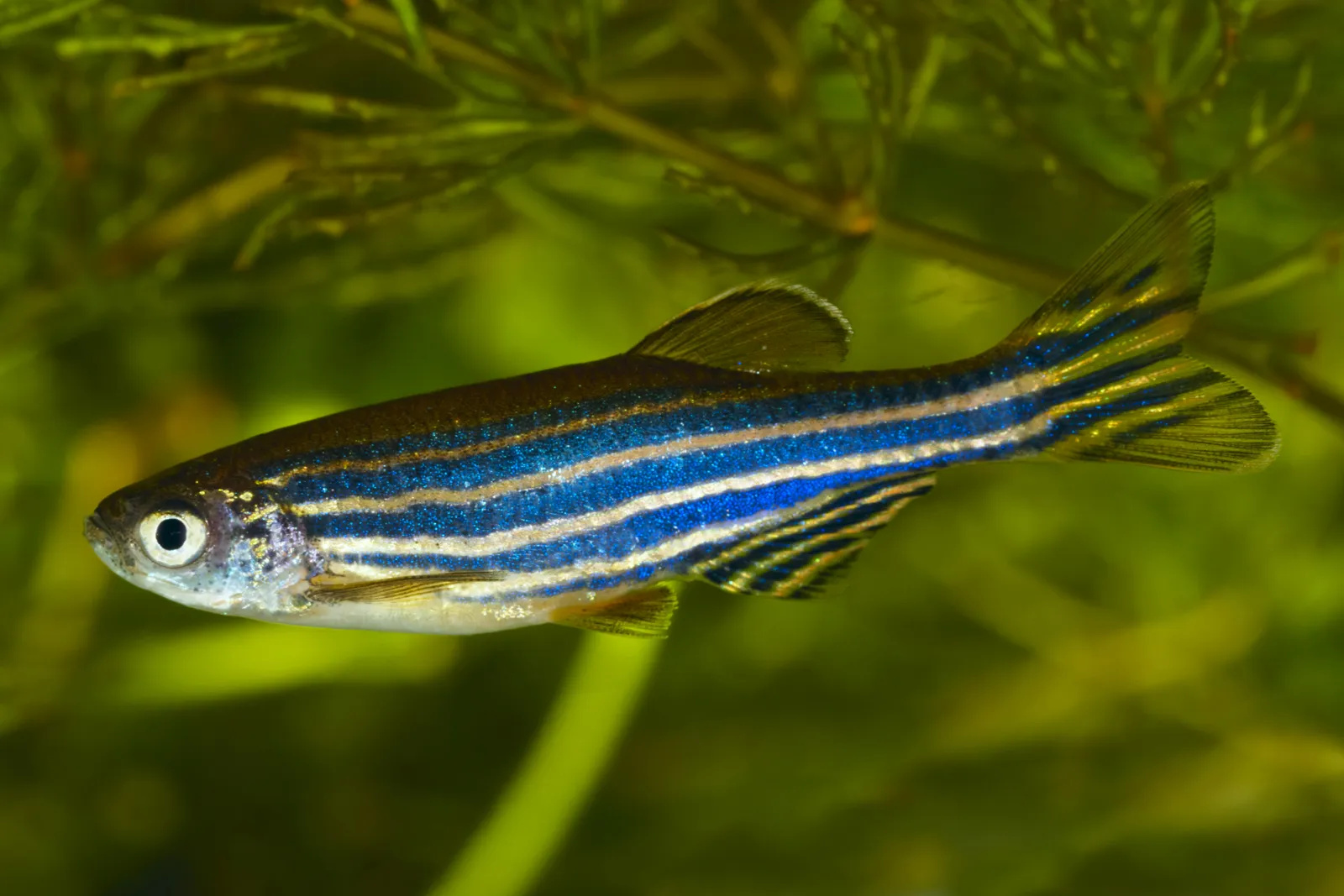


Capable of Reabsorbing and Reconstructing Entire Bones, the Danio Rerio Challenges Traditional Biology and Has Become a Key Piece of Regenerative Medicine.
The Danio rerio, known worldwide as the zebra fish, appears at first glance to be an ordinary aquarium and laboratory animal. Small, discreet, and seemingly fragile, it conceals a capacity that challenges basic concepts of vertebrate biology: the ability to dissolve parts of its own bony tissue and subsequently reconstruct them in a functional, precise way and without permanent scars. This process does not occur as a pathological anomaly, but as an active, controlled, and highly efficient biological mechanism.
What in humans would be associated with severe diseases, such as severe osteoporosis or bone necrosis, is part of a refined system of remodeling and regeneration in the Danio rerio. That is exactly why this fish has become one of the most studied organisms on the planet in research on regeneration, embryonic development, and the medicine of the future.
Extreme Bone Remodeling Challenges the Logic of Vertebrates
All vertebrates have some degree of bone remodeling throughout their lives. In humans, this process is slow, limited, and strongly regulated to avoid structural collapses.
-
Giant superatoms promise to eliminate the biggest problem in quantum computing and could surprisingly accelerate the arrival of powerful universal machines.

-
While drought threatens millions, China is advancing with a technology capable of transforming seawater into drinking water for less than US$1, generating green hydrogen, and converting waste into energy and valuable products, in a solution that can redefine the future of water scarcity in the world.

-
Technology that creates images in the air without a physical screen is already advancing in universities and companies, promises to transform cell phones, computers, and TVs into invisible interfaces, and could forever change the way we use devices in our daily lives.

-
Scientists discover that procrastination is not laziness: 2026 study reveals EV-PV circuit that blocks motivation, exposes conflict between the limbic system and prefrontal cortex, and points to a direct relationship with anxiety and fear of failure.






In the Danio rerio, however, remodeling occurs at a much deeper level. The fish is able to activate mechanisms of intense bone reabsorption, during which specialized cells literally dissolve parts of the mineralized bone.

This process does not compromise the animal’s survival because it occurs in a localized and temporary manner.
Bony regions can be partially dismantled to allow growth, structural adaptation, or regeneration after injuries. Then, the bony tissue is reconstructed almost from scratch, maintaining shape, strength, and perfect integration with muscles, nerves, and vessels.
Complete Regeneration Without Scars or Loss of Function
The most impressive aspect of the biology of the Danio rerio is the complete regeneration of complex structures. Fins, portions of the spine, cartilage, and associated bony tissues can be reconstructed after severe damage.
Unlike mammals, which respond to significant injuries with rigid healing and loss of function, the zebra fish reactivates embryonic genetic programs that allow for a faithful recreation of the original structures.
During this process, the old bone may be partially reabsorbed, making room for new bone cells to organize correctly.
The final result is not a “makeshift repair,” but an anatomical reconstruction that is practically identical to the original, something that is still beyond the reach of human medicine.
Specialized Cells Dismantle and Remount the Skeleton
At the center of this phenomenon are highly specialized bone cells. Osteoclasts come into action to reabsorb the mineralized tissue, while osteoblasts form new bony matrices.
In the Danio rerio, the coordination between these cells occurs much more rapidly and efficiently than in other vertebrates.
Additionally, the fish activates cellular populations similar to stem cells, capable of quickly differentiating into bony, cartilaginous, and connective tissues.
This cellular plasticity explains how the skeleton can be dismantled and remounted without structural collapse, something that would seem biologically impossible in larger organisms.
Body Transparency Allowed Real-Time Observation of Regeneration
One factor that has made the Danio rerio even more valuable for science is its transparency during the early life stages. In embryonic and larval stages, researchers can observe directly, in real time, how bones form, dissolve, and reorganize within a living organism.
This characteristic has enabled unprecedented advances in understanding osteogenesis, angiogenesis, and tissue regeneration. Processes that could previously only be inferred from post-mortem examinations can now be followed cell by cell, opening a new era in developmental biology.
A Key Model for Understanding Human Bone Diseases
The ability of the Danio rerio to control bone reabsorption and reconstruction has turned the fish into an essential model for the study of human diseases.
Research uses this organism to investigate osteoporosis, difficult-to-heal fractures, bony malformations, and metabolic disorders related to calcium.
Genes involved in bone formation and degradation in the zebra fish have direct counterparts in the human genome. This allows for testing medications, observing side effects, and understanding genetic flaws in a functional living system, something that is impossible to replicate faithfully in isolated cell cultures.
Regenerative Medicine Finds a Biological Map in the Danio Rerio
Perhaps the greatest impact of studying the Danio rerio lies in the field of regenerative medicine. Understanding how this fish activates genetic programs capable of reconstructing entire bones without scars provides valuable clues for future therapies in humans.
The goal is not to replicate the process literally, but to identify which molecular signals could be reactivated or modulated in human tissues.
Current research explores how to silence excessive inflammatory responses, stimulate correct cellular differentiation, and avoid the formation of rigid scar tissue. All of this is directly referencing the regenerative biology of the zebra fish.
A Small Fish That Exposes Limits and Faults of Human Biology
The Danio rerio makes it clear that the human inability to regenerate complex bones is not a universal rule of vertebrates, but a specific evolutionary limitation.
In an organism just a few centimeters long, nature has demonstrated that it is possible to dissolve and reconstruct a functional skeleton repeatedly without compromising life.
By studying this seemingly simple fish, science is not just observing a biological curiosity. It is facing an evolutionary mirror that shows how much we still do not know about the real potential of living tissues and how much human medicine still has to learn from organisms that challenge what we consider possible.








Nada que ver. La simbiosis es lo que produce los nuevos efectos y lo hace por generaciones. Nosotros no podemos hacer eso porque la comunidad científica no entienden genética ni biología. Tengo más de 20 videos científicos refutando a la evolución y a la comunidad científica neodarwinistas que atrasa la ciencia y no da resultado. Claro que nosotros también podemos hacer eso pero en generaciones a largos plazos(simbiogenesis). Vean mis vídeos científicos y aprendan genética y biología Marguliana(@la.gaia30
Que as pesquisas continuem e tragam soluções para aqueles que sofrem de males no ossos.