






 Portuguese
  Spanish
  3 min of reading
  0 comments


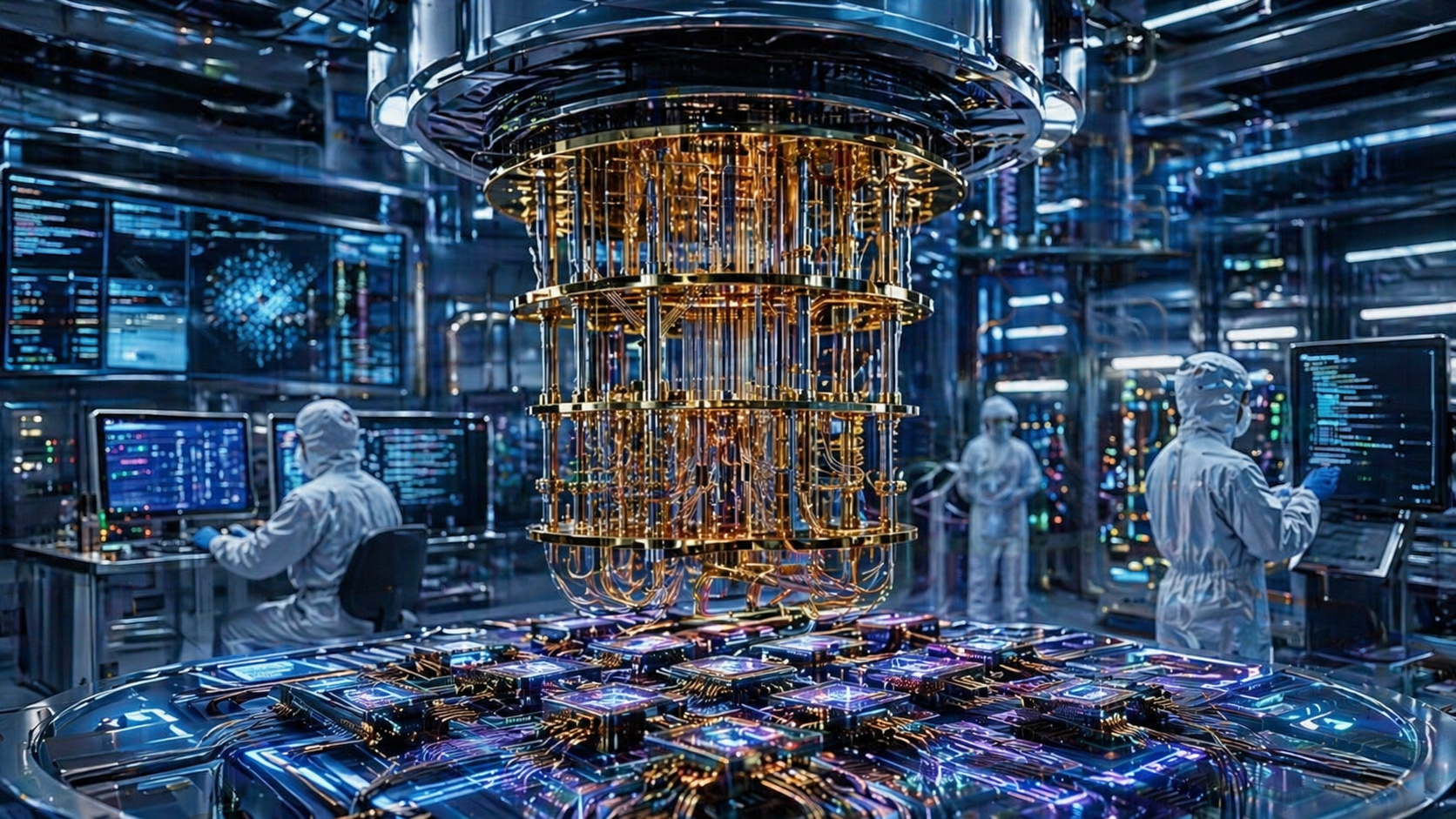
New quantum architecture based on collective structures could drastically reduce critical failures, increase operational stability, and unlock applications currently impossible in industry and science
Quantum computers are no longer just a futuristic promise but are becoming a reality, with their construction accelerated by tech giants like IBM, Google, and Honeywell. Yet, behind the technological fascination, there is a persistent—and critical—obstacle preventing these machines from reaching their true potential: constant errors in their calculations.
Despite impressive advances, current prototypes still face severe limitations. This is because qubits, the fundamental units of quantum computing, are extremely sensitive to their environment. Small external interferences can completely compromise information processing. In this context, a proposal emerges that seems to come from science fiction but could change everything: the so-called giant superatoms.
The information was reported by ScienceDaily, based on research conducted by scientists at Chalmers University of Technology in Sweden.
-
Space technology used to search for water on Mars is now hunting for invisible leaks under the streets of São Paulo, using satellites, AI, and chlorine signals to help Sabesp recover up to 6.7 billion liters of water.

-
Japan sends ship to extract mud rich in rare earths at nearly 6,000 meters deep in the Pacific, attempts to lift 350 tons per day from the seabed, and transforms sediments near Minamitori Island into a strategic weapon to reduce dependence on China.
-
Venus Aerospace promises a rotating detonation hypersonic engine that takes the Stargazer to Mach 9 and crosses oceans in 1 hour, but the flight that made history barely surpassed the speed of sound.

-
Brazilian student creates a cheap formula that makes plants grow up to 90% faster and wins an award in a global scientific competition.





The biggest challenge in quantum computing lies in the fragility of qubits
The main problem with current quantum machines is known as quantum decoherence. This phenomenon occurs when qubits interact with their surrounding environment, losing or altering essential information for calculations.
In practice, this means that quantum computers frequently make errors—and, worse, they cannot yet correct them efficiently. As a result, their practical application remains limited, especially in tasks that require high precision.
On the other hand, scientists around the world are seeking solutions on two fronts: improving error correction systems and developing more resilient qubits. It is precisely on this second path that giant superatoms come into play.
How giant superatoms work and why they are so promising

The proposal, led by physicist Anton Frisk Kockum, introduces an innovative concept that combines two already known ideas in quantum physics: giant atoms and superatoms.
Unlike a conventional atom, a giant atom is an artificial qubit capable of interacting with the environment at multiple points simultaneously, using light or sound waves. This feature allows for a significant reduction in information loss and also enables the system to “remember” previous interactions.
However, there was a significant problem: these giant atoms do not entangle easily. And quantum entanglement is essential for multiple qubits to work together as a coordinated system.
The solution found by the researchers was to combine this model with superatoms—structures formed by several natural atoms that share the same quantum state and behave as a single entity.
According to Lei Du, a member of the team, giant superatoms allow for a non-local interaction between light and matter. This means that multiple qubits can be controlled and stored as a single unit, drastically reducing the need for complex circuits.
Fewer errors, more power: the direct impact on the quantum computers of the future
The main advantage of this approach is the reduction of decoherence. In practical terms, this translates into more stable, reliable quantum computers capable of operating for longer periods without failures.
In this regard, experts point out that machines with the real ability to correct their own errors could revolutionize several areas. Among them:
- Development of new drugs
- Creation of advanced materials
- Optimization of complex industrial processes
Furthermore, these advances bring the world closer to the long-awaited universal quantum computing—systems capable of solving a wide variety of problems that are currently considered unfeasible for traditional computers.
The future is still theoretical, but the potential is already revolutionary
For now, giant superatoms still exist only in the theoretical realm. However, the team led by Anton Frisk Kockum intends to turn this concept into an experimental reality.
If this happens, we will be facing a new type of qubit — much more robust, less susceptible to interference, and ideal for large-scale applications.
In other words, this innovation could represent the turning point needed to take quantum computing from the lab to the real world.


Be the first to react!