






 Portuguese
  Spanish


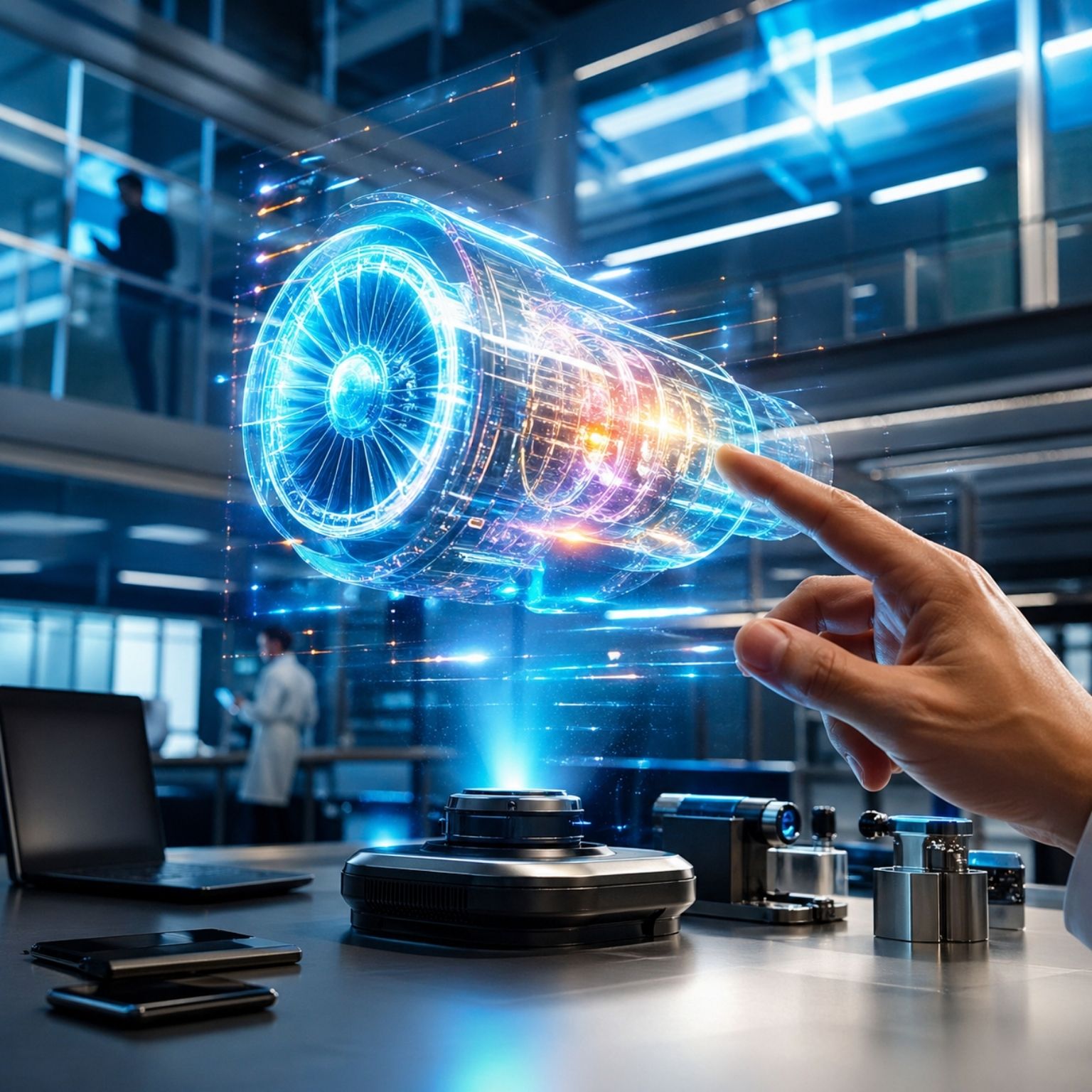


Technology that creates images in the air without a physical screen paves the way for visible interfaces and could transform cell phones, computers, and TVs into a new screen experience.
The idea of a screen that simply disappears is no longer just a movie fantasy and has begun to gain ground in laboratories, research centers, and technology companies. Instead of relying on a fixed surface, these solutions attempt to create images directly in the air, making content appear to float in space and reducing the need for the physical screen as we know it today.
This advancement is noteworthy because it involves major names in research and industry, such as the University of Sussex, Massachusetts Institute of Technology, University of Tokyo, and Looking Glass Factory. The potential impact is enormous: if the technology evolves as promised, the screen could cease to be the center of the digital experience and appear only when needed, changing how we use cell phones, computers, TVs, and other devices.
What an image without a physical screen means

For decades, the logic was simple: every image needed a screen. Whether on a cell phone, computer, or television, there has always been a surface responsible for displaying content. What this new research proposes is precisely to break that rule, creating visible images in space without relying on glass, a panel, or a traditional monitor.
-
Cassini Discovers Fresh Organic Molecules Emanating from Enceladus’ Hidden Ocean, Making Saturn’s Icy Moon a Prime Target in the Search for Extraterrestrial Life

-
Scientists Discover Simple Fluids Can Shatter Like Solids Under Extreme Force, Challenging Our Understanding of Matter

-
Xiaomi to Launch Robot Vacuum 6 Max Globally: Features 85°C Mop Cleaning, 35,000 Pa Suction, Extendable Arms, AI with 3 Cameras, and 6 cm Obstacle Clearance
-
Engineers Develop Jacket That Converts Air Humidity Into Drinkable Water, Producing Up to 900 ml Daily for Hikers, Campers, Rescuers, Rural Workers, and Military in Remote Areas



This doesn’t mean the world has already achieved the perfect holograms of science fiction. The foundation itself makes it clear that the current stage is still more related to systems that project light with extremely high precision to form visible points in the air. When these points are organized, the image appears to float. In other words, the screen is no longer on a physical object but occupies the space around the user.
How the invisible screen works in practice
The operation of this technology involves advanced concepts of optics, photonics, and light manipulation. In simple terms, the systems use lasers or highly controlled light beams to create luminous points suspended in the air. In some approaches, microscopic particles or even the air itself serve as a base to reflect the light.
In practice, this allows for the creation of shapes, images, and visual signals without a conventional screen. Instead of looking at a surface, the person looks at the space where the image was created. It is precisely this principle that places the invisible screen at the center of a transformation that could affect various devices in the future.
Who is already working to replace the traditional screen
The foundation shows that this race is not restricted to a single company or university. Researchers at the University of Sussex have already demonstrated the creation of visible points in the air with a laser, allowing images to be formed directly in space. Researcher Sriram Subramanian has also led projects related to interfaces that can be seen and even touched in the air.
At the same time, companies like Looking Glass Factory have already developed three-dimensional holographic displays that do not require special glasses. In Japan, researchers are working on Mid-Air Display systems that allow interaction with virtual buttons in the air. Institutions like MIT and the University of Tokyo also appear in this scenario, studying ways to manipulate light, projection, and ultrasound to create spatial and interactive interfaces without a physical screen.
What is already possible without a common screen
Even with limitations, these technologies can already deliver concrete results. According to the foundation, systems capable of creating floating three-dimensional images, simple interfaces, and even buttons that can be pressed in the air already exist today. In some prototypes, sensors detect hand movements and respond as if the user were touching an invisible screen.
This point is decisive because it shows that the change is not restricted to image display. The advancement already includes interaction. The screen is no longer just a place to view content but becomes a digital environment where the person can also act, select, press, and command functions without touching a physical surface.
Why this technology attracts so much attention
The appeal of this innovation lies in the practical effect it can generate. If the physical screen is no longer mandatory, the design of devices changes completely. Cell phones, computers, and televisions could lose part of the structure that seems indispensable today and start operating with interfaces that only appear when needed.
This also changes the user’s relationship with the environment. Instead of carrying a screen all the time, a person could trigger content by gesture, command, or proximity, with the interface appearing in the air. Technology would cease to occupy a fixed space and would integrate into the environment much more discreetly.
Where the screen in the air could be most useful first
The source indicates that contactless interfaces can be very useful in medical, industrial, and everyday environments. In places where touching surfaces can be inconvenient or inappropriate, a screen that appears in the air and responds to hand movements opens up new possibilities for use.
This potential helps explain why the technology is being studied so carefully. The invisible screen doesn’t just serve to impress. It can address situations where hygiene, agility, space, or practicality make a difference. This extends the value of the innovation beyond entertainment and visual effects.
What still prevents the physical screen from disappearing now
Despite the progress, the source itself issues an important warning: the replacement of the traditional screen has not yet happened. Image quality can drop in brightly lit environments, the cost remains high, and many solutions still depend on large or controlled equipment. This limits mass adoption and prevents the technology from already taking the place of the cell phone or monitor.
In other words, the physical screen still remains dominant at present. What exists today are demonstrations, prototypes, and systems that prove the concept works, but they still face obstacles to reaching widespread consumption. The promise is strong, but the commercial scale does not yet fully match the project’s ambition.
What changes in practice if the screen disappears


If this evolution continues, the change will be profound. The cell phone may no longer depend on a fixed display. The computer could exist without a monitor and without a visible keyboard. The television could stop occupying the wall as a permanent panel and only appear when activated.
This scenario changes not only the devices but also the very organization of the home, work, and technology consumption. The screen would cease to be an object and would become a function activated on demand. It’s a change that affects design, user experience, and even the way people understand the presence of technology in daily life.
Why the invisible screen is no longer just science fiction
The strongest point of this discussion is that it no longer depends solely on imagination. The source gathers concrete examples from universities, companies, prototypes, and research showing that the surfaceless screen is already being pursued in a real and practical way. It is no longer just a cool idea from a futuristic movie.
What still separates this future from the present are cost, miniaturization, quality, and scale. But the direction is already set. And, looking at the speed with which optics, photonics, sensors, and interaction systems are advancing, the hypothesis of a world less dependent on physical screens seems increasingly plausible.
Would you use a technology that replaces the physical screen with images and buttons floating in the air?


