





 Portuguese
  English
  Spanish
  6 min of reading
  0 comments


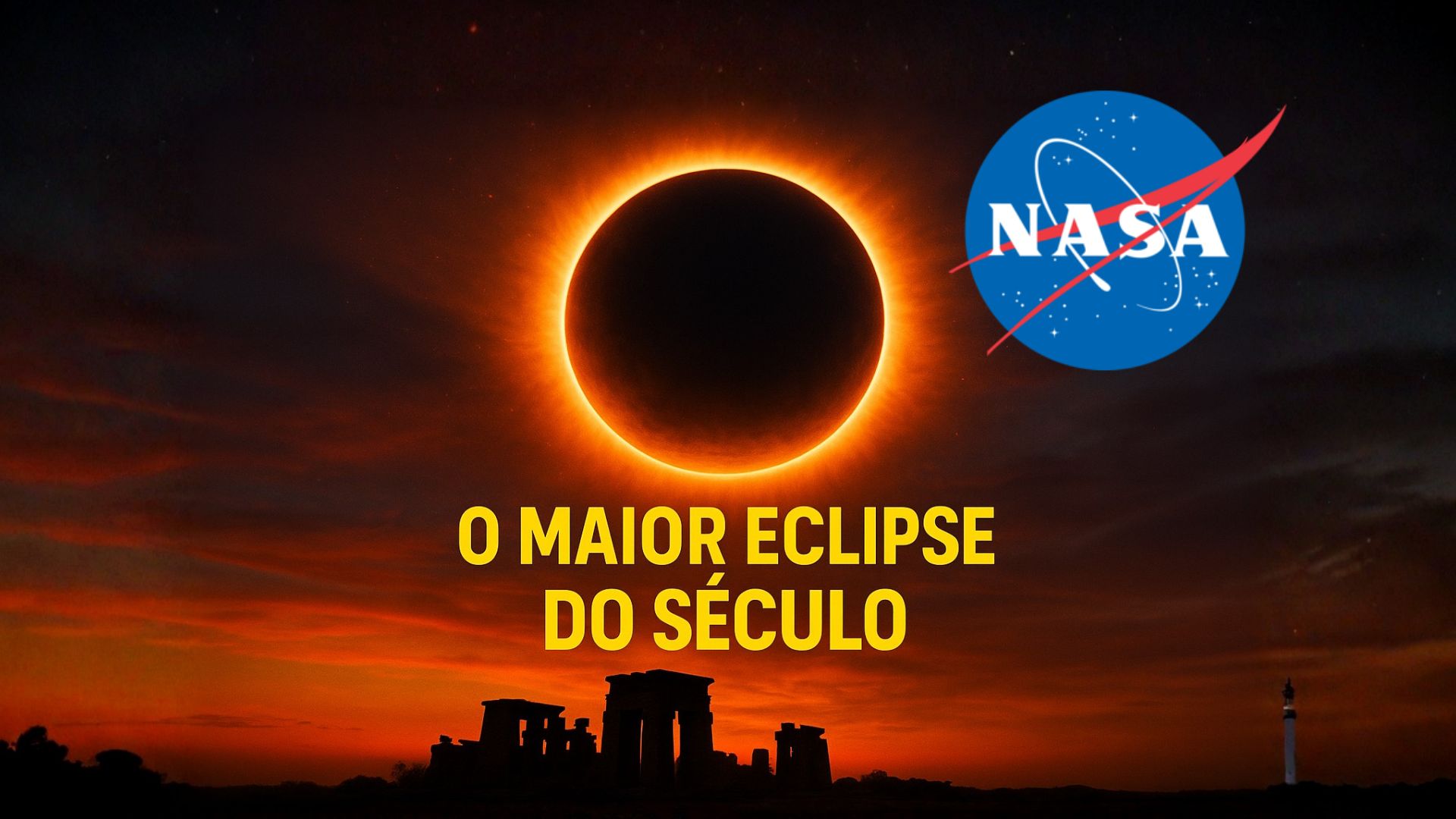
2027 Solar Eclipse Promises Rare Duration and Passage Through Populated Areas, Attracting Global Interest While Turning Day Into Night for Several Minutes.
On August 2, 2027, a total solar eclipse will transform day into night for up to 6 minutes and 23 seconds along a path that crosses the Atlantic, southern Spain, northern Africa, and parts of the Middle East.
Although the phenomenon cannot be seen from Brazil, the combination of long duration and passage over densely populated areas has already led to this event being informally referred to as the eclipse of the century in various countries.
In practice, this is one of the longest total eclipses of the 21st century and the one with the longest duration of darkness on accessible land, with the peak expected in the region of Luxor, Egypt.
-
Who owns the 2.5-acre fortress island in Wales valued at £3 million, which attracts attention with a helipad, terrace bar, office with a sea view, and even a hydraulic crane?

-
Scientist discovered that people with high abilities exhibit 4 unusual behaviors
-
New rule introduces automatic CNH renewal in Brazil, but excludes drivers in some conditions
-
Cyclones and above-average rain arrive in Brazil, driven by anomalies in the Pacific, with extreme accumulations like 539.9 mm, cold temperatures with lows of 13°C, and a high risk of frost in the South.




The path of maximum shadow will cross historic cities, tourist areas, and major urban centers, which should mobilize scientists, amateur observers, and the tourism sector on multiple continents.
Where the Eclipse Will Be Fully Visible
The path of totality will begin over the Atlantic Ocean, still offshore, and will reach the continent passing through the Strait of Gibraltar.
From there, the shadow of the Moon will advance through southern Spain and countries in northern Africa, proceeding to the Middle East and ending in the Indian Ocean.
On the European continent, only southern Spain will be within the complete darkness path.

Cities and areas such as the province of Cádiz, parts of Málaga, as well as Ceuta and Melilla will experience a few minutes of day turned into night, with durations varying from about 2 to nearly 5 minutes, depending on the exact observation point.
Shortly after, the path of totality continues through Morocco, Algeria, Tunisia, and Libya, crossing the northern part of the African continent.
It then crosses Egyptian territory, where the maximum duration approaches 6 minutes and 23 seconds in areas near Luxor, in the Nile Valley.
This region is home to famous archaeological sites, such as ancient temples, which should attract a large influx of visitors interested in seeing the sky darken over millennia-old ruins.
After Egypt, the shadow reaches Saudi Arabia and Yemen, passing through cities like Jeddah and areas near Mecca, and continues toward the Horn of Africa, reaching parts of Somalia.
The path concludes over remote islands in the Indian Ocean, where the eclipse will already be in its final phase.
For the Brazilian public, the event will only be observable from a distance, through live broadcasts and records of scientific missions.
The geometry of the alignment between the Sun, Moon, and Earth ensures that the path of shadow remains entirely in the Eastern Hemisphere, with no visibility, not even partial, in South America.
Global Timeline for the Eclipse on August 2, 2027
Considering the planet as a whole, the reference times for the eclipse are calculated in Coordinated Universal Time (UTC).
The first region on Earth will begin to see the Sun partially covered at around 7:31 AM UTC, which corresponds to 4:31 AM in Brasília time.
Shortly after, at around 8:24 AM UTC (5:24 AM in Brasília), the path of totality effectively begins, when the Moon completely covers the solar disk at a first point along the path.
The moment of maximum eclipse is expected at around 10:07 AM UTC, equivalent to 7:07 AM in Brasília time, when the duration of darkness reaches its maximum value.
The final part of the phenomenon occurs as the shadow moves away from the Earth’s surface.
The last location to register totality should exit the darkness around 11:50 AM UTC (8:50 AM in Brasília), while the last vestige of partial eclipse disappears near 12:44 PM UTC, which corresponds to 9:44 AM in Brasília time.
After this time, the Sun will reappear completely at all points on the globe.
Each city along the path of totality has its own start, maximum, and end intervals, adjusted to the local time zone and exact geographic position.
In cities in southern Spain, for example, total darkness occurs in the late morning, while in parts of Egypt, the peak occurs around noon local time.
Why Day Turns to Night in a Total Solar Eclipse

A total solar eclipse occurs when the Moon is positioned exactly between the Earth and the Sun, such that its apparent disk in the sky is slightly larger than that of the Sun.
In this configuration, the Moon casts a main shadow, called the umbra, over a narrow path on the Earth’s surface.
Those within this path will see the Sun disappear for a few minutes, and the sky darkens as if it were night.
Outside this central path, a broader region is covered only by the partial shadow, the penumbra.
In these areas, the Sun appears “bitten,” with a fraction of the disk obscured, but without complete darkening of the environment.
The transition between fully visible Sun, partial covering, and totality is gradual, and the entire phenomenon usually lasts more than two hours at the same location, although the phase of total darkness does not exceed a few minutes.
Despite attracting a lot of attention, solar eclipses are not as rare when considering the entire planet.
On average, total eclipses happen approximately every 18 months, while partial eclipses occur at least twice a year.
In the same spot on the globe, however, the recurrence of a total eclipse takes hundreds of years.
This local rarity explains why most people see, at most, one or two total eclipses over their lifetime without traveling to chase the phenomenon.
Comparison With Recent Eclipses and Duration Records
In April 2024, a total solar eclipse crossed North America, passing through Mexico, the United States, and Canada.


In that event, the maximum duration of totality was around 4 minutes and 28 seconds, a time already considered long.
The eclipse on August 2, 2027, will surpass this mark, reaching 6 minutes and 23 seconds in the region of greatest darkness.
Still, it is not the absolute record-holder of the 21st century.
The longest duration of this century occurred during the eclipse on July 22, 2009, which reached about 6 minutes and 39 seconds, mainly over the Pacific Ocean.
Therefore, astronomers describe the 2027 event as the second longest total eclipse of the 21st century, but the longest in easily accessible land areas, especially in Egypt.
Safety and Ways to Observe the Eclipse
Before observing a solar eclipse, experts emphasize that looking directly at the Sun without adequate protection can cause permanent eye damage.
Only certified filter glasses, such as those meeting ISO 12312-2 standards, or indirect projection methods are safe during the partial phases.
During totality, when the Sun is completely covered, experienced observers often remove protection for a few moments to see the solar corona.
As soon as the smallest fragment of the Sun reappears, protection must be put back on immediately.
Those in Brazil on August 2, 2027, will be able to track the shadow’s progress in real-time through broadcasts from observatories, space agencies, and educational projects.
Knowing this well in advance, can you imagine traveling to see night fall in broad daylight, or do you prefer to follow everything on the screen?







-

-

-

-

-

-

60 people reacted to this.