






 Portuguese
  Spanish
  6 min of reading
  0 comments


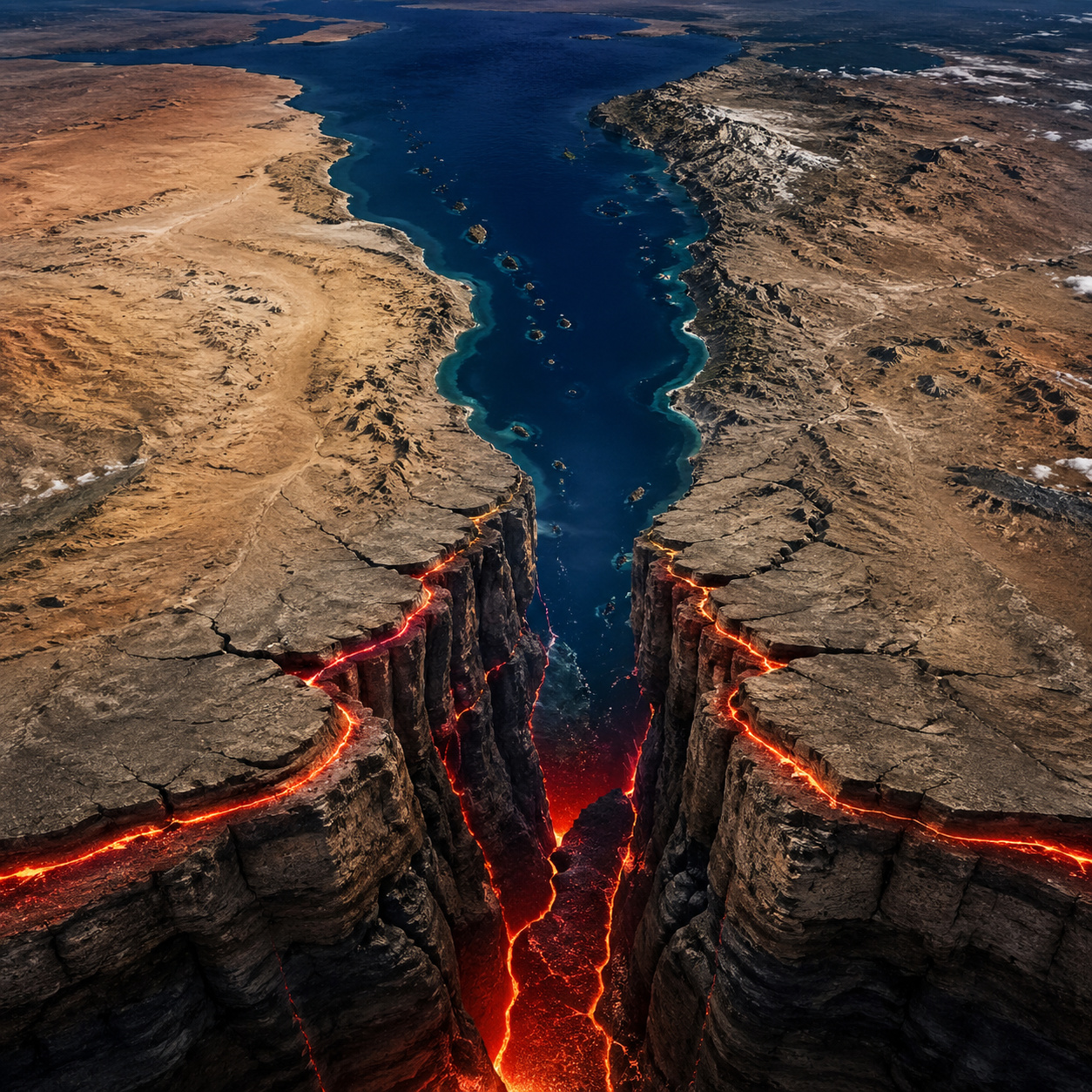
Study shows that the Gulf of Suez continues to open, even though considered inactive, with plates moving apart and revealing still active tectonic dynamics.
On November 3, 2025, a study published in the scientific journal Geophysical Research Letters changed the geological understanding of the Gulf of Suez, in Egypt, between northeast Africa and the Sinai Peninsula. The research, led by David Fernández-Blanco, analyzed about 300 kilometers of the Suez Rift and indicated that the region, considered for decades a practically inactive rift, is still undergoing a slow opening of the Earth’s crust, with estimated rates between 0.26 and 0.55 millimeters per year.
The conclusion challenges the idea that the tectonic system would have been “closed” about 5 million years ago, after the main opening phase began when the Arabian plate moved away from the African plate. Based on topographic profiles, fluvial relief, and terraces of ancient coral reefs now elevated up to 18.5 meters above the gulf level, researchers point out that the deformation did not stop, it only slowed down, keeping the Suez Rift in a residual phase of tectonic extension.
The new interpretation suggests that, even after millions of years of deceleration, the Earth’s crust there has not completely stopped deforming, maintaining a residual movement that can be detected with modern measurement tools.
-
Public school students in the hinterlands of Maranhão create a bioinsecticide with neem and castor to protect corn crops, transform rural waste into biogas and biofertilizer, and bring sustainable technology to producers at ExpoSertão.

-
Ötzi, the 5,300-year-old mummy found in the Alps, reveals a still active microbiome, and the Iceman’s yeast points to an energy-saving fermentation.

-
More than half of the Earth’s largest lakes are shrinking simultaneously: satellites reveal that 53% of the largest lakes and reservoirs have lost water over three decades, in a collapse equivalent to 17 times the largest reservoir in the United States.

-
Goodbye to the microwave: the appliance present in 96% of Brazilian kitchens is starting to lose space to a single device capable of heating, baking, broiling, and preparing recipes like a microwave, electric oven, and air fryer, occupying practically the same spot on the counter.


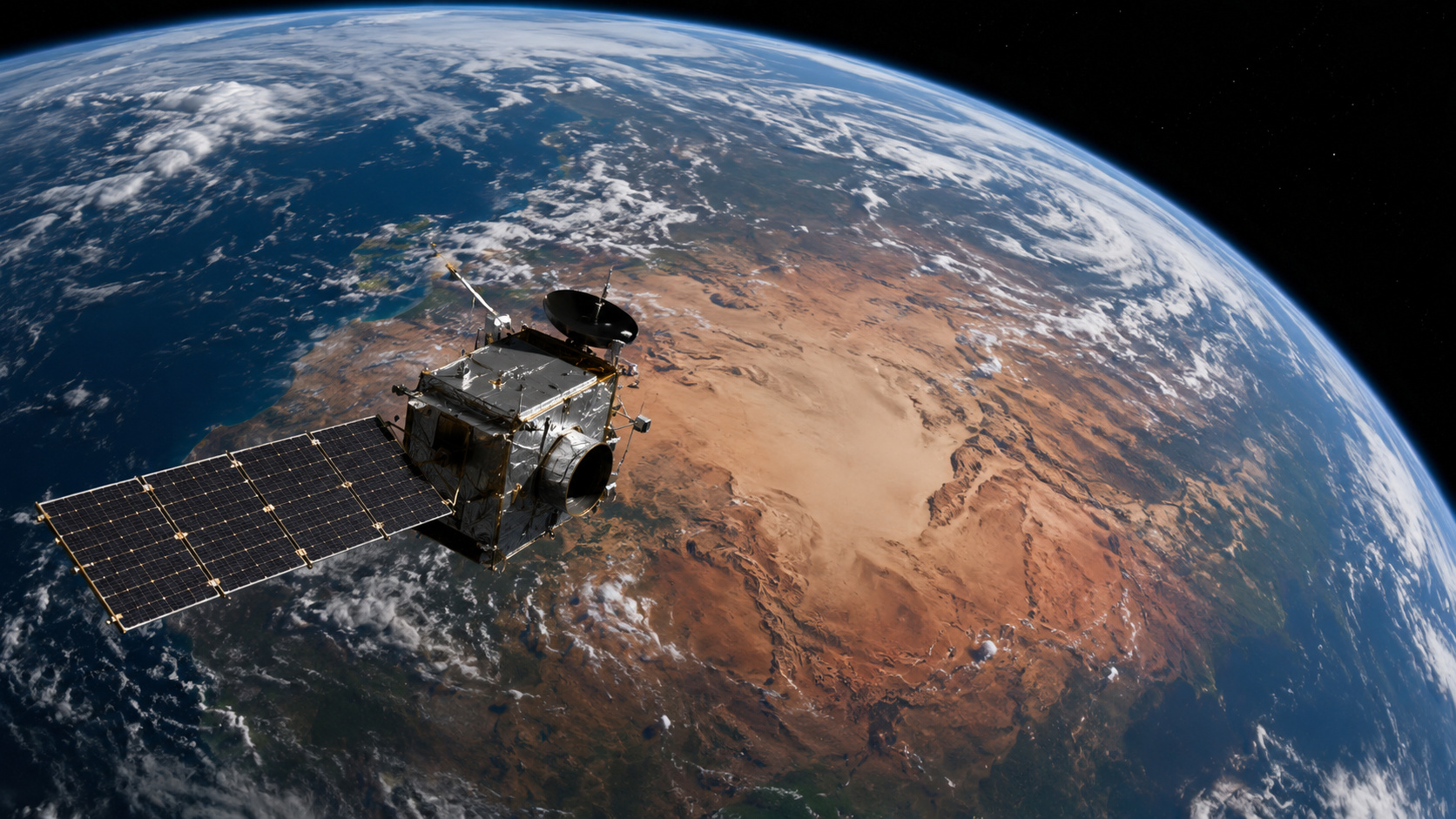

The Gulf of Suez is part of a complex tectonic system that connects Africa, Asia, and the Red Sea
To understand the relevance of the discovery, it is necessary to look at the broader tectonic context of the region. The Gulf of Suez is part of a larger plate separation system that includes the Red Sea and the East African Rift, one of the largest continental opening zones on the planet.
While the Red Sea remains active and expanding, with the formation of new oceanic crust, the Gulf of Suez has always been treated as a secondary arm of this system, whose activity would have drastically decreased after the reorganization of tectonic plates in the region.


The dominant idea was that the opening process had practically ceased, leaving behind a fossilized geological structure, that is, a “scar” of ancient tectonic movement. The 2025 study, however, shows that this interpretation may be incomplete.
Evidence shows that the crust is still being stretched, even at an extremely slow pace
Researchers identified clear signs of recent deformation in the region, even if on an annual millimeter scale. Among the main indications are:
- Elevation of ancient coral reefs above current sea level
- Deformations in drainage systems
- Activity in previously mapped geological faults
- Geodetic measurements indicating continuous plate separation
These combined data indicate that the Gulf of Suez is not a completely inactive system. On the contrary, it still responds to regional tectonic forces, albeit much more slowly than in the past.
This type of movement is called residual deformation, and can persist for millions of years after the main opening phase of a rift.
Why this slow movement matters for science and for understanding Earth
At first glance, a displacement of less than 1 millimeter per year might seem irrelevant. However, in geology, this type of movement has profound implications.
First, it shows that tectonic structures considered closed can remain active at subtle levels, which changes how scientists classify and interpret these regions.
Second, it helps to better understand the evolution of continental rifts, especially those that have not evolved into fully formed oceans.
The Gulf of Suez thus becomes a rare example of an intermediate tectonic system, which is not fully active like the East African Rift, but is also not completely dead.
This type of environment is fundamental for testing geological models and understanding how continents fragment over time.
The region reveals how ancient Earth fractures can remain active for millions of years
One of the most relevant points of the study is the idea that ancient tectonic fractures can remain “active” for extremely long periods, even after the main activity has subsided.
In the case of the Gulf of Suez, the initial opening occurred approximately 20 to 25 million years ago, during the Miocene. Since then, it was believed that activity had practically ceased.

The new evidence shows that this is not entirely correct. Even after millions of years, the crust continues to be slowly stretched, suggesting that regional tectonic forces are still acting on the area.
This behavior is not exclusive to the Gulf of Suez, but it is rarely documented with this level of detail, precisely because it requires high-precision measurements over time.
Comparison with other tectonic systems shows how unusual this behavior is
When compared to other active rifts, the Gulf of Suez exhibits atypical behavior. In the East African Rift, for example, opening occurs at rates that can reach several millimeters per year, with intense volcanic and seismic activity. In the Red Sea, expansion has already led to the formation of oceanic crust.
In the Gulf of Suez, on the other hand, there is no evidence of recent oceanic crust formation or significant volcanic activity associated with the current opening.
This places the region in an intermediate category, where the tectonic process continues, but without evolving to a more advanced stage.
This characteristic makes the gulf particularly interesting for geological studies, as it represents a less common phase in the evolution of continental rifts.
The discovery helps refine models on how continents divide over time
The division of continents is one of the most important geological processes, responsible for the formation of oceans and the reorganization of the Earth’s surface.
Traditionally, this process is described in well-defined stages: initiation of fracturing, rift formation, expansion, and eventual ocean formation. The case of the Gulf of Suez shows that this sequence can be more complex than previously thought.
Not all rifts follow the same path, and some may remain in intermediate states for much longer periods than expected.
This discovery forces scientists to reconsider simplified models and incorporate more detailed regional variations.
Implications for geological risks and monitoring of the region
Although the identified movement is extremely slow, it still has relevance for geological monitoring of the region. Tectonic deformations, even small ones, can be associated with:
- Low-intensity seismic activity
- Reactivation of ancient faults
- Gradual changes in the landscape
This does not mean there is an immediate risk of catastrophic events, but it reinforces the importance of monitoring regions that, at first glance, might be considered stable. The identification of residual activity can also help improve seismic risk models in adjacent areas.
The Gulf of Suez shows that Earth continues to transform even where it seemed static
The main message of the discovery is simple, yet powerful: the Earth rarely stays completely “still“.
Even in regions where the main tectonic activity occurred millions of years ago, slow and continuous processes can persist, shaping the crust almost imperceptibly in the short term, but significantly over geological time.
The Gulf of Suez, viewed for decades as a closed structure, now reveals that it is still transforming, albeit on a scale that requires precise instruments to be detected.
This shift in perspective reinforces the idea that the planet is a dynamic system, where even the most seemingly stable regions can hide active movements.
Now, in light of this discovery, an inevitable question arises: if structures considered “dead” can still move silently for millions of years, how many other regions of the planet might be changing without us realizing it?







-

-

-

-

6 people reacted to this.