





 Portuguese
  English
  Spanish
  4 min of reading
  0 comments


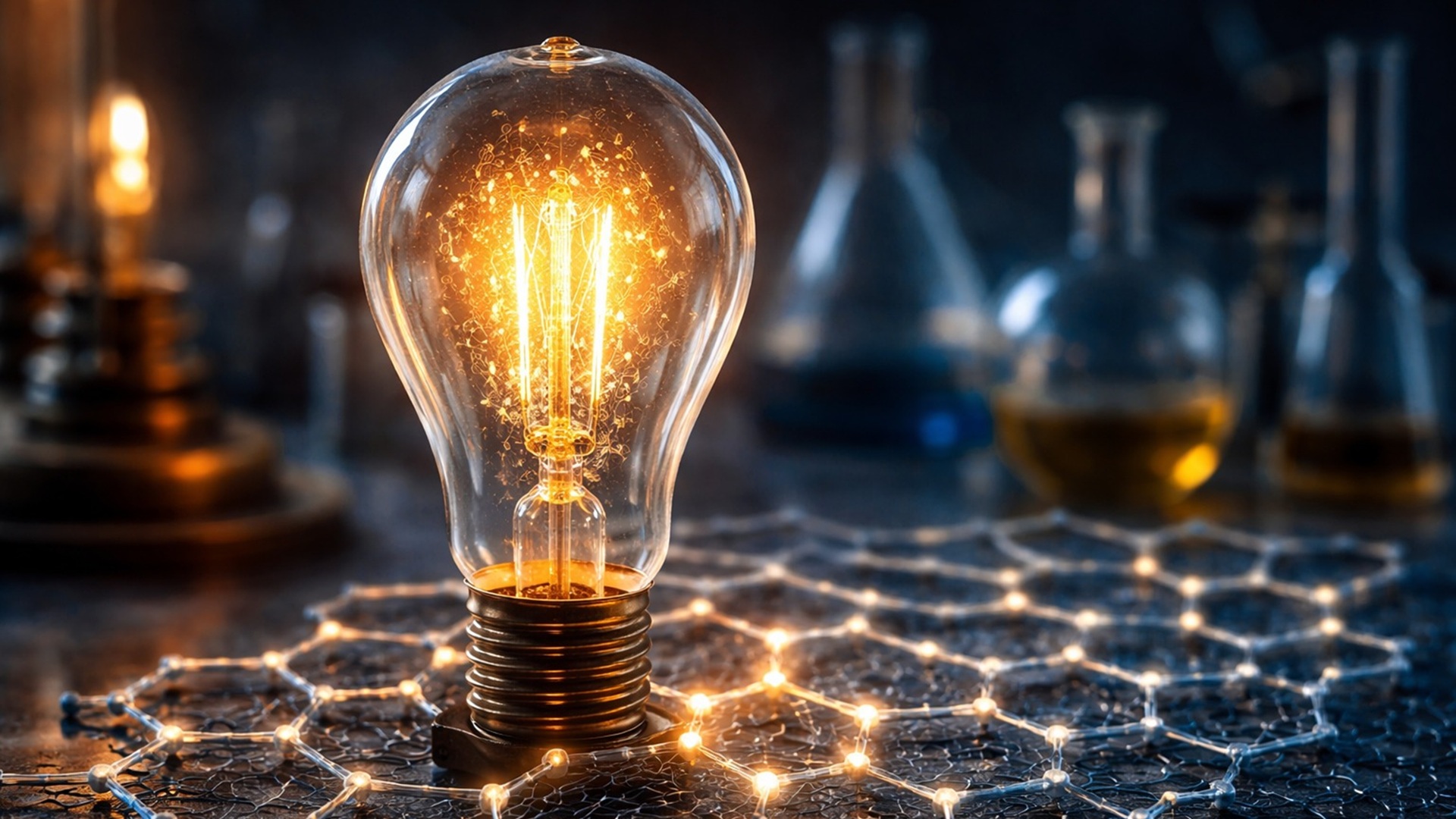
Research Conducted by Scientists in the United States Indicates That Tests Conducted by Thomas Edison in 1879, with Carbon Filaments Exposed to Electric Current Similar to Modern Joule Heating, May Have Generated Turbostratic Graphene Unintentionally, More Than a Century Before Its Scientific Identification
Researchers in the United States have identified evidence that Thomas Edison may have accidentally produced graphene in 1879 while testing carbon filaments in incandescent lamps under electrical conditions similar to those used today in modern Joule heating processes.
Historical Reconstruction of the Incandescent Lamp Experiments
The study was led by James Tour, PhD, professor of chemistry, material science, and nanoengineering at Rice University. The research aimed to reconstruct, with current analytical tools, the original experiments conducted by Edison in the late 19th century.
The team replicated the design of the carbon filament lamp developed in 1879 and applied electrical conditions similar to those of the time. During the tests, the researchers observed that parts of the filament transformed into turbostratic graphene.
-
A country surrounded by scarcity transforms treated sewage into an “agricultural weapon” while the river that supplied generations becomes a regional dispute: Israel recycles almost 90% of its wastewater for irrigation and exposes the water abyss of its neighbors who still depend on what’s left in the Jordan River.

-
Climate change and pollution elevate heart risks: analysis with over 8 million people links extreme heat to 7.5% more complications and 9.5% more deaths, while pollutants already appear in 13% of cardiovascular deaths.

-
An online tool recreates the position of your house on Earth over up to 320 million years and shows how tectonic plates, lost continents, and geological collisions changed the planet’s map up to the present day.
-
China proposes to transform the rarefied atmosphere of Mars into electricity, heat, and fuel with CO₂, nuclear microreactors, and a Sabatier reactor, in a study that could reduce dependence on cargo sent from Earth and pave the way for more autonomous human missions.




According to Tour, reproducing the historical experiments with the knowledge and instruments available today allowed for the observation of phenomena that could not be identified in the original period due to the technological limitations of the time.
Turbostratic Graphene and Its Structural Characteristics
Turbostratic graphene is a form of multilayer graphene characterized by random, rotated, and misaligned stacking between layers.
This specific structure differentiates the material from other more ordered forms of graphene.
This variation of graphene is considered especially relevant for large-scale production, with highlighted applications in energy storage and in the reinforcement of composites used in various industrial sectors.
Graphene, in general, consists of a single two-dimensional layer of carbon atoms arranged in a hexagonal structure resembling a honeycomb, with a thickness of only one atom.
It is recognized as the thinnest material and one of the strongest ever studied, being about 200 times stronger than steel, while also exhibiting high electrical conductivity, flexibility, and transparency.
Joule Heating and Parallels with the 19th Century
Currently, one of the known methods for producing turbostratic graphene is the so-called instant Joule heating. In this process, an electric current rapidly heats carbon-based materials.
The temperatures achieved range from approximately 2,000 to 3,000 degrees Celsius, equivalent to 3,600 to 5,400 degrees Fahrenheit, promoting structural rearrangements in carbon.
In the late 19th century, Edison used carbon-based filaments, often produced from natural materials, such as Japanese bamboo, instead of tungsten used in modern lamps.
When electricity passed through these filaments, electrical resistance caused intense heating, sufficient to generate light. The team assesses that these conditions were very similar to those of modern Joule heating.
Experimental Hypothesis and Material Selection
Lucas Eddy, a former student at Rice University and the first author of the paper, reported that he sought to identify the simplest possible equipment for the mass production of graphene with accessible materials.
During this process, he recalled that the first incandescent lamps used carbon filaments, which raised the hypothesis that these devices could reproduce suitable conditions for the material’s formation.
Eddy examined different alternatives, from arc welders to trees struck by lightning, before concluding that Edison-style lamps provided a more direct and controllable model for laboratory testing.
For the experiments, the researchers obtained Edison-style handcrafted lamps from a small art shop in New York City, designed according to the specifications of the original 1879 patent.
Procedures, Analyses, and Results Obtained
The lamps were connected to a 110-volt direct current source, as per the original configuration described in historical records, and remained energized for approximately 20 seconds.
The scientists observed that longer exposures could lead to the formation of graphite instead of graphene. After the tests, optical microscopy was performed on the filaments.
The analysis revealed a visual change in the surface, which went from dark gray to a silver and metallic appearance. Subsequently, Raman spectroscopy was applied for material identification.
This laser analytical technique enables the recognition of substances through atomic-level signatures. The results confirmed the presence of turbostratic graphene in parts of the analyzed filament.
Although it is not possible to determine if graphene persisted in Edison’s original experiments, the data suggest that it may have formed briefly during the historical tests, even if it went unrecognized at the time.
Publication and Implications of the Discovery
The study was published in the scientific journal ACS Nano. For Tour, the discovery raises questions about other information possibly hidden in classic historical experiments.
According to him, the combination of old records with modern techniques may reveal previously unidentified phenomena, expanding the understanding of scientific advancements from the past and their connections with current technologies.
The research reinforces the idea that processes considered modern may have occurred accidentally in historical contexts, even without the necessary conceptual or instrumental recognition for their formal identification at the time, opening new lines of historical and scientific investigation.








-

-

-

-

-

-

13 people reacted to this.