





 Portuguese
  English
  Spanish
  5 min of reading
  0 comments


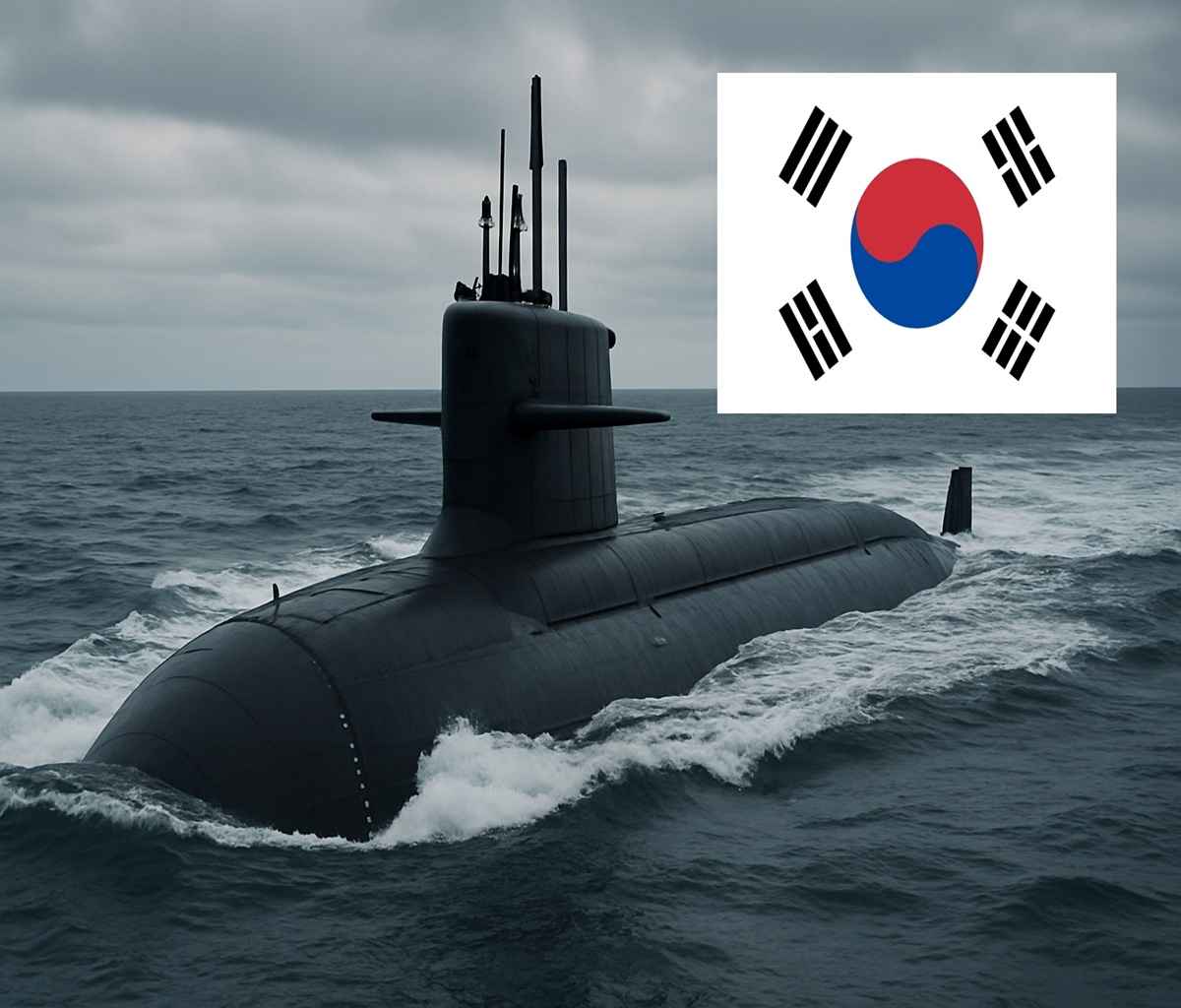
In Light of the Growing Threat from North Korea and the Strategic Dispute in the Pacific, South Korea Wants More Autonomy in Its Defense. The Country is Once Again Discussing Nuclear-Powered Submarines and May Even Renegotiate the Nuclear Treaty with the United States to Enable the Project.
South Korea may be close to a significant breakthrough in its defense policy. On July 18, 2025, Cho Hyun, nominated for the position of Minister of Foreign Affairs, declared that he intends to renegotiate Agreement 123 with the United States. The goal: to allow the development or acquisition of nuclear-powered submarines.
The proposal marks a possible turning point in atomic cooperation between the two countries and reignites the discussion on South Korean military autonomy in the face of the growing threat from the North.
Nuclear Submarine as a Dissuasion Strategy
Currently, the US-South Korea Agreement 123, which governs peaceful nuclear cooperation between the countries, prohibits the enrichment and reprocessing of fuel for military purposes.
-
NASA has just tested a “giant” the size of a car that could change everything in the lunar race: a fuel cell that turns water into energy and then recharges itself, without any refueling from Earth. See how it works.

-
Researchers from the National Institute of Anthropology of Mexico mapped an entire site called El Jefeciño along the route of the Maya Train, with 80 stone buildings, a C-shaped plaza, and 250 acres inhabited between 250 and 900 A.D.

-
While SpaceX and Boeing compete for billion-dollar NASA contracts, Turkey has begun constructing a spaceport in Somalia to launch rockets near the equator and transform the Horn of Africa’s coastline into a strategic shortcut to reach space by 2028.
-
Archaeologists find a vase hidden for 1,200 years on a pilgrimage route with more than 100 jewels of gold, silver, and precious stones.



Cho Hyun’s intention is precisely to create room within this treaty to enable nuclear-powered submarines, which would give South Korea greater deterrent capacity and less dependence on the US Navy.
Cho stated that, after an internal review and coordination with the US, the country could consider introducing these submarines as a tool for strategic enhancement.
Moreover, the minister emphasized that the recent resolution of a bilateral dispute over intellectual property removed one of the main hurdles to resuming high-level technological cooperation with the Americans. This makes it feasible to develop low and high-enriched uranium for small modular reactors.
Parliamentary Support and International Scenario
The idea gained traction with the support of South Korean lawmakers. Kim Gunn cited reports that North Korea is trying to obtain nuclear submarines from Russia and is believed to already be developing its own. For him, nuclear-powered submarines are the only way to maintain strategic balance in the region.
Yu Yong-weon, from the People Power Party, argued that South Korea should negotiate concessions with the US in exchange for a relaxation of the agreement. Cho Hyun agreed, stating that it would be possible to convince Washington that activities would remain strictly civilian.
With the dispute resolved, the country could move forward in developing fuel for small reactors and aim for domestic capacity to enrich uranium up to 20%, within the limits allowed by the revised version of Agreement 123.
Limits of Agreement 123 and US Position
The 2015 version of the US-South Korea Agreement 123 prohibits the enrichment of uranium above 20% and the use of US-origin materials for military purposes, including naval propulsion.
Any change would require formal authorization from the US executive branch and possibly approval from Congress, as mandated by the US Atomic Energy Act.
American officials, such as Secretary of Defense Lloyd Austin, have already indicated that cooperation with South Korea in this area would be difficult. The main reason would be the commitment to the AUKUS pact, which involves supplying nuclear submarines to Australia in partnership with the United Kingdom.
Additionally, the United States has reservations due to South Korea’s history regarding nuclear research. A secret enrichment experiment revealed in 2004 still raises suspicions about a potential military expansion of that technology.
The Threat from North Korea Accelerates Debates
The North Korean advancement in the nuclear sector has intensified debates in South Korea. There are indications that the neighboring country is about to complete its first nuclear-powered ballistic submarine. The vessel, observed during Kim Jong Un’s visit to a shipyard, is about 100 meters long and 12 meters in diameter.
These dimensions suggest that it could be equipped with Pukguksong-6 missiles, comparable to the US Trident system. Experts believe that Russia may have assisted North Korea with reactor and sonar technology, although the project itself is still considered rudimentary.
Nevertheless, the North’s progress has raised the tone of discussions in the South. Nuclear propulsion is seen by many analysts as a key component for the country’s future deterrence, especially in a scenario of increasing regional instability.
Previous Experience and Cancellation of Project 362
South Korea has previously attempted to develop a nuclear submarine. In June 2003, the government of President Roh Moo-hyun launched what was called Project 362. The plan was to build three attack submarines based on the French Barracuda class, using Russian-style BANDI-60 reactors.
These reactors would be fueled with uranium enriched between 21% and 45%. The initiative had the support of the Navy, the Korean Atomic Energy Research Institute, and the Defense Acquisition Program Administration. By 2004, the basic design of the reactor had already been completed.
However, the plan was halted after information leaked and the International Atomic Energy Agency (IAEA) began a review.
Other reasons for the cancellation included internal disputes in the defense sector, resource scarcity, and prioritization of other programs, such as Aegis destroyers.
Even though it was discontinued, Project 362 demonstrated that South Korea has the technical capability to build a naval reactor and integrate it into a submarine platform. Experts believe the project can be resumed if the political and diplomatic conditions are favorable.
Profile of Cho Hyun and Recent Appointment
Cho Hyun has a long diplomatic career. He served as Deputy Permanent Representative at the UN from 2006 to 2008. He was also ambassador to Austria and representative in several international organizations in Vienna from 2011 to 2014. Later, he served as ambassador to India from 2015 to 2017.
In 2017, he was appointed second vice minister and later first vice minister of Foreign Affairs, a position he held until 2019. From 2019 to 2022, he served as South Korea’s permanent representative to the United Nations.
Recently, on June 23, 2025, President Lee Jae-myung nominated him to head the Ministry of Foreign Affairs, joining the new cabinet with ten other nominees.
With the resolution of the intellectual property deadlock and increasing strategic pressure in East Asia, South Korea seems determined to reassess its nuclear position.
The possible renegotiation of Agreement 123 with the US could become the first concrete step to reactivate long-held ambitions—now with stronger political support and national security justification than ever before.


-

1 person reacted to this.