






 Portuguese
  Spanish
  5 min of reading
  0 comments


China announces an ambitious project to drill 15 kilometers in the Tarim Basin, aiming to surpass the iconic Kola Superdeep Borehole of the Soviet Union, which reached 12,262 meters. This China 15 km Kola drilling is not just a record but a colossal technological leap, requiring innovations that will redefine deep exploration engineering.
In 1970, the Soviet Union embarked on one of the most audacious scientific ventures in history: the Kola Superdeep Borehole (SG-3), on the Kola Peninsula.
The goal was simple but technically challenging: to reach the Earth’s mantle and uncover the geological secrets of our planet.
For more than two decades, teams of Soviet engineers and scientists pushed the limits of drilling technology, reaching a surprising depth of 12,262 meters in 1992.
-
Space technology used to search for water on Mars is now hunting for invisible leaks under the streets of São Paulo, using satellites, AI, and chlorine signals to help Sabesp recover up to 6.7 billion liters of water.

-
Japan sends ship to extract mud rich in rare earths at nearly 6,000 meters deep in the Pacific, attempts to lift 350 tons per day from the seabed, and transforms sediments near Minamitori Island into a strategic weapon to reduce dependence on China.
-
Without a mansion, without high investment, and without a traditional classroom, a teacher living in a 22 m² house taught students to build a 9 m² studio apartment with the equivalent of R$10,000.

-
Venus Aerospace promises a rotating detonation hypersonic engine that takes the Stargazer to Mach 9 and crosses oceans in 1 hour, but the flight that made history barely surpassed the speed of sound.


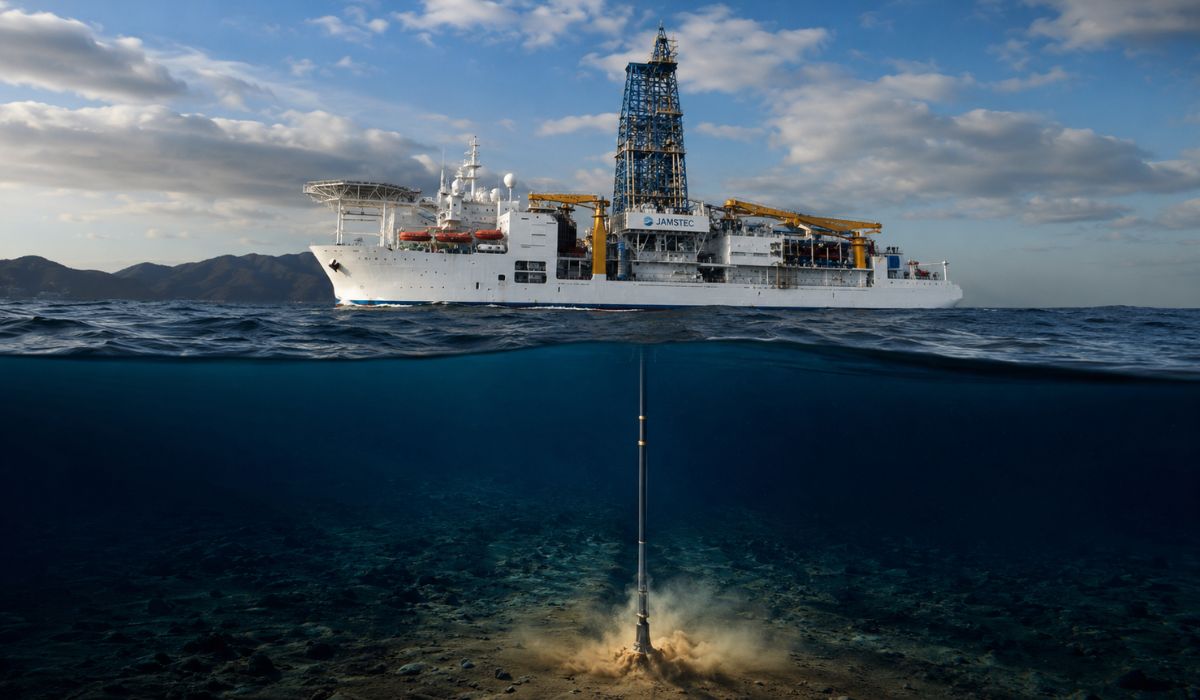


The drilling was finally halted not for lack of will but due to extreme conditions that exceeded the equipment’s capabilities at the time.
The temperature at the bottom of the hole had reached over 180°C, well above the expected 100°C, causing the melting and failure of drills and instruments.
This colossal hole, which became a cultural landmark, fueled decades of conspiracy theories, especially due to an audio supposedly recorded in its depths.
Now, almost 45 years after the start of Kola, China is preparing to rewrite this history with an even more ambitious project in the Tarim Basin, in Xinjiang province.
The Chinese state-owned Sinopec and the China National Petroleum Corporation (CNPC) intend to go further, drilling an incredible 15 kilometers to understand the local geology and seek resources.

Extreme Engineering: Overcoming Limits in China 15 km Kola Drilling
Reaching 15 kilometers in depth requires a quantum leap in engineering and materials, overcoming the limitations that stopped the Soviet project.
Traditional steel drills would not withstand the extreme temperatures and pressures. Therefore, China plans to use polycrystalline diamond (PDC) drills, much more durable and heat-resistant.
Thermal control is another monumental challenge. To combat the expected temperatures of over 200°C, a special drilling fluid will be pumped from the surface at a temperature of -10°C.
This fluid will not only cool the drill but also carry rock debris to the surface, maintaining the integrity of the well.
Sensors and telemetry equipment, nonexistent in the Kola era in 1979, are crucial. They will need to withstand temperatures of up to 250°C to transmit real-time data about the rock and well conditions.
Pulse wave and electromagnetic telemetry technology, combined with high-temperature fiber optic cables, will allow engineers to monitor every meter of progress.
The Chinese project, known as Shenditake, already has experience in deep drilling, but not on this scale. The Tarim Basin is geologically complex, presenting layers of ancient sedimentary and metamorphic rocks.
Each layer will bring new challenges, from well stability to detecting high-pressure zones, which will require special metal casings and advanced cementing.
Precision in drill navigation is also vital. Minimal deviations can lead to an exponential increase in friction and temperature, compromising the entire operation that may last years.

What is Gained at the Earth’s Core: Science and Resources
Reaching 15 kilometers in depth is not just a race for a record; it is an unprecedented opportunity for science and resource exploration.
Samples of rocks from the Earth’s mantle, or from the crust-mantle interface known as the Moho discontinuity, can reveal the composition and internal dynamics of our planet.
We may discover exotic hydrocarbons, such as abiotic methane gas, formed by deep geological processes, and not by the decomposition of organic matter.
This discovery would redefine our understanding of the origin of oil and natural gas, opening new frontiers for global energy exploration.
The possibility of finding microbial life forms in extreme environments, known as extremophiles, is fascinating. They could survive high temperatures and pressures, expanding our concept of life.
These microorganisms could offer clues about the origin of life on Earth and even about the existence of life on other planets with similar conditions.
The study of deep rocks can also enhance our ability to predict earthquakes and understand seismology, an invaluable benefit for geologically active regions.
The China 15 km Kola drilling is a massive investment, but the potential returns in scientific knowledge and energy resources are equally grand, justifying the technological risk.
Global Implications and the Future of Underground Exploration
The Chinese ambition reflects a new era in deep exploration, where technology allows us to go beyond the limits imagined in the 1970s.
The Tarim Basin is strategic for China, with significant reserves of oil and gas in complex geological formations, requiring cutting-edge vertical and horizontal drilling techniques.
Success in this project could encourage other nations to invest in ultra-deep drilling, creating a new technological race to uncover the secrets of the underground.
I imagine the impact these new technologies will have on resource exploration in other locations, including the complex formations of the Brazilian pre-salt.
The experience gained in the Chinese project, especially in telemetry and high-performance drills, can be adapted to optimize operations in ultra-compact and high-temperature reservoirs.
I confess that the idea of drilling so deep, touching the heart of the planet, is one of the greatest demonstrations of human persistence and ingenuity.
It’s not just a hole, but a window to the geological past and future, opening doors to discoveries that can revolutionize various areas of science and industry.
We closely follow this journey, hoping that the lessons learned will help us better understand our own planet and seek more sustainable energy solutions.
Will this new race to the center of the Earth reveal secrets that will change our understanding of the planet?


Be the first to react!