





 Portuguese
  English
  Spanish
  4 min of reading
  0 comments


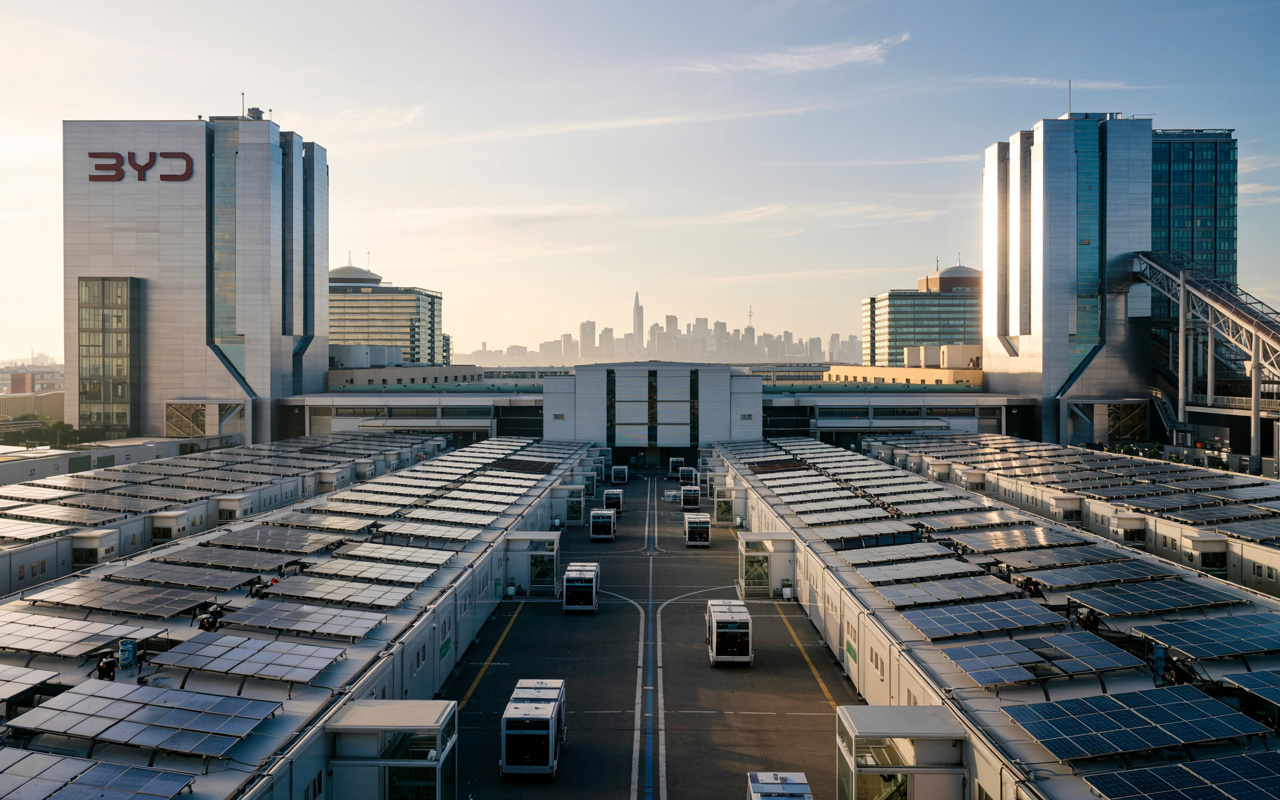
The BYD Factory in Zhengzhou Will Be Larger Than San Francisco and 10 Times Larger Than Tesla’s. Discover the Megaproject That Redefines the Scale of the Global Automotive Industry.
The Chinese automaker BYD is building, in Zhengzhou, a facility that not only challenges the limits of industrial engineering but also redefines global standards in the automotive industry: when completed, its factory will be larger than the city of San Francisco in built area, surpassing even the scale of giants like Tesla. With over 32,000 acres — equivalent to about 129.5 km² — the new plant will be 10 times larger than Tesla’s Gigafactory in Nevada, which occupies approximately 12 km².
This monumental project not only highlights BYD’s ambition to dominate the electric vehicle sector but also the central role of China as an industrial power in the race for the global energy transition.
BYD’s Factory Will Be Larger Than San Francisco
With a total area exceeding 121 km² of San Francisco (USA), the BYD factory positions itself as one of the largest industrial infrastructures in history. Divided into three phases, the megacomplex’s first stage was inaugurated in April 2023, with an initial capacity to produce 400,000 vehicles per year.
-
Man starts filling potholes on his own and mocks the city hall: “Pay me instead of taxes.” The action caught attention and drivers began to reward him with money and coffee.

-
A 1945 wine bottle is sold for over R$4 million and surprises the world by breaking a historical record at an international auction.

-
Croatia looks like a boomerang on the map and leaves Bosnia with only 20 km of sea, but compensates with 5,830 km of coastline, over 1,200 islands, and a giant bridge inaugurated in 2022.

-
World War II plane appears out of nowhere on a beach in the United Kingdom, becoming an attraction for tourists and locals and reigniting the story of the mysterious Maid of Harlech buried beneath the sea.

By the end of the project, the expectation is that capacity will exceed 1 million vehicles annually, supplying not only the Chinese market but also the growing demand for electric cars worldwide.
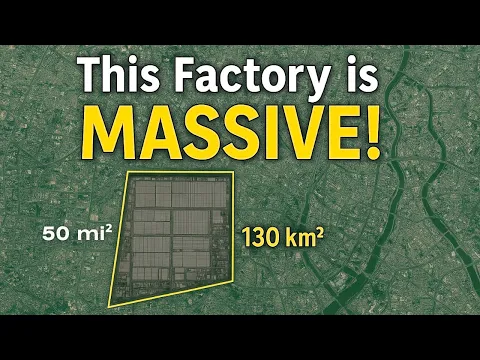

The choice of Zhengzhou, the capital of Henan province, was strategic: in addition to having robust logistics infrastructure, the city is located in a central region of China, facilitating the national and international distribution of vehicles and components.
10 Times Larger Than Tesla’s Factory: A New Industrial Scale
The Tesla Gigafactory in Nevada is one of the most talked-about plants in the global automotive sector, with its 12 km² of area. However, BYD not only surpasses this mark — it multiplies it by ten, symbolizing a new stage of scale in the electric mobility industry.
While Tesla has established itself as a reference in innovation and vertical production, BYD has been distinguished by integrating all manufacturing stages internally: from batteries to chips, assembly to research and development.
This strategy not only ensures greater cost control but also protects the company from bottlenecks and global supply chain crises.
New BYD Industrial Tower: Innovation in Solid-State and Vehicle Intelligence
One of the differentiators of the factory in Zhengzhou is its innovation and research center, focused on emerging technologies such as:
- Solid-state batteries, which promise higher energy density and lower fire risk.
- Ultrafast charging systems, focusing on efficient urban mobility.
- Artificial intelligence for autonomous driving, integrating LiDAR sensors and embedded neural networks.
The presence of these R&D (research and development) centers within the factory accelerates the innovation cycle and allows BYD to bring more advanced products to market in less time.
BYD Factory Boosts Local Economy and Solidifies Chinese Hegemony
With tens of thousands of direct and indirect jobs, the mega-structure is also transforming the regional economy of Zhengzhou.
The construction of the factory has already stimulated the emergence of new roads, urban services, and industrial zones in the surrounding area, creating a clean mobility-oriented urban ecosystem.
This movement reflects a Chinese national strategy to consolidate the country as a global leader in the new energy vehicle (NEV) industry. In 2023, BYD surpassed Tesla in the number of electric vehicles sold worldwide, and the new factory is the bet to maintain this lead in the coming years.
BYD Factory and the Repositioning of the Global Automotive Industry
BYD’s ascent represents more than a competition between companies: it is a geoeconomic axis shift in the automotive industry. With a market value exceeding US$ 100 billion, BYD already surpasses traditional names like Ford and GM, which face challenges in accelerating their transition to electric mobility.
While Western companies are still adjusting their factories for electric vehicle production, BYD is advancing with facilities specifically designed from scratch to meet this demand, integrating sustainable technologies from the ground up.
The decision to centralize a megafactory focused on passenger vehicles, with potential for mass production and advanced research, places the company ahead in terms of agility, scale, and quality control.
China, Tesla, and the Future of Electric Mobility
The direct comparison with Tesla is not accidental. Both companies represent different growth philosophies: while Tesla prioritized iconic design, software innovation, and autonomy, BYD opted for scale, internal production, and aggressive penetration into emerging markets.
With the new factory, BYD not only matches Tesla in capacity but surpasses the American rival in industrial scope. This shows that the battle for leadership in the energy transition of transport is just beginning — and China is preparing to win.
The BYD factory will be larger than the city of San Francisco and 10 times larger than Tesla’s, but this achievement is not merely symbolic — it translates into a new industrial era, where companies with long-term vision, productive verticalization, and a focus on innovation gain competitive advantage.
As BYD expands its global presence and redefines the limits of electric vehicle production, the Zhengzhou plant becomes a symbol of the future of mobility — large, sustainable, connected, and deeply integrated into the technological ecosystem of the new automotive era.







Seja o primeiro a reagir!