






 Portuguese
  Spanish


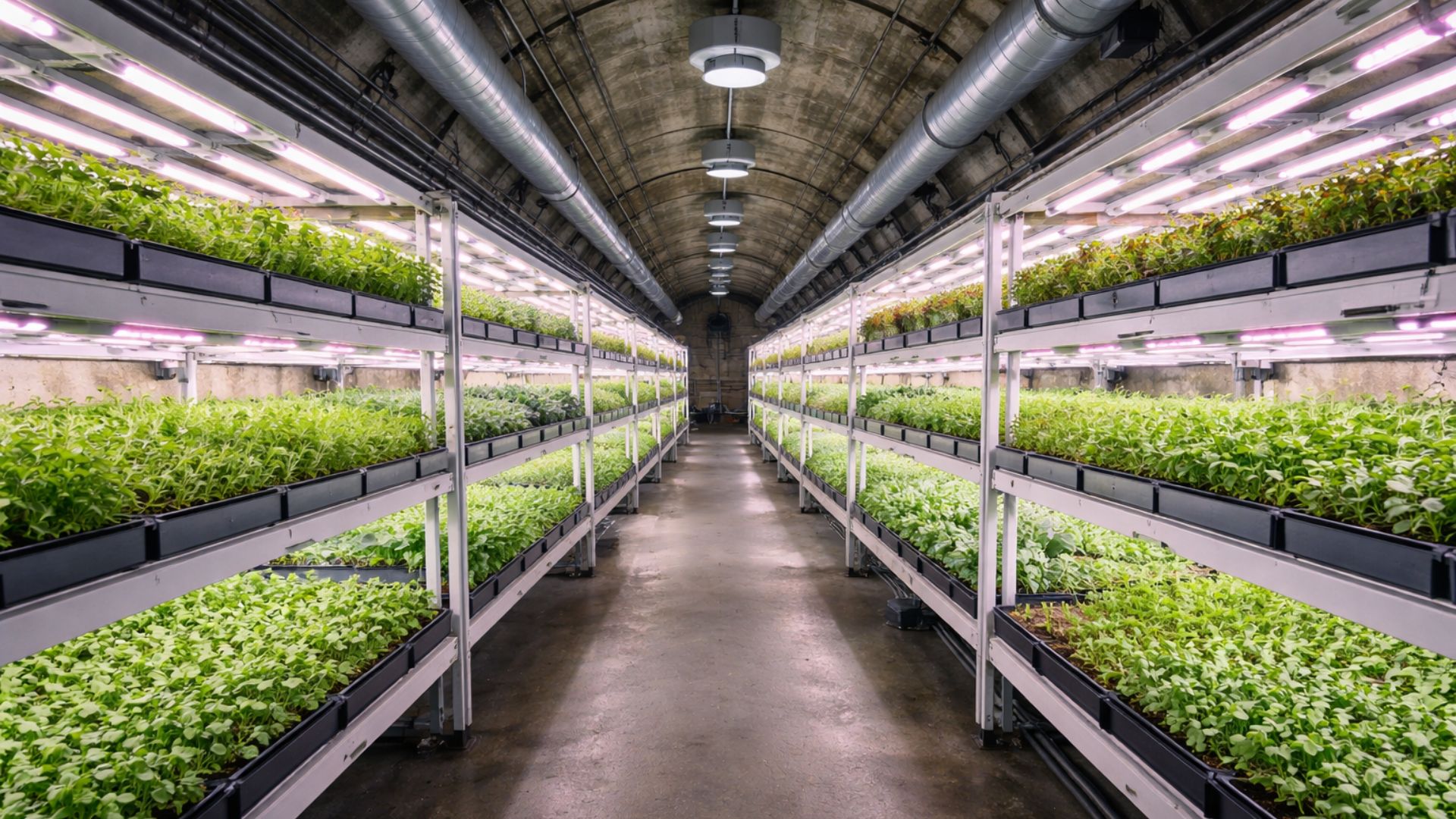


Historical Tunnels Under Clapham Transform Into Underground Farm With LED And Hydroponics To Produce Microgreens In Controlled Environment, Reusing Shelters From World War II And Connecting Agricultural Technology To Urban Logistics Supplying Major British Retail Chains.
Underground Farm 33 Meters Below London
About 33 meters below the streets of the Clapham neighborhood in South London, a set of tunnels built as air raid shelters during World War II now houses an underground farm that produces microgreens and young leaves using LED lighting and hydroponic cultivation.
The operation is presented by the company Zero Carbon Farms as the world’s first underground urban farm of its kind, and according to its own institutional website, it supplies major retailers in the UK, including Waitrose and Tesco, as well as other food service networks.
The cultivation takes place in a closed environment, without direct sunlight, with controlled conditions such as lighting and irrigation.
-
Thailand Converts 8 Tons of PET Bottles into 3,500 School Backpacks, Showcasing Circular Economy with Over 40 Factories Involved

-
Mysterious Bats Spotted in Paris’s Père Lachaise Cemetery, Drawing Tourists to the “Vampire Cemetery”

-
From Selling Street Food to Leading a $300 Million Construction Firm: The Journey of a Brazilian Entrepreneur

-
Abandoned Penthouse in Houston Reveals Million-Dollar Suite with 24-Karat Gold, Tiffany Crystals, and Opulence Even Elvis Might Have Snubbed

Instead of soil, the plants grow with nutrients dissolved in water, in a hydroponic system.
On-site, the artificial lighting is provided by LEDs positioned over shelves and growing benches, a resource adopted to allow leafy plant growth in areas where there is no natural light entry.
How Hydroponics And LED Production Works


According to Zero Carbon Farms, the production on-site includes microgreens and “baby leaf,” a term used for young harvested leaves common in salad mixes.
The company claims it sells the produce to national retailers and also supplies cafés and restaurants in London through distribution partners connected to the wholesale market of New Covent Garden Market, described as less than a mile from the site, facilitating delivery logistics in the city.
The project is associated with the brand Growing Underground, which has become known for repurposing London’s underground infrastructure for controlled environment food production.
In an impactful report published by the Alan Turing Institute, a British institution focused on data science and artificial intelligence, the space is described as a World War II air raid shelter adapted for cultivation, with stacked benches of leaves under LEDs and an effort to optimize the production process with the support of engineers and data specialists.
Second World War Tunnels And The Origin Of The Space In Clapham
The use of underground tunnels was not a casual choice.
According to the company itself, the site is part of a set of deep structures built between 1940 and 1942, when the British government implemented a network of underground shelters to protect the population from bombings.
Zero Carbon Farms reports that after the war period, there was a plan to transform these tunnels into part of an express route connected to the subway, but the project did not go ahead.
The space underwent different uses over time, including periods of residential occupancy and use as a storage area, before being converted into a farm.
The company states that it has occupied the tunnels with agricultural activity since 2015 and that the farm went into full production that year, supplying retailers and the hospitality and restaurant sector via distributors.
Furthermore, the company notes that there was an expansion of the cultivation area in 2022, when the total area for planting reportedly reached around 1,050 square meters.
These figures refer to what the organization publicly discloses about the operation.
Supermarkets, Supply And Urban Logistics
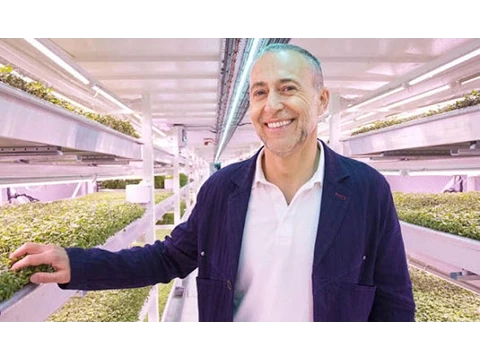
The controlled environment cultivation technology is often presented as an alternative to produce leaves and herbs close to urban centers, with less dependence on climate and seasonal rhythms.
The World Economic Forum described the initiative as an example of an underground farm aimed at supplying the city and noted that the company claims to use less water than conventional outdoor agriculture.
The comparison is treated as a claim of the project: in practice, water savings depend on the irrigation system and the level of recirculation applied in the operation.
In the case of Zero Carbon Farms, the institutional site details that the system is “closed circuit,” with water reuse and filtration, and claims that internal measurements would indicate significant reduction in consumption per kilogram produced compared to some open field crops.
Energy, Certifications And Public Claims Of The Company
The same discussion appears in public materials from the venture regarding certifications and sustainability.
On institutional pages, the company claims it operates the farm with renewable energy and that it achieved, in March 2021, a milestone it describes as “Carbon Neutral+” certification, linked to an external consultancy.
The site itself acknowledges that there are criticisms regarding the use of carbon offsets and states that it sought advice from third parties to structure a long-term strategy.
As this is a technical and sensitive subject, these statements are disclosed as the company’s positioning, without the institutional material replacing independent audits published in detail for the general public.
Pesticides, Controlled Environment And Indoor Cultivation
Another point frequently associated with controlled environment farms is the reduced use of agricultural pesticides.
In the case of the Clapham project, Zero Carbon Farms states in its materials that it does not use pesticides or “chemicals” in cultivation, justifying that the protected environment reduces pest pressure.
This type of claim, when made by greenhouse and indoor farm operators, is usually linked to the physical barrier and control of entry and circulation in the space, but the scope and manner of verification vary according to the operator and the standard adopted.
Engineering, Ventilation And The Challenge Of The Subsoil
The underground operation also attracts interest due to the engineering of space adaptation.
The report from the Alan Turing Institute indicates that cultivation is hydroponic and describes the use of a type of substrate to support the plants, as well as tanks of water at a lower level and quick harvest cycles for leaves.
The text also points out that collaborative work with researchers aimed to create a “digital twin” of the process to adjust production parameters and reduce energy consumption, within the challenge of maintaining constant productivity in an environment without natural light.
In practice, transforming an underground shelter into a production area involves issues of ventilation, air circulation, occupational safety, and electrical and hydraulic infrastructure to support intense lighting and constant irrigation.
International reports on the farm over the years have highlighted the presence of large fans, long corridors, and cultivation shelves, elements compatible with underground installations adapted for industrial use.
The exact operation, however, depends on engineering and management choices that are not always fully detailed to the public in complete technical documents.
Reuse Of The Subsoil And Urban Agriculture In London
The Clapham farm is part of a broader scenario in which cities seek to reuse underutilized spaces, from the subsoil to warehouses and old industrial areas, for local production functions.
In the case of London, the historical factor adds a layer of curiosity: structures created to protect people from bombs have, decades later, been used to produce food that reaches supermarket shelves.
In times of debate about food logistics, energy costs, and pressure for shorter supply chains, the model draws attention not only for the unusual aesthetics of the LED-lit tunnels, but for connecting urban past and agricultural technology at the same address.




É, o tempo muda tudo…
Qta transformação e aproveitamento. Hoje, utilizando por um projeto interessante para o bem do povo. Antes para esconder de ataques do inimigo…
É a história e seus ciclos..
Parabéns!