Portuguese
  Spanish


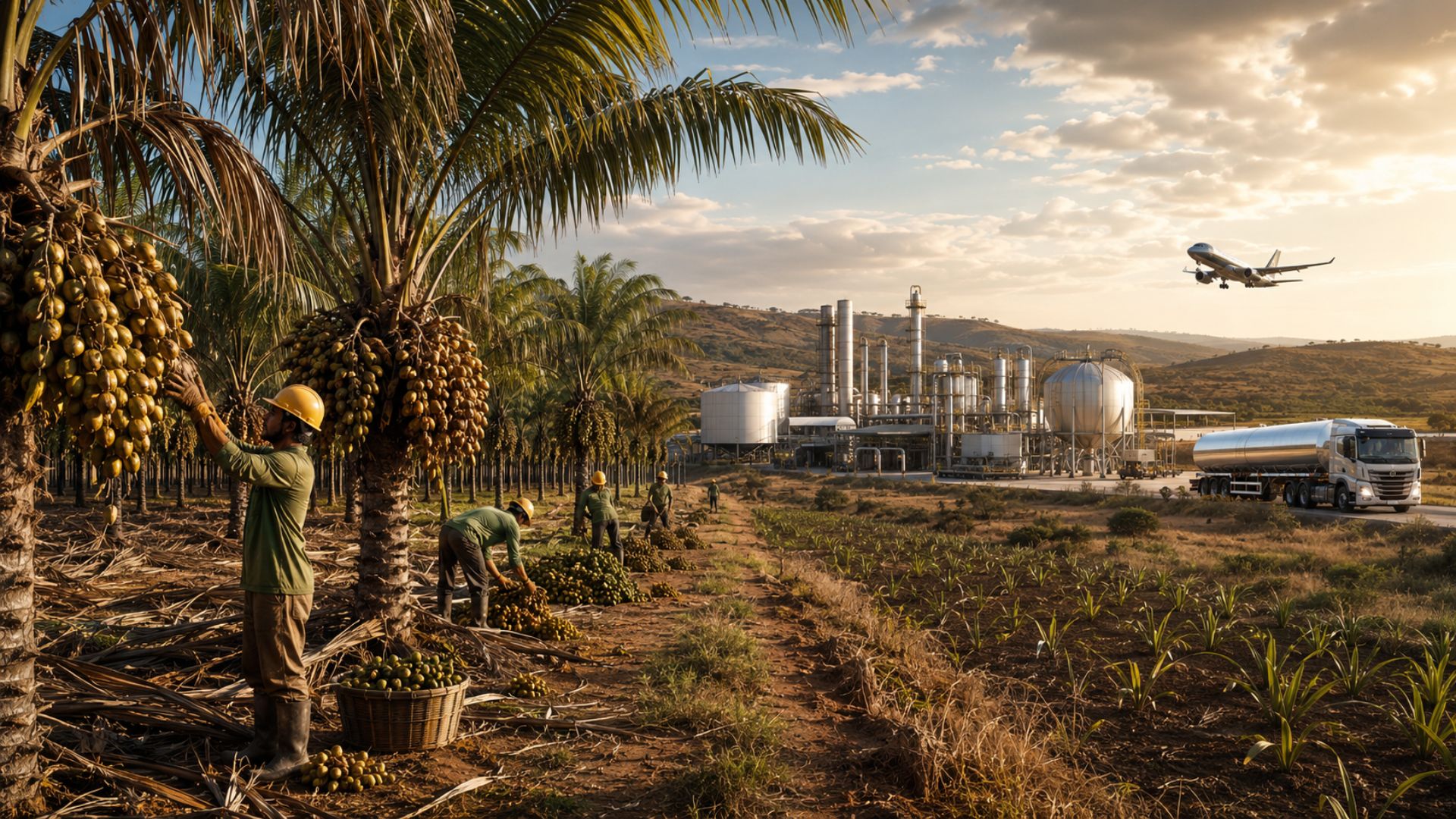

With an investment of R$ 15 billion linked to Acelen Renováveis and Mubadala Capital, the macaúba sheds its label as a pest in the Cerrado to supply HVO and SAF, recover degraded lands, and test if Brazilian vegetable oil can reach commercial scale without repeating the unfulfilled promises of biodiesel in the field.
The macaúba, a palm native to Tropical America and common in Cerrado areas, has gone from being seen as a nuisance by farmers to a billion-dollar bet for producing vegetable oil intended for fuels like HVO and SAF. Embrapa began studying the species more intensively in 2006, while Acelen Renováveis, linked to Mubadala Capital, aims for investments of R$ 15 billion by 2038 to structure the chain in Brazil.
The bet is happening because trucks, buses, ships, and airplanes remain dependent on liquid fuels, while companies and governments seek alternatives with lower carbon emissions. The macaúba fits into this scenario by producing a lot of oil per hectare, growing in degraded lands, and allowing integration with pastures. The problem is that the promise still needs to pass the toughest test: efficient harvest, maturation time, and real commercial scale.
Macaúba moved from old rural use to the center of the energy transition
Before becoming a topic for international investors, the macaúba was already part of rural life in regions of Minas Gerais, Goiás, and transition areas between Cerrado and the Atlantic Forest. The fruit was used to produce cooking oil, soap, lamps, and even traditional homemade preparations.
-
Brazilian Farmers with Basic Education Create Backyard Machines That Win National Invention Contest, Beating 242 Projects

-
Brazilian Farm Innovates with Cage-Free Chickens, Producing 3,300 Odorless Eggs Daily

-
From Selling Unsold Saplings to Creating Brazil’s Most Awarded Olive Oil Brand with 330 Accolades and a $12 Million Goal by 2026
-
China Builds 400-Hectare Irrigation System in Tanzania to Aid 1,000 Families Dependent on Rainfall


With urbanization and the arrival of electricity, the palm lost economic utility for many producers. As it sprouted spontaneously, had long thorns, and made management in pastures or crops difficult, it came to be treated as a pest. The same plant that many ordered to be cut down now appears as the raw material for a billion-dollar energy chain.
Cerrado concentrates an important part of this new bet
The macaúba, scientifically named Acrocomia aculeata, occurs from Mexico to northern Argentina, passing through Brazil, Paraguay, and Bolivia. In Brazil, it appears in various regions but dominates rural landscapes in the Cerrado and transition areas with the Atlantic Forest.
Minas Gerais, Goiás, Mato Grosso, and Mato Grosso do Sul are states with a large presence of native macaúbas. In some areas, the groupings are so dense that researchers call these areas macaúba massifs. What was once abundance without a market has come to be seen as a strategic reserve of vegetable oil.
Vegetable oil can become HVO for trucks
The current interest comes from the ability to transform vegetable oil into advanced fuels. One of them is HVO, which stands for hydrotreated vegetable oil. Unlike conventional biodiesel, HVO can function as a direct substitute for fossil diesel in diesel engines, without requiring vehicle modification.
This characteristic places macaúba in an important competition. If the palm oil can be produced in volume, it could supply heavy transport chains, such as trucks and buses. The attraction is not just planting a palm tree; it’s entering the fuel market compatible with the existing infrastructure.
SAF targets aviation, where engine replacement is not simple


The other front is SAF, sustainable aviation fuel. Airplanes cannot simply change their engines to use any energy alternative, so the industry seeks liquid fuels capable of behaving like aviation kerosene.
The vegetable oil from macaúba could feed this route, along with other raw materials such as soy, palm, animal fat, and used cooking oil. The race for SAF increases the value of oilseed plants, but also raises the pressure for reliable, traceable, and commercial-scale production.
Productivity per hectare explains the enthusiasm
The most striking data is productivity. Macaúba can produce more than 4,000 liters of oil per hectare per year, while soy, the main raw material for Brazilian biodiesel, produces on average about 400 liters per hectare.
This difference helps explain why investors are looking at the palm. In the same space, macaúba could generate a much larger volume of vegetable oil. But potential productivity in study does not pay the bills alone; the field needs to prove cost, harvest, logistics, and regularity.
Degraded lands become a central part of the narrative
One of the strongest arguments is the use of degraded lands. The estimate from the Ministry of the Environment is that Brazil has between 50 million and 70 million hectares of degraded pastures, areas with low productivity and reduced income.
The macaúba appears as an alternative because it tolerates poor soils and can help recover organic matter and reduce erosion. The idea is to use already open areas, without pressuring new frontiers. If it works, the gain will not only be in fuel but in the economic recovery of degraded lands.
Palm tree allows coexistence with cattle in the same space
Another relevant point is the integration with livestock. Since the macaúba has a high and spaced canopy, the sun continues to reach the ground, allowing the maintenance of pasture under the trees.
In this model, the producer could raise cattle and produce fruit for vegetable oil extraction in the same area. The cake resulting from the pulp processing can still become feed for the herd. The promise is to transform a weak pasture into a more profitable system without completely removing the cattle from the property.
Mubadala and Acelen want to control the chain from the seedling
Acelen Renováveis, linked to Mubadala Capital, appears as the main business name in this new phase. The plan foresees R$ 15 billion by 2038, focusing on HVO and SAF made from macaúba oil.
To not rely solely on external suppliers, the company decided to structure the production chain. The starting point is a nursery of 138 hectares in Montes Claros, in the north of Minas Gerais, with the capacity to produce 10 million seedlings per year. The bet is not to buy fruit on the market; it is to create a market where it does not yet exist.
Goal involves 180 thousand hectares planted in the Cerrado
The presented plan foresees the planting of 180 thousand hectares of macaúba in the Cerrado in the coming years. The Montes Claros nursery would have the capacity to support 20 thousand to 30 thousand new hectares per year.
The company also invests in genetic improvement to select plants with more fruits and adaptation to large-scale cultivation. This point is decisive. A native palm tree can be promising, but industrial fuel requires standardization, predictability, and commercial scale.
Traceability becomes a condition to sell outside Brazil
Acelen also closed a partnership with a European startup specialized in traceability. The goal is to serve markets like Europe and the United States, which require proof of the production chain, origin of the raw material, and environmental criteria.
This requirement changes the standard of rural business. It’s not enough to produce vegetable oil; it’s necessary to prove where the macaúba was planted, how it was cultivated, and whether it came from degraded lands or areas with environmental risk. In the international market, sustainable fuel without traceability can lose value even before leaving the farm.
Macaúba fruit has almost complete utilization
The macaúba fruit is divided into layers with different uses. The shell can generate energy. The pulp concentrates the oil intended for HVO and SAF. The residue from extraction can become protein cake for animal feed.
The endocarp, the hard part that protects the seed, can be used for high-density charcoal. Meanwhile, the kernel produces another type of oil, with applications in cosmetics and human food. The economic argument becomes stronger because the palm tree does not depend on a single product to generate value.
Leaves and trunk expand uses beyond fuel
Besides the fruit, the entire palm tree has possible applications. Fibers from the leaves are of interest to the textile industry and can be used as animal forage. The wood from the trunk, resistant and dense, can become slats for construction.
This set creates a narrative of complete utilization. One hectare of macaúba could generate fuel for airplanes and trucks, feed, charcoal, cosmetic input, and construction material. The commercial strength lies in diversification, but it only confirms if there are buyers for each fraction.
Comparison with castor bean requires caution
The history of castor bean in Brazilian biodiesel serves as a warning. In the early 2000s, the plant was presented as a solution for the northeastern semi-arid region, but many farmers faced low productivity, lack of technical assistance, high costs, and commercial frustration.
The macaúba has important differences. There is heavy private investment, international demand for HVO and SAF, and accumulated research on productivity. Even so, the comparison is useful. Brazil has already seen rural energy promises turn into losses when the production chain wasn’t ready beyond the discourse.
Harvest is still a technical bottleneck
The main operational risk is in the harvest. The macaúba is tall, thorny, and requires efficient fruit collection. Without adequate mechanization, the cost can rise and compromise profitability for producers.
This bottleneck separates potential from reality. Planting the palm tree is just the beginning. It’s necessary to harvest, transport, process, extract the vegetable oil, and ensure continuous supply to refineries. The commercial scale can stall precisely at the most basic point: removing the fruit from the tree at a competitive cost.
Maturation time leaves return for the end of the decade
Another challenge is the biological timeline. While soy, corn, and sunflower yield returns in months, macaúba takes between 5 and 6 years to allow for the first significant harvest. After that, it can produce for decades, reaching up to 100 years.
This creates a window of uncertainty. The seedlings planted now will only show their real performance closer to the end of the decade. In this interval, prices, technology, competitors, and fuel policies may change. Macaúba has a long horizon, but the energy market changes quickly.
Macaúba combines rare elements: it grows in the Cerrado, produces a lot of vegetable oil, can occupy degraded lands, coexist with cattle, and supply HVO and SAF chains. With Acelen Renováveis and Mubadala Capital aiming for R$ 15 billion by 2038, the plant has definitively moved from being a rural pest to entering the radar of sustainable fuels.
But caution is mandatory. Harvesting, mechanization, maturation time, traceability, international price, and commercial scale still need to be proven. Macaúba could become a new Brazilian energy frontier or repeat promises that seemed too big on paper. Do you think macaúba will be Brazil’s “green oil” or just another rural gamble surrounded by risk? Share your opinion.