Portuguese
  Spanish


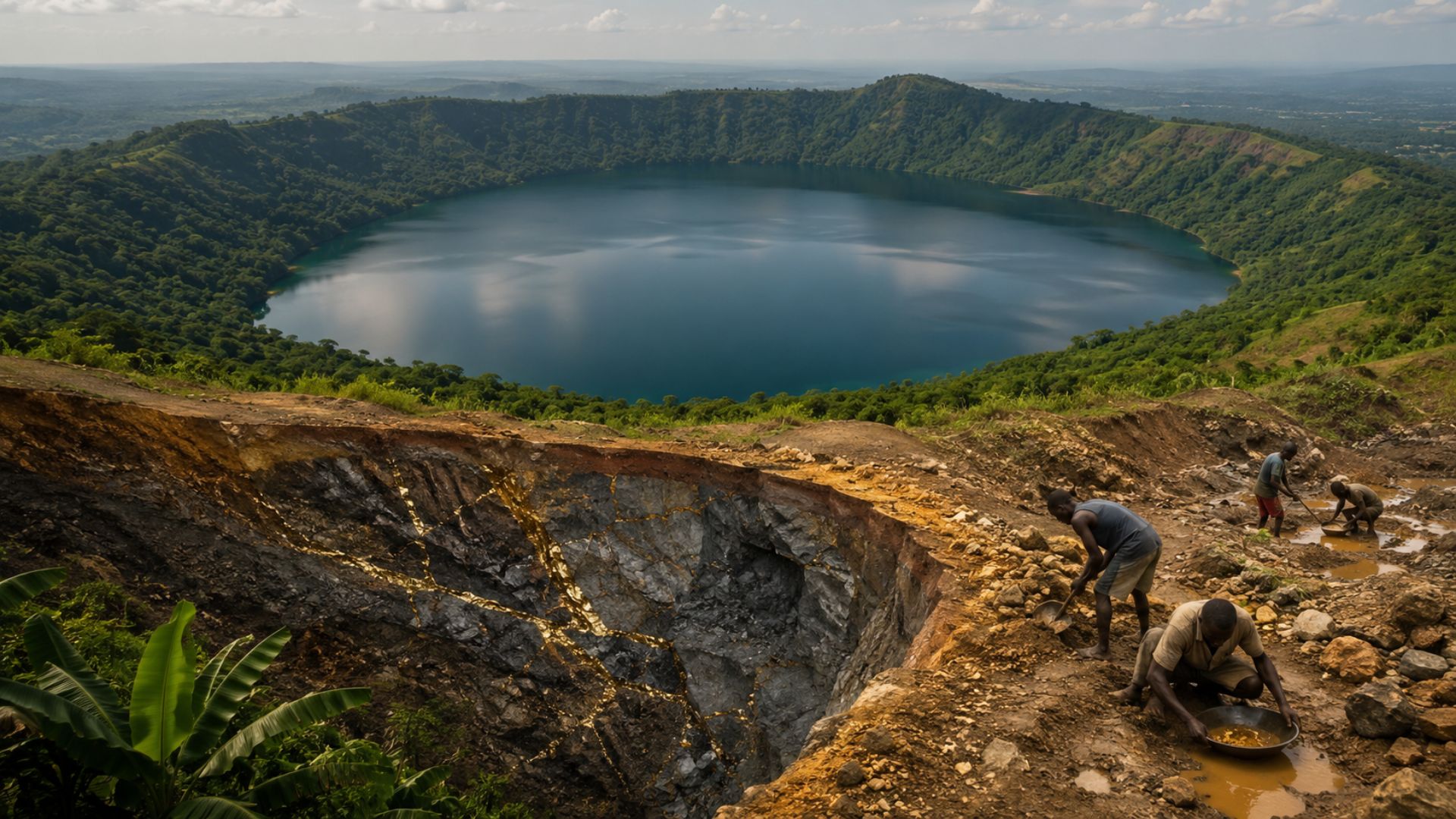

Attention to a detail that confuses many people: the meteor did not bring gold from space. It cracked the Earth’s crust and opened a path for hot fluids to concentrate the gold that already existed underground in the region. And the golden glow in satellite photos is not gold shining, but the mark of mining.
A meteorite about 1 kilometer in diameter created, more than 1 million years ago, the crater that today forms Ghana’s only natural lake, the sacred Lake Bosumtwi. The impact was so violent that it fractured the Earth’s crust, creating a network of faults that helped expose gold veins mined to this day in the Ashanti region, in western Africa.
The case returned to the news in May 2026, after NASA’s Earth Observatory released satellite images of the location, captured by the Landsat program. The photos show the surroundings of the lake taken by golden tones, which made headlines around the world. But, as explained by geochemist Marian Selorm Sapah, senior professor at the University of Ghana, it is necessary to properly understand what really happened there, separating myth from science.
How the meteorite created the lake

With an almost perfectly circular shape, it extends over about 49 square kilometers and reaches depths of up to 70 meters, being the country’s only natural lake. Its round shape is the most evident clue of its extraterrestrial origin.
-
Collector adapts forklift electric motor in a Kombi Corujinha pickup, hides 16 batteries under the bed, and makes the Brazilian classic run silently with up to 90 km of range.

-
Goodbye traditional vacuum: Samsung surprises and launches 2-in-1 robot with steam, AI that recognizes floors and stains, self-cleaning station, hot air drying, automatic emptying, water refill, and app control.
-
Brazil is transforming acerola waste discarded by the pulp industry into an ambitious and surprising project that could forever change the way the country utilizes one of the most invisible by-products of the fruit sector.
-
Scientists have created a colossal digital twin to predict tsunamis in real time, a simulation of 55.5 trillion unknowns run on 43,520 GPUs that reduced 50 years of calculation to 0.2 seconds and could change the defense of coastal cities.


Scientists estimate that the crater is about 1.07 million years old, formed when a meteorite approximately 1 kilometer in size hit what was then a tropical forest. The resulting hole, about 10.5 kilometers in diameter, is today considered one of the best-preserved young impact craters on Earth and has been recognized as an international geoheritage site. According to Sapah, if a similar impact occurred today, it would likely destroy the entire city of Kumasi.
The Important Correction: Gold Did Not Come from Space

The meteorite did not bring gold from space, nor was it made of gold. What happened is that the impact fractured the Earth’s crust, creating an extensive network of faults and cracks that allowed the circulation of hot fluids and the rise of magma rich in minerals, concentrating the gold that already existed in the region’s subsoil.
This is because the lake is located right in the middle of the so-called Ashanti gold belt, one of the most well-known gold-bearing areas in the world. In other words, the gold was already there, in the Earth’s crust, long before the impact. What the meteorite did was function as a gigantic geological agent, fracturing the rocks and helping to concentrate and expose shallow veins of gold and other valuable minerals, which became accessible to mining over generations.
The Golden Shine of the Images Is Not Gold
The second common confusion concerns precisely the satellite images. The golden tones that appear around the lake in NASA photos are not shining gold veins, as many imagine, but rather the mark left by human mining activity, with its excavations, trails, deforested areas, and altered vegetation.
In other words, what glitters in the images is the result of mining, not the metal itself. Researcher Marian Sapah herself highlights the contrast between this human-caused transformation in just a few decades and the geological landmark of over 1 million years represented by the crater. The most recent images even show that the mining area has grown significantly in the last decade, driven by advances in extraction technology.
A Sacred Lake for the Asante People
Long before science deciphered its origin, Bosumtwi was already a special place. For the Asante people, also spelled Ashanti, the lake is sacred and known as the “lake of souls,” the place where, according to tradition, the souls of the dead go to say goodbye before leaving Earth. The name itself comes from local terms related to God and the antelope.
Oral tradition tells that the lake was discovered by a hunter named Bompe, who, while chasing a wounded antelope, saw the animal disappear into the waters. The story is part of the cultural identity of the region, and the lake remains central to the life of local communities, used for fishing, bathing, and daily activities. This spiritual dimension makes the place even more valuable, combining science, culture, and faith in the same point on the map.
The threat of mining and the race for protection
The scientific recognition, however, comes with a warning. Researcher Marian Sapah argues that immediate action is necessary to contain the advance of illegal mining and deforestation on the edge of the crater, which threaten both the scientific value and the cultural and environmental heritage of the lake. Without control, uncontrolled mining could compromise one of the best-preserved impact sites on the planet.
Among the suggested measures are satellite monitoring to track illegal mining and forest loss, stricter enforcement of mining bans, and community engagement programs. It is a delicate balance between preserving a unique natural treasure and the economic reality of populations that depend on gold extraction to survive, a dilemma that echoes in various mining regions around the world.
Why this topic matters to the CPG reader
For those who follow mining, geology, and the environment, the case of Bosumtwi is especially rich. It shows how major geological impacts can influence the formation and concentration of mineral deposits, a central theme in the science that guides the exploration of gold and other metals around the planet, including in Brazil.
Brazil, by the way, is well acquainted with both mineral wealth and the challenges of mining, with notable episodes involving gold extraction in sensitive areas, such as the Amazon, and the debate on illegal mining and its environmental and social impacts. The story of the Ghanaian lake thus serves as a distant mirror of dilemmas very present in Brazilian reality, uniting scientific curiosity and reflection on the responsible use of natural resources.
Lake Bosumtwi is one of those places that seem to gather all the layers of a good story: a meteorite that fell over a million years ago, a rare and well-preserved crater, a people who consider it sacred, and a treasure of gold that, contrary to popular belief, did not come from space but was exposed by the force of the impact. Correctly understanding this story also means valuing science and reinforcing the importance of protecting a natural heritage and cultural heritage that took a million years to form and could be degraded in a few decades.
And you, were you already familiar with the story of the meteorite that created the sacred Lake Bosumtwi in Ghana? Were you surprised to learn that the gold did not come from space but was already in the Earth’s crust? Leave your comment, tell us what impressed you most about this story, and share the article with those who love science, geology, and the mysteries of our planet.