






 Portuguese
  Spanish


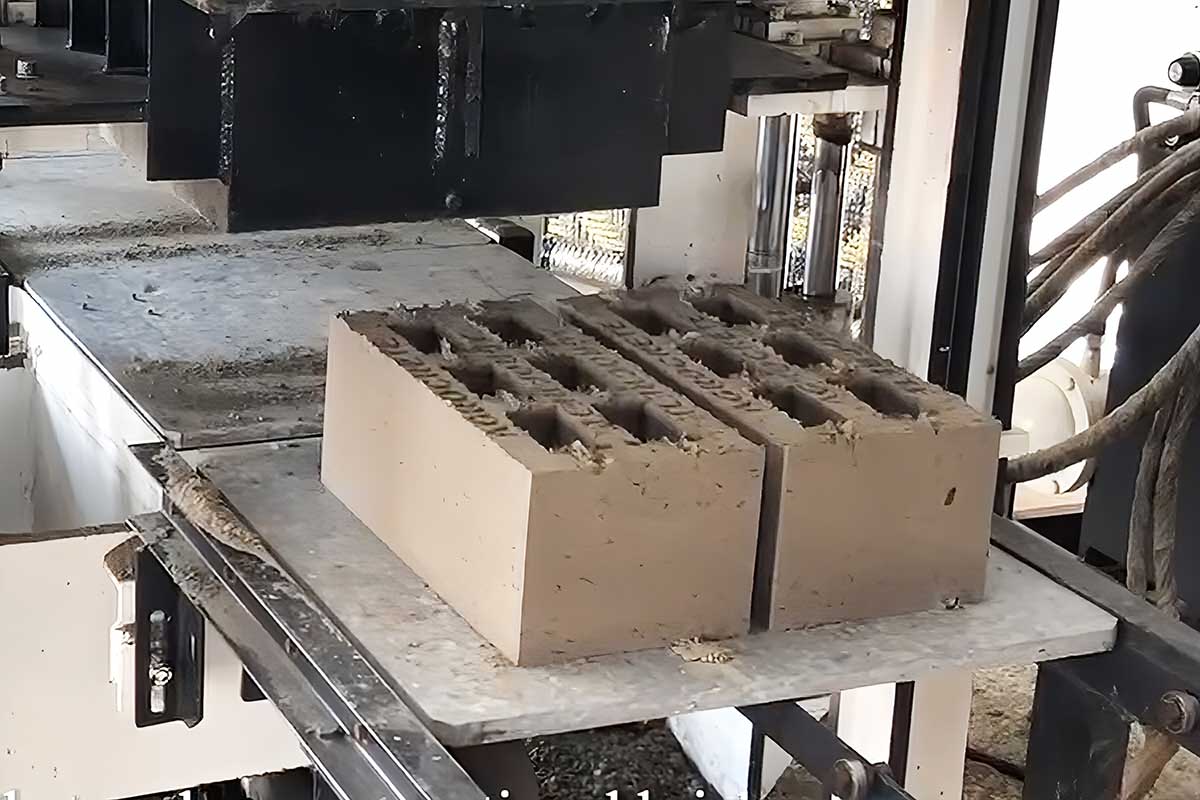
The piece has a male and female interlock, like a Lego piece, and therefore stacks without needing cement between the rows. As it cures in the open air, without burning, it avoids cutting down trees and smoke from kilns. In well-executed constructions, the material can reduce costs by up to 40% where the soil is suitable.
Made from local soil, a little cement, and a lot of pressure, the eco-friendly soil-cement brick has been gaining ground in Brazilian popular construction. It fits together like a building block, eliminates the need for mortar between rows, and doesn’t require a kiln for manufacturing, simultaneously reducing construction time, waste generated, and carbon emissions compared to traditional ceramic bricks.
Also known as compressed earth block, or CEB, the product is a mixture of sieved soil, a small proportion of Portland cement, usually between 8% and 12%, and water, compacted under high pressure in manual or hydraulic presses. The result is a dense block with precise dimensions, which has become an increasingly attractive alternative in a country with a huge demand for low-cost housing.
How the soil-cement brick is manufactured

While the traditional brick goes into a kiln and relies on burning wood or gas, the soil-cement brick undergoes no burning: curing occurs in the open air, through cement hydration, in a process that takes from 7 to 28 days. This eliminates fuel consumption in the production process and significantly reduces carbon emissions per unit.
-
They exchanged the idea of a large house for a 35 m² warehouse, spent US$ 12,000 on the structure, and created a tiny house in Colorado with space to live and work.

-
A newly opened terminal in the middle of the Amazon has begun transporting soy and corn through Amapá, eyeing the queue of ships that is congesting the ports in the South.

-
Goodbye to old tiles: renovation technique without construction transforms bathrooms in a few hours, eliminates debris, and reduces costs with coverings using special paints, high-resistance adhesives, and modern finishes that completely renew the space.
-
Goodbye to the traditional clay brick: Indian startup transforms burnt straw into a carbon-negative brick that costs half, insulates better, and even removes CO2 from the air.


The positive environmental impact is significant. According to estimates by the National Association of the Eco-Friendly Brick Industry, Aniteco, the production of a thousand units can save from seven to twelve medium-sized trees compared to traditional ceramic bricks. It is precisely this lighter footprint that gives the product the nickname of eco-friendly brick, although the cement used in the mixture still has its own carbon footprint, which requires caution when calling it completely clean.
The fitting that dispenses with mortar
One of the biggest attractions of the system is the method of laying. The modular blocks are produced with protrusions and recesses, the so-called male and female system, which locks each row onto the previous one. The fitting works like a building block, with geometric locking, not chemical, dispensing with mortar between the pieces and greatly accelerating the construction of walls.
As a result, mortar is used only in specific points, such as foundations, lintels, beams, and structural joints. Projects that adopt the system report a reduction of up to 70% in mortar consumption compared to conventional masonry, with a proportional decrease in the volume of debris generated on site. Another advantage is that the vertical holes in the blocks facilitate the passage of pipes and the filling of columns, organizing the plumbing and electrical parts.
Why it better insulates heat
Thermal comfort is another strong point. The density and typical thickness of soil-cement blocks, around 14 to 15 centimeters, give the wall a greater thermal mass than that of the equivalent eight-hole ceramic brick. Walls with high thermal mass absorb external heat during the day and release it slowly at night, cushioning temperature variations inside the house.
In hot climates, such as those in the Northeast and Midwest, this behavior helps reduce dependence on ventilation and air conditioning, which can mean lower energy bills. For low-income families, this is a direct and relevant benefit, as the cost of air conditioning weighs on the household budget, especially in regions with intense heat for much of the year.
The limitations the market still faces
Despite the advantages, it is important not to treat the material as a perfect solution. The main restriction is soil quality control: not all soil is suitable, and soils with high levels of expansive clay or organic matter compromise the block’s strength, requiring correction or replacement of the material. This requires simple tests before production, a step that informal builders often skip, resulting in fragile pieces.
There are other points of attention. Uncoated blocks perform poorly in very rainy regions, making external coating with waterproof mortar recommended in wet areas. Quality hydraulic presses cost between R$ 8,000 and R$ 25,000, which requires production scale to offset the investment. And although standardization exists, it still faces limited oversight in informal works, leading to quality variation in the market.
What the technical standards say
The soil-cement brick is regulated by a set of standards from the Brazilian Association of Technical Standards, ABNT. Among them are NBR 8491 and NBR 8492, aimed at solid bricks and tests for resistance and water absorption, NBR 10833, on manufacturing with a press, and NBR 10834, which deals with non-structural soil-cement blocks.
This detail is important and deserves caution: part of the material available on the market is intended for sealing, and not necessarily for structure. The use of soil-cement in walls that support the building depends on a specific project, suitable blocks, and strict compliance with standards, and should not be assumed automatically. Therefore, having technical supervision and demanding quality tests is essential to ensure safety, especially in constructions of more than one floor.
The potential in the face of the housing deficit
The Brazilian scenario favors the expansion of this technology. The country has a housing deficit of over 8 million homes, concentrated in low-income families who often build incrementally, adding rooms over the years. The soil-cement brick fits well in this profile, as it can be produced on-site with local soil and does not require highly specialized labor for laying.
In regions where the soil is suitable, the material can reduce the total construction cost by up to 40% compared to conventional masonry, according to industry estimates. Production can also be facilitated by community efforts and organizations that collectively acquire the press, strengthening assisted self-construction. Not surprisingly, the topic directly engages with housing policies and the sustainable construction agenda in Brazil.
Why this topic matters to the CPG reader
For those following civil construction, energy, and the environment, the ecological brick is a concrete example of innovation with environmental impact. By eliminating kiln firing, it reduces emissions and deforestation associated with the production of construction materials, directly engaging with the decarbonization and low-carbon construction agenda, increasingly relevant in the sector.
Civil construction is one of the largest consumers of natural resources and a significant source of emissions worldwide. Solutions like soil-cement, alongside other sustainable technologies, are part of a broader movement to rethink how we build, balancing cost, performance, and environmental responsibility. For the Brazilian market, with its enormous housing deficit, this balance is especially strategic.
The eco-friendly soil-cement brick is not an absolute novelty, but it has been gaining traction for practical and economic reasons that are hard to ignore. It cuts costs, reduces debris, insulates heat better, and decreases carbon emissions, while requiring attention to soil quality, moisture, and compliance with technical standards. Properly applied, with adequate monitoring, it can be an important piece in addressing the Brazilian housing deficit and in building a more sustainable future.
And you, would you build or renovate your house with eco-friendly soil-cement bricks? Were you already familiar with this system that fits together like building blocks and requires no mortar? Leave your comment, tell us if you would trust this technology, and share the article with those interested in construction, sustainability, and cost-saving in building.


