Portuguese
  Spanish


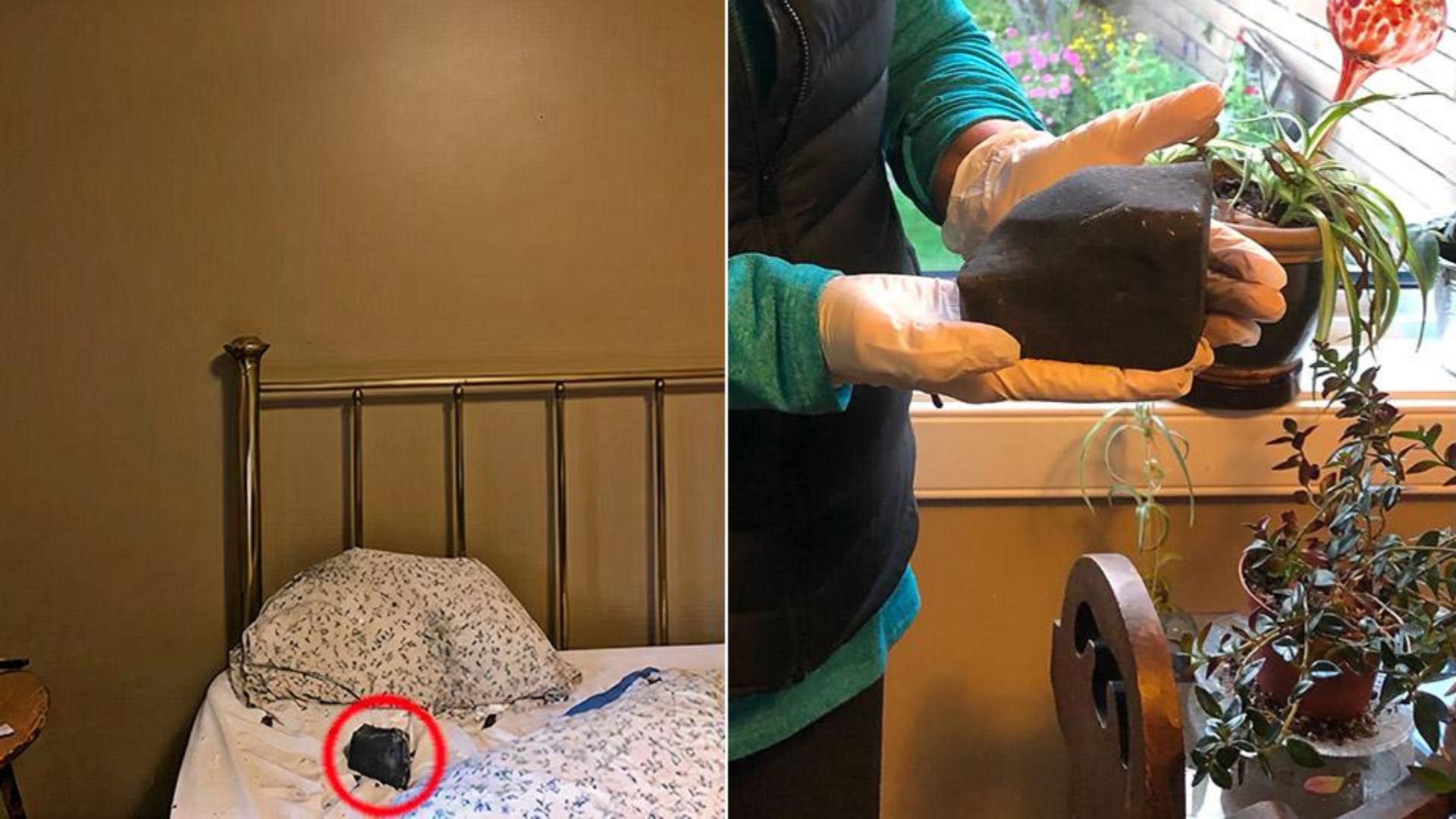

Rare fall inside a house becomes a scientific clue and allows tracking the origin of a meteorite to the asteroid belt region, revealing data about its trajectory and age in space.
A meteorite that crashed through the roof of a house in Golden, British Columbia, Canada, became a subject of study after researchers reconstructed its trajectory before the fall and pointed out its most likely origin in the Solar System.
The rock fell on October 4, 2021, at 5:34 am universal time, and the first recovered fragment weighed about 1.3 kilograms.
The piece hit an occupied bed, in a rare episode both for the impact location and the speed of material recovery.
-
Orphaned Youth Turns Dismissed Idea into Global Prestige with Innovative Wristwatch

-
English Skills Boost Career Opportunities in the Oil and Gas Industry

-
Brazil Secures Second Place at WorldSkills 2024 in Lyon, with 64 Young Professionals and 8 Medals, Including Gold from a Rio de Janeiro Hairdresser

-
3,000 Military Personnel from 10 Countries, Including US and Chinese Marines, Train Together in Brazil’s Savanna: Operation Formosa Becomes Largest Naval Ground Exercise Before First Cancellation Since 1988



Origin of the meteorite and connection with asteroids
The analysis, published in the journal Meteoritics & Planetary Science, classified the Golden meteorite as an ordinary chondrite of type L/LL5, with a low level of shock.

This condition helped scientists preserve important data about the composition, age, and physical history of the rock.
According to the authors, the fragment found inside the house was part of a much larger object.
Before entering Earth’s atmosphere, the original body had an estimated mass between 70 and 200 kilograms, but broke apart during its high-speed passage through the sky.
The reconstruction of the route indicated a high-inclination orbit, calculated at 23.5 degrees.
Based on this data, the team concluded that the meteorite likely came from the inner asteroid belt, a region that concentrates rocky bodies between Mars and Jupiter.
Among the scenarios evaluated, the Hungaria group appeared as the most likely hypothesis, with a 60% chance.
This population of asteroids is located in the inner part of the main belt and is already studied as a possible source of fragments that reach Earth.
What the scientific analysis revealed

The examinations also indicated that the meteorite was exposed to cosmic rays for about 25 million years.
The gas retention ages, on the other hand, were above 2 billion years, which helps reconstruct ancient stages of the material’s history.
These numbers not only mean that the rock traveled for a long time.
They show that the fragment preserved signs of events prior to the fall, including collision, rupture, and displacement processes that occurred long before arriving in Canada.
The scientific importance of the case lies in the combination of factors.
There was a record of the fireball, rapid recovery of the fragment, laboratory analysis, and sufficient data to link the impact on the ground to a calculated orbit in space.
Few meteorites allow this type of tracking.
Most of the time, fragments are found without complete information about their trajectory, which limits researchers’ ability to associate them with a specific region of the Solar System.
Fall in inhabited area and relevance of the case


The episode drew attention because it combined an unusual domestic scene with a robust set of scientific evidence.
A space rock hit a residence, went through the roof, and landed in a bedroom, but also provided data on distant asteroids.
Comparison with other orbits reinforced this context.
The study noted that, among 18 reconstructed orbits of L and LL chondrites, there is a preference for origins in the inner belt, which places the Golden case within a broader trend.
Still, the Canadian meteorite stands out for how it was found.
The impact on an occupied bed transformed the fall into one of the most unusual records ever analyzed, without reducing its value as a natural sample from a remote region of space.
The rock that ended its journey inside a house carried a defined composition, a measurable trajectory, and signs of a geological history long predating the impact.
For scientists, this set helps understand how small fragments leave asteroids and reach Earth’s surface.