Portuguese
  Spanish



New vessel reinforces rescues in the Southeast with advanced technology; Brazilian Navy expands efficiency at sea with modern Search and Rescue Boat (LSAR).
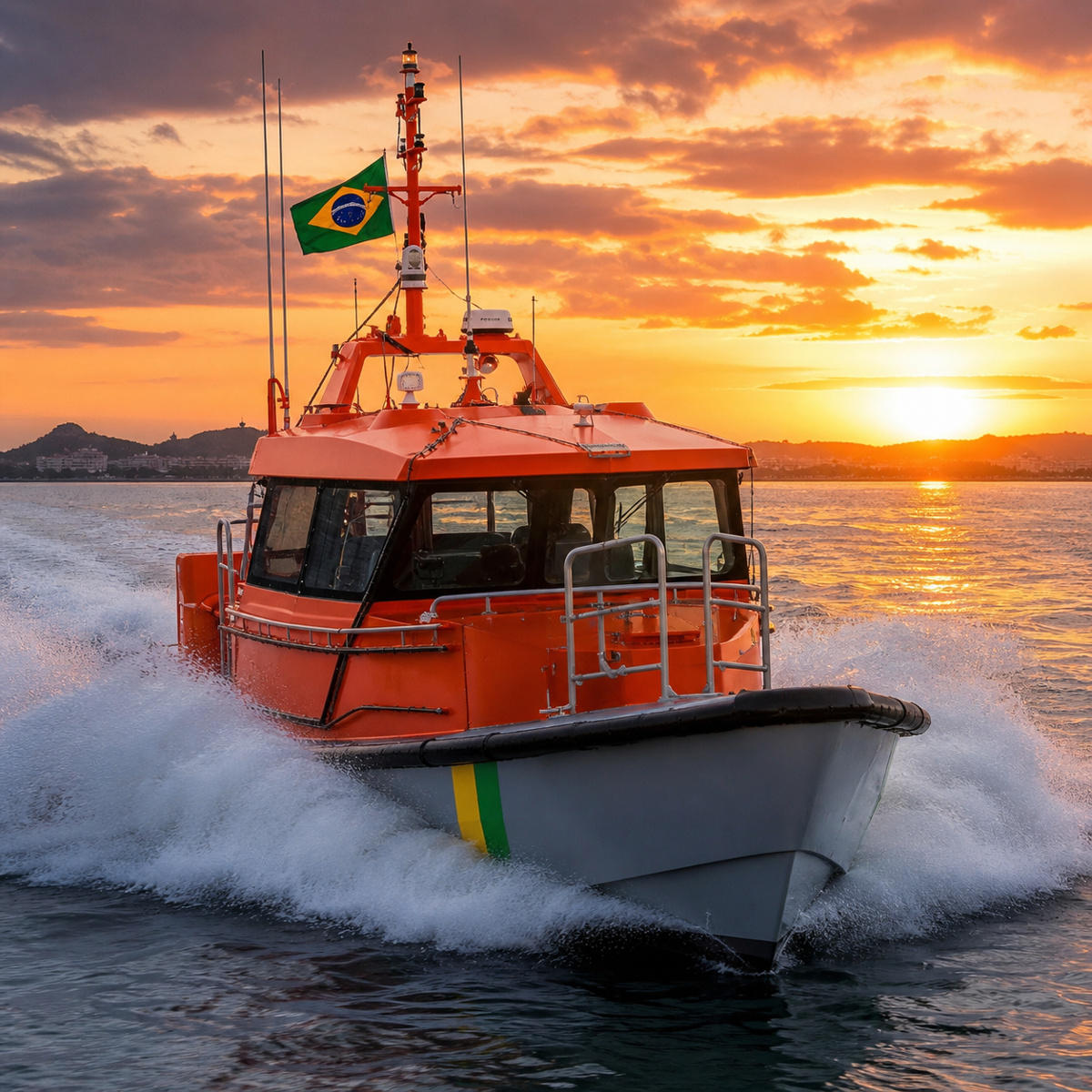
The Brazilian Navy has reinforced its maritime emergency response structure with the incorporation of a new high-performance boat, designed to operate in critical rescue operations. The vessel, classified as a Search and Rescue Boat (LSAR), will operate in the Southeast, a strategic region due to intense naval movement, and represents a significant advance in technology applied to maritime safety.
According to the Navy News Agency on April 29, the boat, named “Rio de Janeiro,” was officially delivered in a traditional ceremony and is already part of the Salvamar system, responsible for coordinating search and rescue missions in waters under Brazilian jurisdiction. The arrival of this new asset reduces response time, expands operational capacity, and raises the standard of actions conducted by the Brazilian Navy.
New boat reinforces Brazilian Navy’s rapid response in the Southeast
The incorporation of the new boat into Salvamar marks an important moment for the Brazilian Navy, especially in the Southeast, where there is a large flow of commercial, tourist, and fishing vessels. The need for rapid responses in risky situations makes this type of investment essential.
-
Brazilian Navy Demonstrates Strength in Naval Exercise with Over 20 Nations, Deploys Frigate Independência in Anti-Submarine and Air Defense Scenarios, and Joins Historic Formation with 26 Ships from 14 Allied Navies off the U.S. Coast

-
BAE Systems to Supply New Bofors 40Mk4 Cannons to the Brazilian Navy
-
Ukraine Bets on Swedish Gripen E Jets to Counter Russia, But 16 Fighters Won’t Arrive Until Late 2020s; Kiev to Use C/D Models for Pilot Training and Operations Amid Ongoing Missile and Drone Threats
-
End of an Era: US Navy’s C-2A Greyhound Makes Final Catapult Launch Before Retiring to Arizona Desert; Aircraft Supported Carriers in Wars and Humanitarian Missions for Nearly 60 Years


The Search and Rescue Boat (LSAR) was designed precisely for critical scenarios, focusing on agility, efficiency, and safety. Its presence reduces the time between activation and response to an incident, a decisive factor in rescue operations.
Furthermore, the vessel strengthens the structure of the 1st Naval District Command, expanding coverage in densely used coastal areas.

Onboard technology transforms maritime rescue operations
One of the great differentials of the new boat lies in its set of onboard technology. The Brazilian Navy has invested in systems that increase the precision and efficiency of operations, especially in adverse conditions.
Among the main available resources are:
- Modern radar for safe navigation;
- Advanced communication systems;
- Thermal camera to locate shipwreck survivors at night;
- Equipment that enhances crew situational awareness.
The Search and Rescue Boat (LSAR) also has self-righting capability, a fundamental feature in extreme situations. This ensures that the vessel continues to operate even after critical events, such as capsizing.
This level of technology places the Brazilian Navy at a new operational standard in the Southeast, significantly increasing the chances of success in rescues.
Performance and autonomy enhance the efficiency of the Search and Rescue Boat (LSAR)
The new boat features technical characteristics that make a difference in daily operations. Equipped with two 700 HP engines, the vessel can reach up to 30 knots, equivalent to approximately 56 km/h. This speed allows it to quickly reach emergency areas near the coast.
Another relevant point is its autonomy of about 200 nautical miles, which corresponds to approximately 370 kilometers. This extends the reach of missions and allows operation in an extensive area of the Southeast.
Furthermore, the Search and Rescue Boat (LSAR) has the capacity to rescue up to 20 people per operation, making it extremely efficient in multi-victim scenarios.
These numbers demonstrate how the Brazilian Navy is investing in practical and effective solutions, combining performance and technology to save lives.


Strategic operations in the Southeast expand Brazilian Navy’s coverage
The operation of the new patrol boat will be the responsibility of the Rio de Janeiro Port Authority, but its operations are not limited to a single area. The Brazilian Navy will be able to deploy the vessel throughout the region under the jurisdiction of the 1st Naval District.
This means that the Southeast now has an important strategic reinforcement, capable of responding to different types of maritime occurrences.
Among the main situations in which the Search and Rescue Boat (LSAR) can be deployed are:
- Shipwrecks and vessel accidents;
- Disappearance of people at sea;
- Support for vessels in distress;
- Operations in adverse weather conditions.
This versatility increases the efficiency of actions and expands the presence of the Brazilian Navy in critical areas.
Operational efficiency reduces costs and optimizes teams
Another relevant aspect of the new patrol boat is its operational efficiency. Unlike larger vessels, the Search and Rescue Boat (LSAR) can be operated by just four military personnel, which reduces the need for large teams.
According to Captain Leonardo Carvalho de Lucena Navaes, the vessel was designed to offer high performance with lower operational costs. This characteristic allows the Brazilian Navy to optimize resources without compromising the quality of operations.
In the context of the Southeast, where the demand for rescues is constant, this efficiency makes a difference in the planning and execution of missions.
The integration of technology also contributes to simpler maintenance and greater equipment durability.
Modernization driven by investments and new protocols
The arrival of the new patrol boat represents not only an operational reinforcement but also an advance in the modernization process of the Brazilian Navy. The incorporation of the Search and Rescue Boat (LSAR) led to the updating of routines, training, and internal procedures.
Vice Admiral Iunis Távora Said, commander of the 1st Naval District, highlighted the importance of this operational leap, emphasizing that the vessel combines resources that enhance the efficiency and safety of missions.
Among the advancements promoted are:
- Revision of maintenance protocols;
- Updating of rescue strategies;
- Specialized training for the use of new technology;
- Integration of modern systems into operational planning.
This set of changes strengthens the Brazilian Navy‘s operations in the Southeast and prepares the institution for increasingly complex challenges.
More safety at sea with technology and rapid response
The presence of the new patrol boat in the Southeast represents a direct gain for maritime safety. The Brazilian Navy, by investing in technology and innovation, expands its response capability and reinforces its commitment to the protection of human life.
The Search and Rescue Boat (LSAR) allows for quick, precise, and efficient action, essential characteristics in emergency situations. In many cases, the difference between success and tragedy lies in the response time — and it is precisely at this point that the new vessel stands out.
In addition to directly benefiting rescue operations, this advancement also positively impacts:
- Navigators and fishermen;
- Maritime sector operators;
- Tourists who frequent the coast;
- Coastal communities.
With this, the Brazilian Navy strengthens its presence and increases the confidence of those who depend on the sea daily.
A new standard for maritime rescue on the Brazilian coast
The incorporation of the new boat marks an important moment for the evolution of rescue operations in the country. The Brazilian Navy demonstrates, in practice, how investment in technology can transform response capability at sea.
With a speed of 30 knots, an autonomy of 200 nautical miles, capacity for 20 rescued persons, and operation with only four military personnel, the Search and Rescue Boat (LSAR) establishes itself as a modern and efficient model.
In the Southeast, where challenges are constant, this vessel represents more than an operational reinforcement — it symbolizes a new standard of operation, more agile, safer, and aligned with current needs.
By continuing to invest in innovation and modernization, the Brazilian Navy reaffirms its essential role in protecting life at sea and ensuring maritime safety along the entire Brazilian coast.
With information from Navy News Agency.