Portuguese
  Spanish


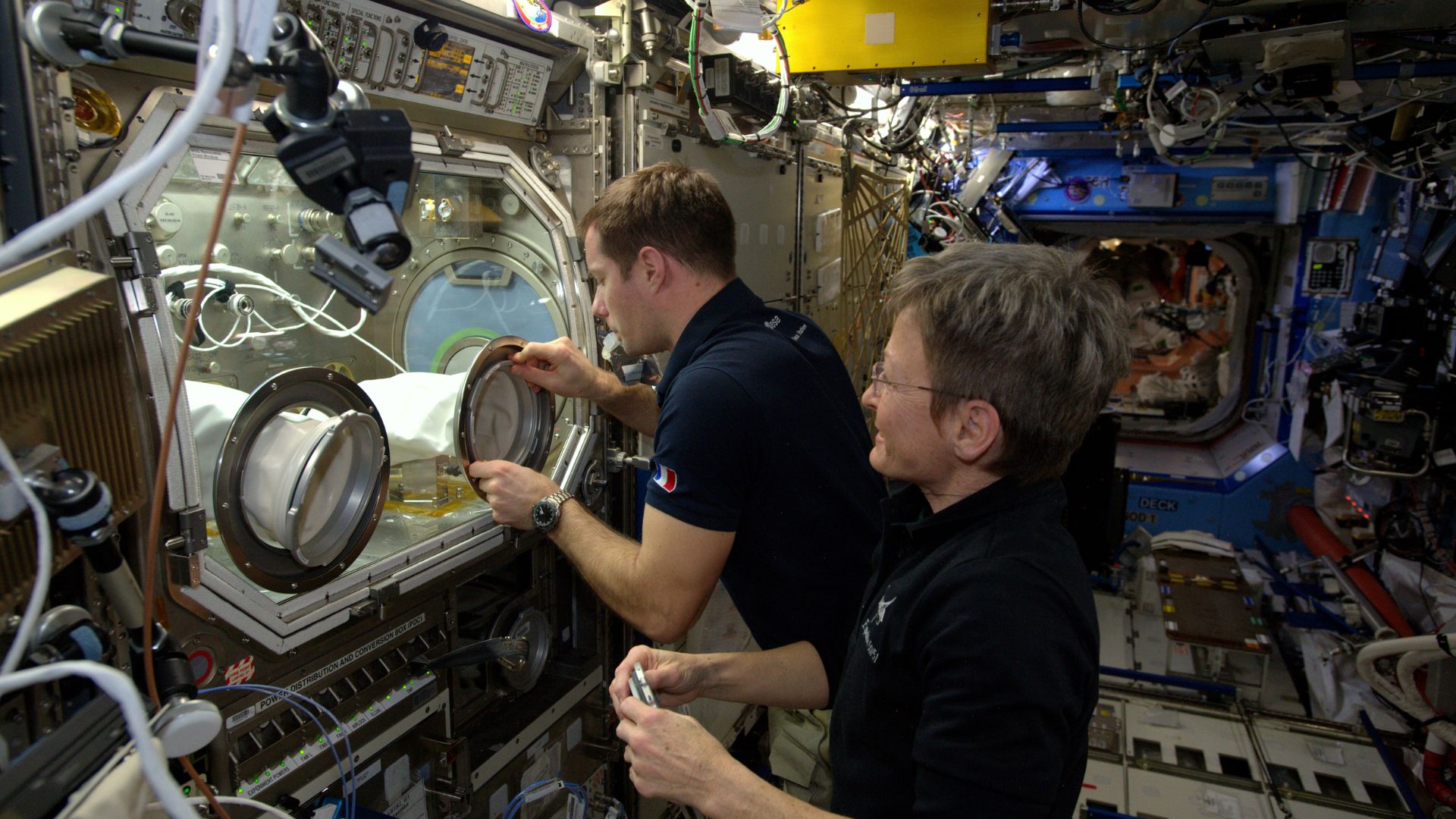


Brain adaptation to microgravity alters fine hand control and persists after returning to Earth, affecting simple daily tasks and requiring new sensorimotor calibration even in seemingly automatic activities.
Astronauts who spend months on the International Space Station may return to Earth with temporary difficulty in adjusting the force used when holding and moving objects, according to a study published in April 2026 in the Journal of Neuroscience.
The research followed 11 astronauts in manual manipulation tests conducted on the ground, in microgravity, and after returning, showing that the brain does not immediately recalibrate the relationship between weight, movement, and finger pressure.
Brain maintains reference of Earth’s gravity
In orbit, participants tended to grip objects more tightly than necessary, especially during movements, because the motor system continued predicting effects of Earth’s gravity even in an environment where objects do not fall in the same way.
-
AI Video Generator Automatically Creates Subtitles and Animated Captions

-
São Paulo Unveils Latin America’s Largest Underground Reservoir, Holding 900 Million Liters, in the Greater São Paulo Area

-
Chinese Teen Wins Gold in Germany for Invention Turning Air Moisture into Underground Irrigation in Drought-Stricken Areas

-
Desertification Threatens Brazil’s Caatinga: 85% of Semi-Arid Region Affected, 30 Million at Risk, and Efforts Underway to Restore 10 Million Hectares by 2045





After returning, the adjustment also did not occur automatically.
The astronauts made initial errors in predicting the appropriate force to hold and move items, although they gradually readjusted hand control over time.
The result shifts attention from more well-known effects of space travel, such as muscle loss and bone changes, to an everyday skill: adjusting finger pressure in simple tasks, without relying on conscious calculation.
Why holding objects changes in space
On Earth, holding a cup, a tool, or equipment involves quick brain predictions about weight, friction, and risk of falling, with automatic adjustments between fingers, wrist, and forearm in fractions of a second.
When gravity is no longer perceived as it is on the ground, this logic changes.
The object still has mass and inertia, but does not exert the same downward weight, which alters the expected hand response during contact.

Even after months in space, the brain retains a strong memory of Earth’s gravity.
Therefore, according to the researchers, astronauts may act as if they still need to compensate for an imminent fall when moving objects in microgravity.
Operational impacts on space missions
The discovery has practical impact for space missions because manual control is part of sensitive activities, such as operating scientific instruments, handling tools, organizing loose objects, and executing procedures in confined space modules.
In a confined environment, an excess or lack of force can compromise precision and safety.
A poorly held object can escape, float, and follow an unexpected trajectory, requiring a quick response from the crew during a technical operation.
The study also reinforces that returning to Earth does not end the body’s adaptation.
The spacecraft lands, but part of the motor system still needs to readjust references built during the stay in microgravity.
Relearning of strength and coordination


Research shows that the human hand does not rely solely on muscular strength.
Precise movement arises from the combination of motor memory, tactile perception, and physical expectation of the object being manipulated.
When these expectations no longer match the real environment, the gesture loses part of its automaticity.
The person remains capable of holding and moving objects but needs time to recover the exact measure of applied force.
For future missions to the Moon, Mars, or environments with different gravity levels, the ability to quickly recalibrate hand strength may become as important as preserving muscles, bones, and physical endurance.