Portuguese
  Spanish


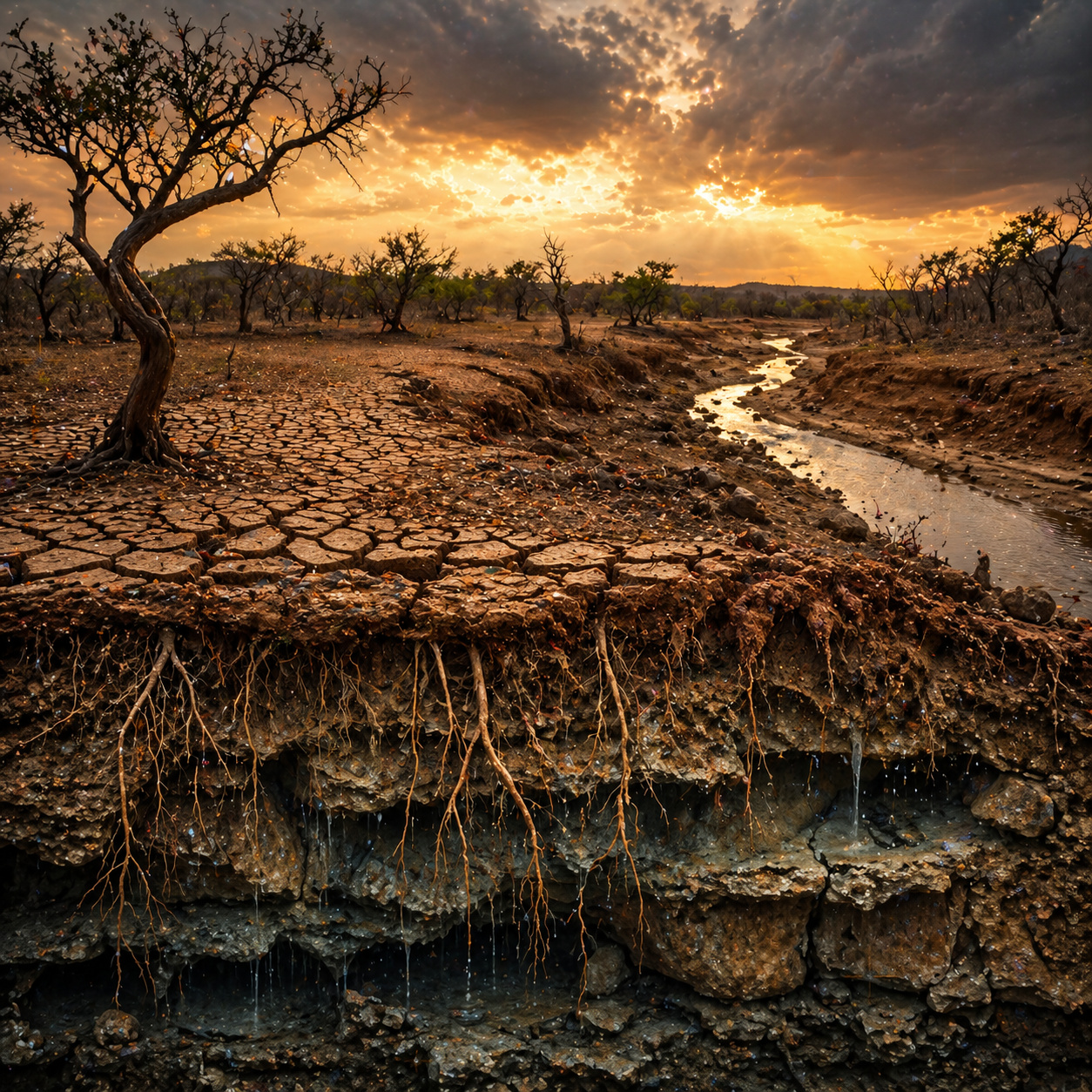

USP and Inpe warn that climate change in the Cerrado could reduce groundwater recharge by up to 666 mm/year and weaken rivers before 2100.
According to the Institute of Geosciences of the University of São Paulo, a study conducted by scientists from IGc-USP and the National Institute for Space Research, published in August 2025 by FAPESP Agency, concluded that the climate crisis could significantly compromise the natural recharge of Brazilian aquifers, reducing the supply of groundwater across virtually the entire national territory. The study used a water balance model based on geoprocessing and corrected data from CMIP6 climate projections, the most recent set from the World Climate Research Programme, which integrates information from dozens of research centers worldwide. The analysis estimated changes in temperature, precipitation, surface runoff, and aquifer recharge between 2025 and 2100 under two emissions scenarios.
The most alarming result was identified in the Bauru-Caiuá Aquifer System, which covers parts of Minas Gerais, São Paulo, Goiás, and Mato Grosso do Sul. In this system, groundwater recharge could decrease by up to 666 millimeters per year in the most affected areas. For an aquifer that supplies municipalities, supports agricultural irrigation, and maintains fluvial ecosystems in four states, this reduction represents a structural change in water availability, not just a statistical variation.
Continue reading to understand why the Cerrado is at the center of this process and how changes in rainfall patterns are altering the dynamics of aquifer recharge in Brazil.
-
El Niño Intensifies: Over 90% Chance of Persisting Until 2027, Raising Ocean Temperatures and Increasing Severe Weather Risks in Southern Brazil, Warns Federal Report

-
NASA Prepares Trio of Small Satellites to Track Tropical Storms and Capture Rapid Rainfall Development from Above the Clouds

-
$7,999 Isaac 1 Robot Aims to Tackle Household Chaos: Folds Clothes, Makes Beds, and Organizes, but Raises Privacy and Cost Concerns with Camera Reliance and Remote Human Assistance
-
Mobile Electron Accelerator Units Enable Safe Testing of Water, Materials, and Industrial Waste Treatment in Countries Without Permanent Labs




The strategic role of the Cerrado as the main water recharge zone and natural groundwater reservoir in Brazil
The Cerrado is often described as the most biodiverse savanna in the world, with over 12,000 plant species, about 40% of which are endemic. This definition, while correct, does not convey its most critical function: the biome acts as Brazil’s main water reservoir.


The Cerrado is home to eight of the twelve largest hydrographic basins in the country, including the Amazon, Plata, São Francisco, Araguaia-Tocantins, Parnaíba, and Atlantic basins in different regions. Furthermore, it concentrates three of the continent’s main aquifer systems: Guarani, Urucuia, and Bambuí.
The springs that supply cities such as Brasília, São Paulo, Goiânia, Campo Grande, and Cuiabá are directly connected to this biome. Agricultural production in the Central-West and MATOPIBA regions directly depends on the water stored and recharged by the Cerrado, both in rivers and in underground aquifers.
How the soil structure and deep roots of the Cerrado ensure efficient infiltration and aquifer recharge
The Cerrado’s capacity to function as a water reservoir is directly linked to its ecological structure. The native vegetation has deep roots that can reach 15 meters or more in depth, creating natural channels that facilitate rainwater infiltration.
These roots maintain soil porosity and allow water to pass through different layers until it reaches the aquifers. The biome’s lithology reinforces this process: about 57% of the Cerrado’s area is underlain by porous sedimentary rocks with a high water storage capacity.
This system functions as a natural mechanism for slow and continuous recharge, essential for maintaining the base flow of rivers during dry periods.
The direct impact of deforestation and agricultural expansion on the loss of soil infiltration capacity
When the native vegetation of the Cerrado is replaced by pastures or monocultures like soy, a profound transformation occurs in the hydrological functioning of the soil.
Deep roots disappear, the soil undergoes compaction due to the use of machinery and cattle trampling, and natural infiltration channels are destroyed. As a consequence, rainwater no longer penetrates the soil and instead flows superficially.

This process generates two simultaneous effects. During rainy periods, the risk of floods increases due to accelerated runoff. During drought, the absence of recharge reduces aquifer levels and compromises river flow.
A degraded Cerrado not only loses its recharge function but also exacerbates extreme events, intensifying both floods and water scarcity.
How climate change and intense rainfall reduce infiltration and compromise aquifer recharge
The study also identifies an additional factor that exacerbates the problem: the change in rainfall patterns. Even in regions where the total volume of precipitation is not expected to undergo major changes, such as the Southeast, the distribution of rainfall tends to shift.
According to researcher Ricardo Hirata, from IGc-USP, there will be longer dry periods interspersed with more intense and concentrated rain events. This pattern favors surface runoff and reduces infiltration.
Water infiltration into the soil depends on the terrain’s absorption capacity, vegetation cover, and rainfall intensity. When precipitation occurs very intensely, water arrives faster than the soil can absorb, generating runoff.
Even when infiltration occurs, the process to the aquifer is slow. Studies indicate that water can take two to three months to cross 10 to 15 meters of soil. In rapid and concentrated rain events, this dynamic is interrupted.
The result is a paradoxical scenario: more extreme rain events and, at the same time, less aquifer recharge.
The Brazilian aquifers most vulnerable to climate change and Cerrado degradation
The study identified different levels of vulnerability among Brazil’s main aquifer systems. The Bauru-Caiuá Aquifer System appears to be the most critical, with projections of up to a 666 millimeters per year reduction in recharge. Considering that annual precipitation in Cerrado regions varies between 1,200 and 1,800 millimeters, this loss represents a significant portion of the available water.
The Guarani Aquifer also faces increasing pressure. Its recharge zone, located in areas of intense agricultural activity, is being impacted by deforestation and changes in rainfall patterns.
The Urucuia Aquifer, essential for maintaining the flow of the São Francisco River, suffers from agricultural expansion in MATOPIBA. The reduction in recharge in this system has a direct impact on the water supply for millions of people in the semi-arid region.
Why Cerrado deforestation generates invisible and delayed water impacts on water supply
The Cerrado has already lost approximately half of its native vegetation. Currently, it accounts for more than half of the deforestation recorded in Brazil, even surpassing the Amazon in annual proportion.
The hydrological impact of this process is silent and occurs with a delay. Unlike the immediate loss of biodiversity, the reduction in aquifer recharge manifests over the years.

Water stops infiltrating at the time of deforestation, but the effects appear later, when aquifer levels drop, rivers lose flow, and water abstraction becomes more difficult. This temporal mismatch hinders the perception of the problem and reduces response capacity.
Managed aquifer recharge emerges as an existing technical solution, but still little applied in Brazil
The study points out that managed aquifer recharge, known as MAR, is a viable solution already used in other countries.
This technique consists of artificially inducing water infiltration into the soil through structures such as infiltration basins, retention dams, and direct injection systems.

In countries like Israel, Australia, and the United Arab Emirates, these technologies are already part of the water security strategy.
According to researchers, rainwater or even treated sewage can be directed to these systems, being naturally filtered by the soil before reaching the aquifers.
In Brazil, however, this approach is still little used and does not integrate a structured national policy.
What this scenario reveals about the future of water in Brazil and the need for structural decisions
The study by IGc-USP and Inpe makes it clear that the problem is not a lack of scientific knowledge. The processes are identified, the impacts are known, and the solutions have already been tested.
The challenge lies in large-scale implementation. Aquifer recharge still does not hold a central position in public policies for water infrastructure.
Without structural changes, Brazil could face a scenario where the availability of groundwater decreases while demand grows, putting pressure on cities, agriculture, and energy generation.
Caruaru was a warning in the past. The Cerrado and Brazilian aquifers indicate that the next challenge could be much broader and more systemic.