Portuguese
  Spanish


The taxiway at Surat International Airport, India, was already ready, but a sacred tree linked to a spiritual entity prevented immediate release, delayed civil aviation inspection, and forced authorities to choose transplanting instead of cutting to respect local faith
A sacred tree near an Indian temple held up a multi-million dollar project at an international airport and postponed the use of an already completed taxiway in the state of Gujarat, India.
The case occurred at Surat International Airport, where a new taxiway costing about ₹63 crore was completed, but could not immediately enter operation due to a tree approximately 10 feet tall considered sacred by local residents.
The report was published by Times of India, an Indian English-language newspaper. The tree was located near the Lalbai Mata temple and was seen as the abode of a Yakshini, a female entity linked to nature in Indian tradition.
-
Women Who Faced Death Head-On Break Taboos and Uncover Forgotten Funeral Rituals

-
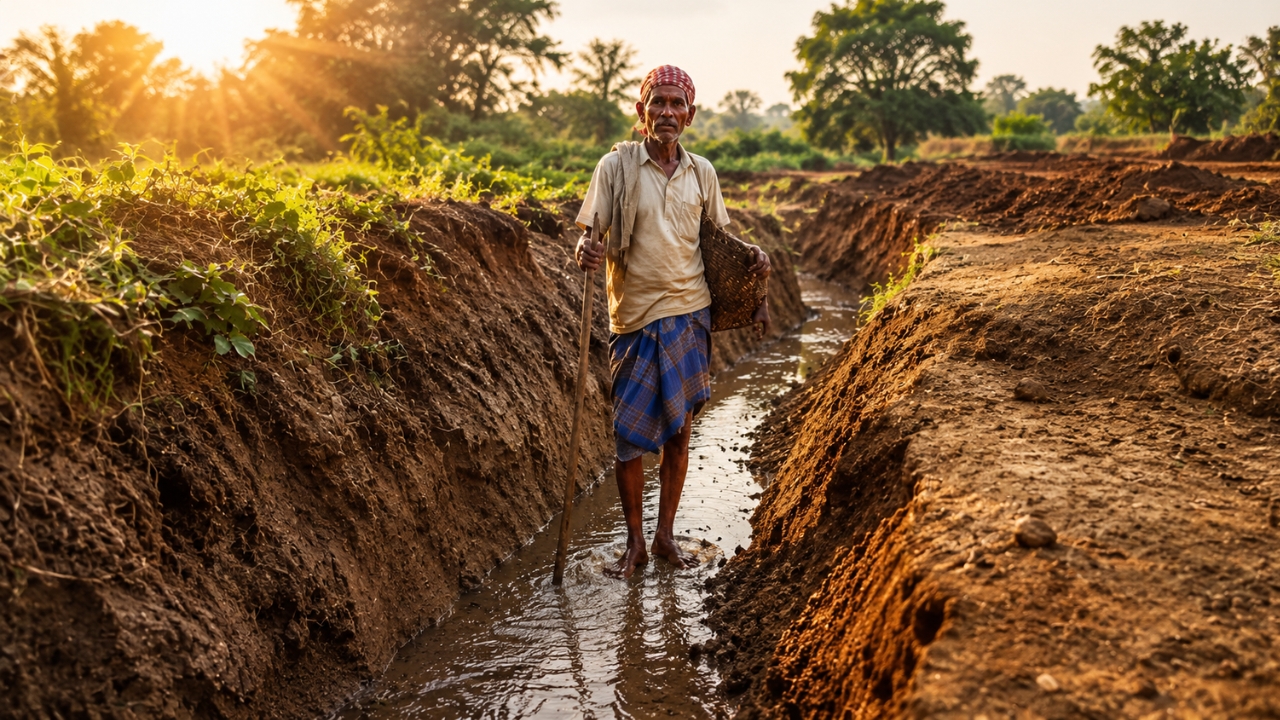
Elderly Man in His 70s Spends Nearly 30 Years Digging 3 km Canal to Transform Arid Land into Farmland in Rural India

-
Submerged Town Reemerges in São Paulo as Reservoir Levels Drop, Revealing Ruins and Memories of Displaced Families
-
In Northeastern Brazil, 1,200 Residents Face a Silent Nightmare as Giant Sinkholes Threaten Entire Neighborhoods
Completed ₹63 crore project stalled due to a tree considered sacred
The new taxiway was completed, but the path was not clear for use. The tree was in an area sensitive to airport operations and also held strong religious value for local residents.
A taxiway is the path used by airplanes to move within the airport. It helps aircraft exit the main runway, reach the apron, and move with more organization.

Even with the structure ready, its release depended on the removal of the tree. The curious point is that the obstacle was not an engineering flaw, but a religious symbol linked to the Lalbai Mata temple.
Tree was seen as the abode of a Yakshini and required careful handling by authorities
The tree was considered the abode of a Yakshini, a female figure associated with nature in Indian tradition. Therefore, its removal could not be treated as a simple intervention within the project.
The case brought together airport engineering, operational routine, and community faith in the same space. Cutting down the tree could generate conflict with residents who viewed the site as sacred.
The chosen solution was the transplanting of the tree within the airport area. The religious structure linked to the spot was also transferred, preserving the symbolic value of the site.
Authorities waited for the monsoons to increase the tree’s chance of survival
The tree’s removal did not happen immediately. Authorities waited for the monsoon period, a phase marked by rains, to increase the chances of survival after the transplant.
The decision shows that the objective was not just to clear space for the taxiway. There was also concern about keeping the tree alive and respecting the religious significance attributed to it.
The tree was transplanted within the airport area. With this, the path was cleared for the next stage, which involves inspection by Indian civil aviation.
Times of India detailed that the release still depended on DGCA inspection
Times of India, an Indian English-language newspaper, detailed that the taxiway could only proceed to the next stage after the respectful removal of the tree and the religious structure associated with the site.
Inspection by the DGCA, the Indian civil aviation authority, is necessary to verify if the structure can operate safely. Without this evaluation, the taxiway does not enter regular operation.
This process is common in airport construction, because any new path used by aircraft needs to meet safety requirements before becoming operational.
Case shows how major projects still need to negotiate with community symbols
The story is noteworthy because it involves an international airport, a high-value project, and a local belief with great symbolic weight.
For the airport, the tree occupied an area that prevented the operation from advancing. For part of the community, it represented a spiritual connection to a feminine nature entity.
The case shows that modern infrastructure does not depend only on machines, money, and design. In some situations, a project also needs to consider religious symbols and community ties.
Delay had operational impact and mobilized a no-cut solution
The delay affected the operationalization of the taxiway and required specific mobilization for the transplant. There was also a wait for the most suitable climatic moment.
The practical consequence was clear: a ready structure, of about ₹63 crore, had to await the respectful removal of the tree before proceeding to inspection.
The case of Surat International Airport became an example of how a modern project can clash with local traditions and still find a negotiated solution.
The sacred tree that delayed the taxiway in India was not cut down. It was transplanted within the airport area, along with the religious structure linked to the site.
In the end, the project’s approval depended on a balance between air operations, engineering, and respect for local faith. Do you think major projects should change their plans to preserve religious and cultural symbols of the community? Share your opinion in the comments.