






 Portuguese
  Spanish


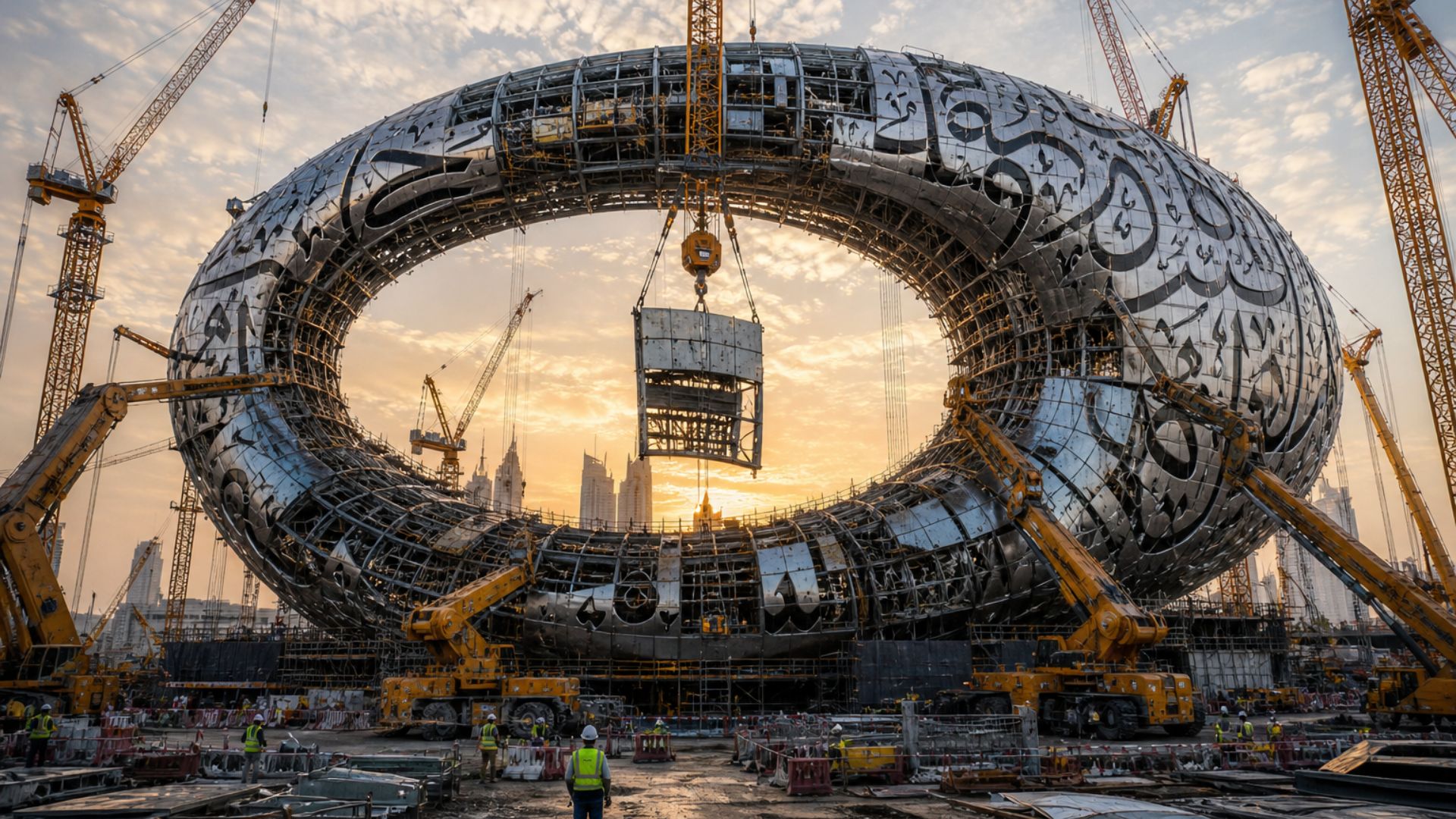

Circular structure, advanced engineering, and robotic manufacturing transform building into one of the world’s most complex architectural projects, combining parametric design, illuminated calligraphy, and urban integration in a construction that redefines the concept of a museum and contemporary cultural space.
The Museum of the Future in Dubai stands 77 meters tall, with seven floors without internal pillars and a metallic facade formed by 1,024 stainless steel panels produced with the aid of robots, establishing itself as one of the most complex constructions associated with the Dubai Future Foundation.
With about 30,000 square meters of total area, the building occupies a strategic position in the city and synthesizes advances in engineering, architecture, and digital manufacturing, characteristics that explain why the project has become a global reference among large-scale contemporary works.
Ring-shaped architecture challenges urban standards
Located in one of the busiest regions of Dubai, the building breaks away from the pattern of straight, glass towers that dominate financial centers by adopting a circular shape that completely reorganizes the traditional reading of the urban landscape.
-
Creative Uses for Toilet Paper Rolls That Will Change Your Perspective

-
Crab Trapped in Plastic Bottle for 62 Days Near Okinawa Highlights Little-Known Impact of Marine Pollution on Small Animals
-
Esperanza’s Bamboo Barrier in Oaxaca Redirects River and Reduces Erosion by 85% in Five Years

-
Family Builds Homemade Wind Turbine to Power Off-Grid Home, Video Reaches 555,000 Views on Ngô Thị Huyền’s Channel



Instead of growing vertically like conventional skyscrapers, the structure was conceived as a monumental ring with a large central void, supported on a landscaped base that reinforces the contrast between nature and technological construction.

According to the Dubai Future Foundation, the design incorporates three symbolic dimensions: the green base represents the Earth, the main body translates human innovation capability, while the central void points to the unknown and unexplored possibilities.
This combination transforms the building into an architectural manifesto that goes beyond aesthetics, converting abstract concepts into physical form and contributing to making the museum one of the city’s most recognizable images.
Parametric design and digital technology in construction
To enable such an unusual geometry, the project resorted to advanced digital tools, being developed with parametric design, a method that uses data and variables to create complex shapes and adjust each element precisely throughout the process.
Unlike traditional constructions, which repeat structural patterns, the museum required individualized calculations for practically all components, as its surface does not follow straight lines, rigid angles, or repetitive modules.
According to the responsible foundation, it is one of the most fluid structures ever executed, without sharp corners on the outside, a characteristic that significantly increased the level of difficulty both in planning and in the execution of the work.
Facade with 1,024 panels and robotic production
On the outside, the project’s complexity becomes even more evident, especially on the facade composed of metallic panels covering a total area of 17,600 square meters, the result of a highly specialized manufacturing process.
Produced with the aid of robotic arms, these elements were developed in a system considered pioneering in the region, allowing millimetric precision in creating unique pieces that fit into a continuous structure without simple repetition.

Each panel went through 16 manufacturing stages and was assembled in four layers, requiring a detailed process before installation, which contributed to the long period needed to complete this stage of construction.
The installation of the facade, carried out individually, took more than 18 months to complete, highlighting the level of precision required to maintain the visual continuity of the building without compromising its structure.
Arabic calligraphy and integrated illumination
Beyond its structural function, the metallic cladding also serves as an artistic support by incorporating phrases in Arabic calligraphy inspired by texts from Sheikh Mohammed bin Rashid Al Maktoum, integrating language, architecture, and cultural identity into a single surface.
The inscriptions, created by Emirati artist Mattar bin Lahej, were incorporated into the design as hollowed-out and illuminated elements, helping to transform the facade into an active component of the museum’s visual experience.
With approximately 14,000 meters of light lines, the lighting system enhances the readability of the inscriptions at night and expands the building’s presence in the urban landscape without relying exclusively on height or volume.
To ensure internal comfort, the calligraphic openings received high-performance glass, developed to control natural light entry and improve thermal insulation, balancing aesthetics and functionality.
Cultural, scientific, and innovation space


Conceived as more than an exhibition space, the museum also functions as a research, debate, and experimentation center, bringing together different areas of knowledge in an environment focused on innovation.
Among the internal structures, there is a multi-purpose space with capacity for over a thousand people, as well as an area dedicated to lectures and workshops that can accommodate more than 345 participants simultaneously.
The institutional proposal seeks to bring together scientists, researchers, technologists, and specialists from different sectors, creating an environment conducive to discussing solutions and scenarios for the future of cities and society.
Immersive experience and urban connection
Internally, the experience was planned as a narrative journey that transports visitors to the year 2071, connecting themes such as science, technology, sustainability, and space exploration in immersive environments.
This concept reinforces the idea that the building functions not just as an enclosure, but as an extension of the content presented, aligning architecture and narrative in a single conceptual proposal.
In the surroundings, integration with the city was also prioritized through direct connections, including a 69-meter bridge to the Jumeirah Emirates Towers complex and another 212-meter bridge to the Emirates Towers metro station.
By combining symbolic form, digital engineering, robotic fabrication, and cultural function, the Museum of the Future establishes itself as one of the most representative examples of how architecture and technology can integrate to redefine the role of contemporary urban spaces.


