






 Portuguese
  Spanish


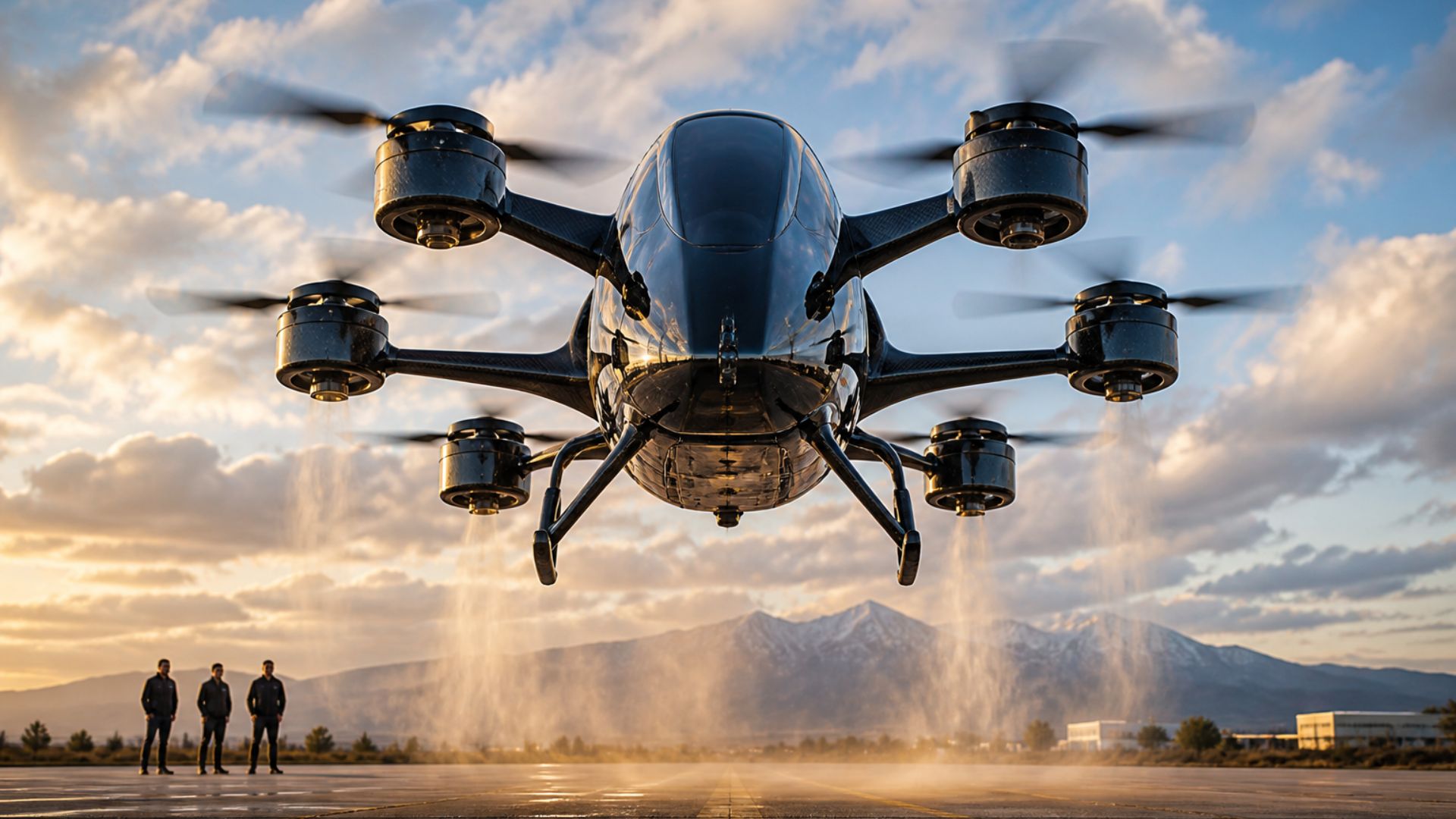
Experimental electric propulsion technology advances with real flight and highlights total movement control in the air, focusing on precision maneuvers, operation in restricted spaces, and new paths for compact urban air mobility.
The first flight of the BlackBird marked the transition from concept to real tests, with the Austrian CycloTech putting into operation an electric demonstrator equipped with six seventh-generation cyclorotors and full vector thrust.
With 4.9 meters in length, 2.3 meters in width, and 2 meters in height, the aircraft was conceived as a technological validation platform, prioritizing control and maneuverability over raw performance, within a proposal aimed at advancing compact eVTOLs.
Attention is drawn to the capabilities gathered in a reduced cell, which include vertical takeoff, lateral movement, air braking, and precision landing, as well as the ability to hover with an inclination of up to 30 degrees in different operational scenarios.
-
Couple Transforms School Bus into Mobile Home with Full Bathroom Using YouTube Tutorials, Invests $50,000

-
Chester County, USA, Achieves “Functional Zero” in Chronic Homelessness by 2026 with Housing First, Reducing Shelter Use by 52%

-
Brazil Extracts 12 Million Cubic Meters of Sand for Largest Beach Expansion Project, 82% Complete Along 8.8 km Coastline
-
Bosch Unveils Revolutionary 2.3 kg Hub Motor for E-Bikes with 45 Nm Torque and 400 Watts Power, Eliminating Resistance Above 25 km/h in Historic Shift for German Manufacturer



Vector thrust and cyclorotors: the differential of the BlackBird

Unlike conventional configurations, the BlackBird adopts six electric CycloRotors capable of continuously adjusting the direction and intensity of thrust, allowing quick responses and refined control without relying on traditional rotors or constant fuselage inclination.
In practice, this architecture expands the maneuver envelope, enabling lateral movements, deceleration in mid-flight, and precise positioning in the airspace, including the so-called aerial “parallel parking” described by the manufacturer itself.
Additionally, two cyclorotors installed along the longitudinal axis allow direct lateral movement, reducing the need for structural inclination and favoring operations in restricted environments or with nearby obstacles.
Inaugural flight and accelerated project timeline

Over a cycle considered short for the sector, the BlackBird went from paper to first flight in about 11 months, after development began in April 2024 and assembly was completed in approximately ten months.
During this interval, extensive ground tests were conducted involving battery systems, electric propulsion, flight controls, embedded software, and avionics, an essential step to validate integration before aerial operation.
Already in a real environment, the tests took place at a general aviation airport within the guidelines of the European Union Aviation Safety Agency, EASA, ensuring regulatory compliance in the initial phase of the program.


In technical terms, the demonstrator has a maximum takeoff weight of 340 kilograms and an estimated speed of up to 120 km/h, numbers compatible with an experimental platform focused on stability and control.
Safety, redundancy, and future application
In the field of safety, the proposal incorporates redundancy by using six cyclorotors, a strategy that, according to CycloTech, allows maintaining controlled flight even in the event of a failure in one of the engines under certain operational conditions.
At the same time, full thrust control tends to enhance correction capability in congested environments, favoring more precise landings and quick attitude adjustments during low-speed maneuvers.
Despite the advancements, the BlackBird remains a technology demonstrator, focused on testing the viability of the CycloRotor in real flight and gathering data for future applications in more compact electric aircraft.
In this context, the program positions CycloTech among companies seeking to overcome maneuverability and control limitations in electric air mobility, especially in urban operations that require precision and rapid response.


Be the first to react!