






 Portuguese
  Spanish
  3 min of reading
  2 comments


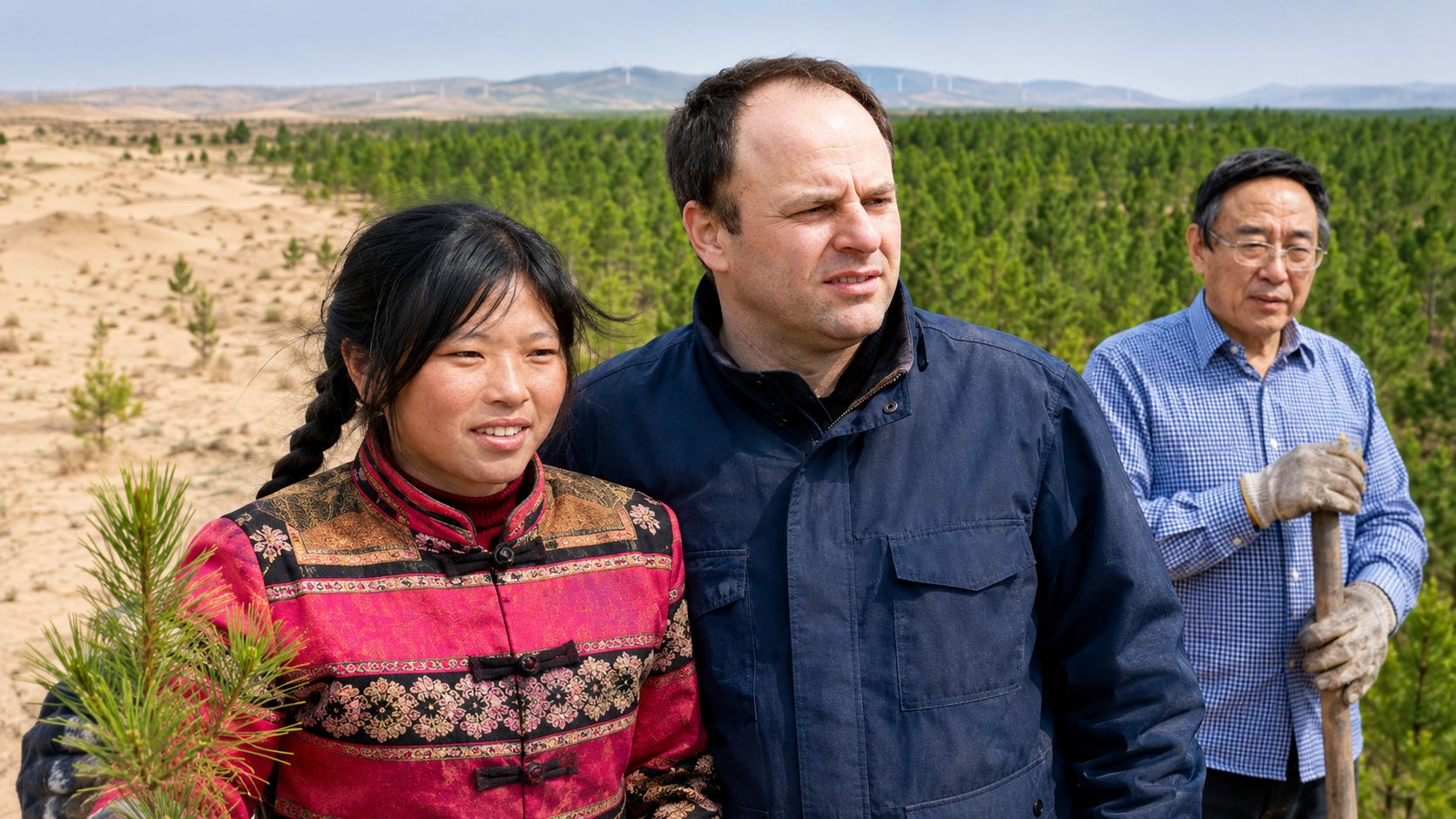


Donation made by Ronald Sakolsky after CCTV report helped Yin Yuzhen buy seedlings in the Maowusu desert; decades later, the area gathers more than 50 thousand trees and became a symbol of combating desertification in China.
More than 50 thousand trees were born from a $5,000 donation made decades ago by American Ronald Sakolsky to Chinese farmer Yin Yuzhen, who has now invited him to visit the forest in the Inner Mongolia desert.
Donation turned into forest where there was sand
Yin Yuzhen, 60 years old, lives in the Maowusu desert, also called the Ordos desert, one of China’s four major sandy areas. She moved to the region in the 1980s after marrying a local resident.
Since then, she has been planting trees with her husband, facing drought and strong winds. The work gained visibility in 1999 when it was shown by CCTV.
-
Survivor of 1966 SS Daniel J. Morrell Shipwreck in Lake Huron Recounts 38-Hour Ordeal in Extreme Cold

-
The Greatest Hoax in World Cup History? The Film That Denied Brazil’s 1958 Victory and Exposed How Fake Evidence Can Seem Convincing on TV
-
Fake South Korean Online Stores Offer Shopping Thrill Without Spending Money or Receiving Products
-
The War of Jenkins’ Ear: How a Severed Ear Sparked One of the 18th Century’s Most Unusual Conflicts


At the time, Sakolsky was teaching English at Luoyang No 2 Foreign Language School, in Henan. Moved by the story, he donated $5,000 to the farmer, an amount she said she had never seen before.
Farmer in the desert becomes symbol of persistence
Yin used the money to buy seedlings and expand the planting. She recalled that when Sakolsky visited the place, he found a landscape taken over by yellow sand and reacted by saying it seemed impossible.
The seedlings funded by the donation have transformed, according to Yin, into more than 50 thousand adult trees. In early May, she asked the Henan school for help in locating the American.
On May 17, Deputy Director Bai Fan called Sakolsky and conveyed the family’s invitation. The American replied that it would be “incredible” to see the forest, although the date of the trip has not yet been announced.
Case gains repercussion in China
The story attracted attention on Chinese social networks, where users highlighted trust, persistence, and popular friendship between China and the United States.
By the end of 2024, 53% of China’s manageable desertified lands had been treated, with a net reduction of 65 million mu, about 4.3 million hectares.
Importance of Forest Protection
Protecting forests is important for the world because they support an essential part of life on the planet. They help regulate the climate, store carbon, protect rivers, conserve biodiversity, and maintain natural services that directly affect food, water, health, and the economy.
Forests act as major climate regulators. Trees absorb carbon from the atmosphere and help reduce the advance of global warming. When a forest is cut down or burned, part of this carbon returns to the air, worsening climate change.
They also protect water. Forests help maintain springs, rivers, and aquifers, reduce soil erosion, and contribute to the rainfall cycle. In many regions, the loss of vegetation can affect the availability of water for cities, agriculture, and energy production.
Another central point is biodiversity. Thousands of species of animals, plants, fungi, and microorganisms depend on forests to survive. The destruction of these environments can cause extinctions and unbalance entire natural chains.
Forests also have a direct impact on human life. They support traditional communities, indigenous peoples, legal economic activities, tourism, scientific research, and the production of food and medicines. Protecting forests is not just an environmental issue; it is a measure of climate, food, water, and economic security.
This article was prepared based on information published by the SCMP. The content was supported by AI tools in editorial organization and underwent human review before publication.





What a loser. Why didn’t he donate the money to plant trees in America’s deserted areas? Moron indeed.
Seriously? , 5K to help people WAY below our means…and you complain because it’s not in the great USA? Get a life and contribute yourself instead of complaining about someone who has actually made a difference in Life!