






 Portuguese
  Spanish
  5 min of reading
  3 comments


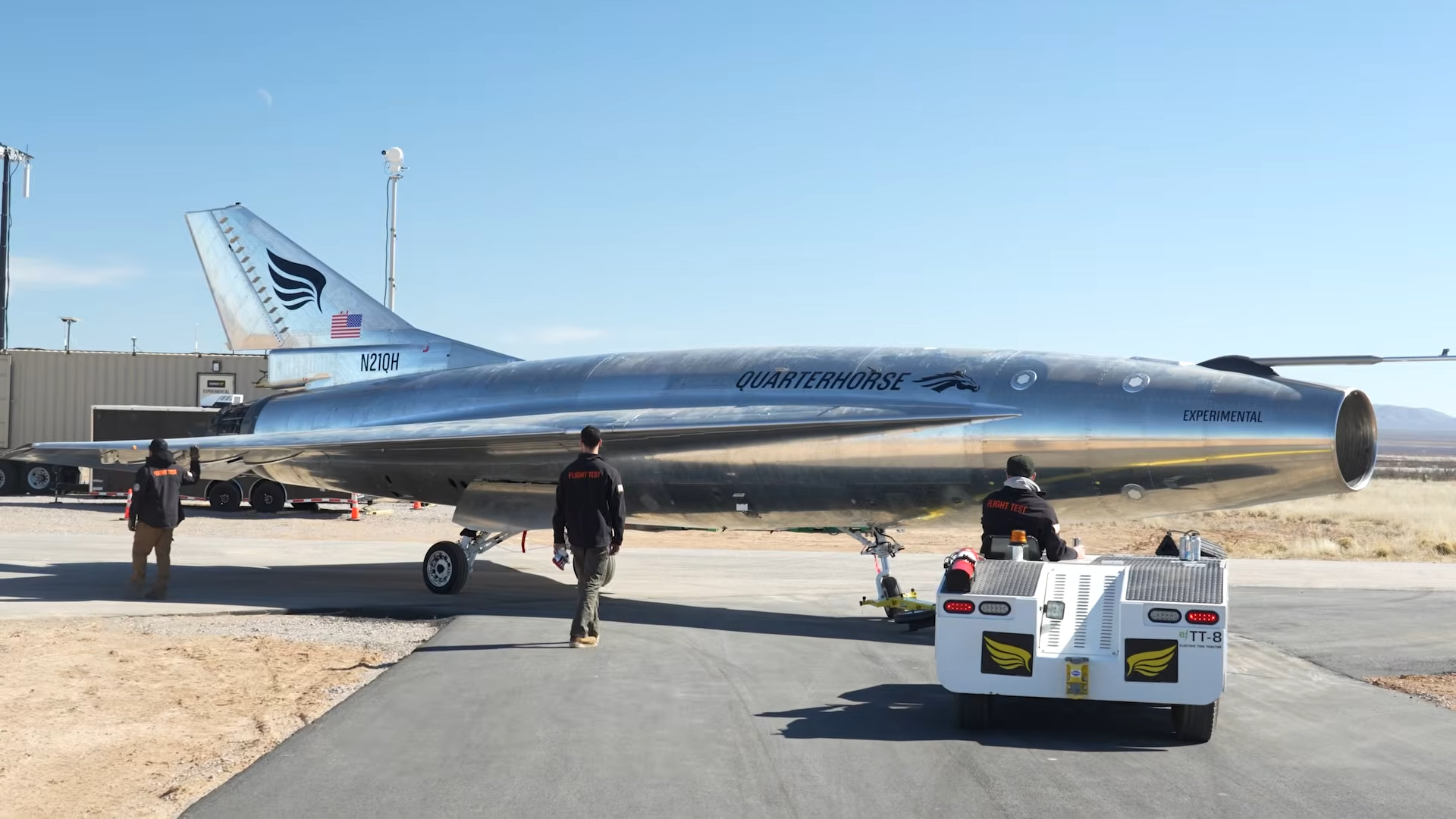


Quarterhorse Mk 1 makes first flight, accelerates Hermeus hypersonic program and brings the Mach 5 Halcyon passenger plane project closer.
According to The Aviationist, the American startup Hermeus conducted the first flight of the unmanned prototype Quarterhorse Mk 1 at Edwards Air Force Base, California, on a date publicly announced on May 27, 2025. The prototype took only 19 months from design to inaugural flight, a timeframe the company describes as the fastest in jet aircraft development in the last 80 years.
The Quarterhorse Mk 1 is equipped with a General Electric J85 engine, the same used in the F-5 fighter and the T-38 trainer, and was created to demonstrate high-speed takeoff and landing on conventional runways. This point is considered by the company as the most critical capability for any future commercial hypersonic aircraft.
Hermeus wants to create hypersonic plane with startup pace and goal of one prototype per year
Hermeus was founded in Atlanta by former engineers from SpaceX, Generation Orbit, and Blue Origin, with the proposal to apply to hypersonic aviation the same model of accelerated iteration that SpaceX used in rocket development. The company has already raised over US$ 100 million by May 2025.
-
Space technology used to search for water on Mars is now hunting for invisible leaks under the streets of São Paulo, using satellites, AI, and chlorine signals to help Sabesp recover up to 6.7 billion liters of water.

-
Japan sends ship to extract mud rich in rare earths at nearly 6,000 meters deep in the Pacific, attempts to lift 350 tons per day from the seabed, and transforms sediments near Minamitori Island into a strategic weapon to reduce dependence on China.
-
Venus Aerospace promises a rotating detonation hypersonic engine that takes the Stargazer to Mach 9 and crosses oceans in 1 hour, but the flight that made history barely surpassed the speed of sound.

-
Brazilian student creates a cheap formula that makes plants grow up to 90% faster and wins an award in a global scientific competition.





In addition to private capital, the company received direct support from the United States government. The Air Force Research Laboratory invested US$ 1.5 million in 2020 and another US$ 60 million the following year, while the Defense Innovation Unit selected the Quarterhorse for the HyCAT program, aimed at expanding the hypersonic flight testing capability of the Department of Defense.

The strategic differential of Hermeus lies in its pace. The declared goal is to design, build, and fly a new prototype in less than a year, something extremely uncommon in high-speed aviation, a sector where traditional programs usually drag on for many years.
Chimera Engine is the central technology of Quarterhorse and the greatest challenge of hypersonic flight
The technological center of the program is not just the aircraft, but the Chimera engine, a combined cycle turbine ramjet propulsion system that Hermeus is developing in parallel with the prototypes. According to the text, this is the most important element to overcome the main technical obstacle of horizontal takeoff hypersonic flight.


The Chimera combines pre-cooler, turbojet, and ramjet. At lower speeds, the system uses conventional propulsion to accelerate the aircraft to somewhere between Mach 3 and Mach 3.5. From there, the ramjet kicks in, allowing continued acceleration to Mach 5 and beyond.
The transition between these two propulsion modes is the most difficult point of hypersonic engineering. Hermeus claims to have demonstrated this capability in a wind tunnel in November 2022, but the decisive step will be to show the change in real flight, which is planned for the next phases of the Quarterhorse program.
Quarterhorse sequence was designed to solve each stage of hypersonic flight
The Quarterhorse family was organized to tackle each technical obstacle separately. The Mk 0 was a non-flying prototype, built in six months, with test objectives completed in 37 days at the Arnold Engineering Development Complex in Tennessee.

The Mk 1, now flown, validates the basic operations of takeoff and landing. The Mk 2, larger and equipped with a Pratt & Whitney F100 engine, the same as the F-16, is expected to demonstrate autonomous supersonic flight up to Mach 3. The Mk 3 will be the first to attempt the transition between turbojet and ramjet in real flight and aim to break the speed record of the SR-71 Blackbird, set at Mach 3.4 in 1976.
Next, the Mk 4 is expected to be the first in the line to reach full hypersonic speeds. This step-by-step architecture allows the company to validate one problem at a time, reducing technical risk and accelerating learning between prototypes.
Halcyon is the hypersonic passenger plane that Hermeus wants to put in the air before the end of the decade
The ultimate goal of the program is the Halcyon, a hypersonic passenger plane with 20 seats, a cruising speed of Mach 5, and the ability to use conventional runways. According to the text, the company’s goal is to have it flying before the end of the decade.
At a speed of about Mach 5.5, the proposal would allow connecting New York to London in less than an hour. The comparison used in the text is with the Concorde, retired in 2003, which made the same journey in about 3.5 hours at Mach 2.04.
In addition to the civil market, Hermeus is also developing the Darkhorse, an unmanned hypersonic aerial system aimed at defense and security, leveraging the same technological base created throughout the evolution of the Quarterhorse.
Investors and the American government bet that Hermeus can change hypersonic aviation
The composition of Hermeus‘ capital helps explain the weight of the project. Among the investors are Raytheon Technologies, Khosla Ventures, and Sam Altman, in addition to funding from the American government itself through the Air Force Research Laboratory.
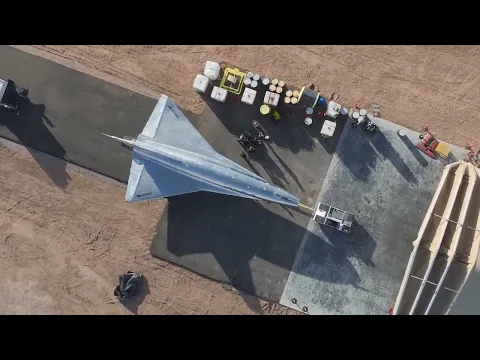
The first flight of the Quarterhorse Mk 1 does not solve the problem of hypersonic transport on its own, but it represents a concrete validation of the company’s approach. What was once just a startup promise has turned into a real aircraft capable of taking off and advancing the program’s schedule.
With the Mk 2, the Chimera test, the attempt to surpass the SR-71 record, and the goal of reaching the Halcyon, Hermeus is trying to transform an idea that for decades was restricted to military programs and laboratories into a concrete path for the commercial hypersonic plane.


Makes me wonder how many jackpot lottery wins to travel in this “aeroplane “. And no way can one even think of comparing it to Concord.. That was in a class of it’s own.
Why is this being compared to Concorde? It can carry very few passengers and is a fraction of the size. Its sn impressive plane, but not in the same league.
If they can get it operational, producing a larger capacity plane would be the list of your worries thus putting it in similar league with the Concorde.